

Orbital Forcin g
449
SYNTHESIS : THE PERIGLACIAL FLUVIAL CYCLE
_,.
f• • �VEGETATION DENSITY
0
row
hi h
l k E J.. p 'I
'"lmoomlog'
Hydr<:>logy
!o
�n ormal
·-'
-
MORPHOLOGICAL
ACTIVITY
�tart of
I
)
INTER�}' '"'"n" I
bank stability
=(>
RIVER INCISION
GLACIAL
E �
n . m o
Hhi g h
( meandering )
OEVELOPM�NT
e
I
t"" '"'
AEOLIAN ACTIVITY
"
"dl.lserr
lownmoft
=(> ( strongly reduced
0
fluvial activity )
I
\
high
GLACIAL
peak • discha19as
RIVER
=(> AGGRAOA TION
(braiding )
"
continuous
I
high
A
permalrost
I
sediment • supply
'
I
\
I
(aeoiian,s!ope deposits )
PERIOD
I
I
I
•
\
"'\ T """'''' \ I bank slability
'
=(> RIVER INCISION
'
L>.Yol
I
E lo;;;-" " r
u
oo l lhigh
'·
� o�c�v
I
(cndo l )
\
\
\
I
INTERI
GLACIAL
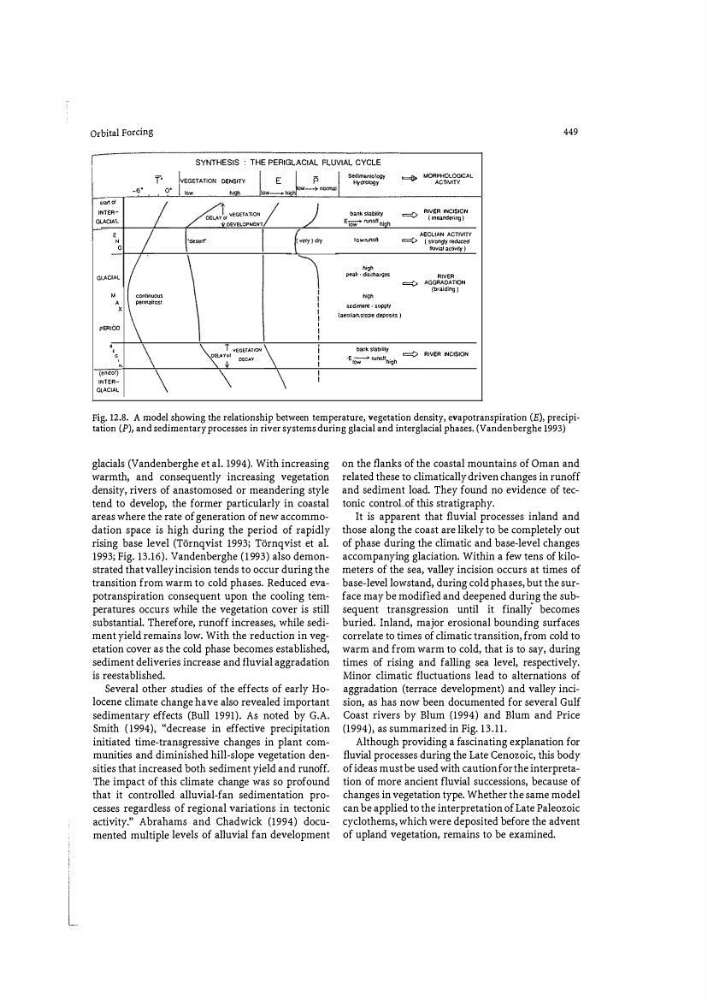
Fig. 12.8. A model showing the relationship between temperature, vegetation density, evapotranspiration (E), precipitation (P), and sedimentary processes in river systems during glacial and interglacial phases. (Vandenberghe 1993)
glacials (Vandenberghe et al. 1994). With increasing
warmth, and consequently increasing vegetation
density, rivers of anastomosed or meandering style
tend to develop, the former particularly in coastal
areas where the rate of generation of new accommodation space is high during the period of rapidly
rising base level (Tornqvist 1993; Tornqvist et al.
1993; Fig. 13.16). Vandenberghe (1993) also demonstrated that valley incision tends to occur during the
transition from warm to cold phases. Reduced evapotranspiration consequent upon the cooling tern�
peratures occurs while the vegetation cover is still
substantial. Therefore, runoff increases, while sediment yield remains low. With the reduction in vegetation cover as the cold phase becomes established,
sediment deliveries increase and fluvial aggradation
is reestablished.
Several other studies of the effects of early Holocene climate change have also revealed important
sedimentary effects (Bull 1991). As noted by G.A.
Smith (1994), "decrease in effective precipitation
initiated time-transgressive changes in plant communities and diminished hill-slope vegetation densities that increased both sediment yield and runoff.
The impact of this climate change was so profound
that it controlled alluvial-fan sedimentation processes regardless of regional variations in tectonic
activity." Abrahams and Chadwick (1994) documented multiple levels of alluvial fan development
on the flanks of the coastal mountains of Oman and
related these to climatically driven changes in runoff
and sediment load. They found no evidence of tectonic controLof this stratigraphy.
It is apparent that fl uvial processes inland and
those along the coast are likely to be completely out
of phase during the climatic and base-level changes
accompanying glaciation. Within a few tens of kilometers of the sea, valley incision occurs at times of
base-level lowstand, during cold phases, but the surface may be modified and deepened during the subsequent transgression until it finally
" becomes
buried. Inland, major erosional bounding surfaces
correlate to times of climatic transition, from cold to
warm and from warm to cold, that is to say, during
times of rising and falling sea level, respectively.
Minor climatic fluctuations lead to alternations of
aggradation (terrace development) and valley incision, as has now been documented for several Gulf
Coast rivers by Blum (1994) and Blum and Price
(1994), as summarized in Fig. 13.11.
Although providing a fascinating explanation for
fluvial processes during the Late· Cenozoic, this body
of ideas must be used with caution for the interpretation of more ancient fluvial successions, because of
changes in vegetation type. Whether the same model
can be applied to the interpretation of Late Paleozoic
cyclothems, which were deposited before the advent
of upland vegetation, remains to be examined.
449
SYNTHESIS : THE PERIGLACIAL FLUVIAL CYCLE
_,.
f• • �VEGETATION DENSITY
0
row
hi h
l k E J.. p 'I
'"lmoomlog'
Hydr<:>logy
!o
�n ormal
·-'
-
MORPHOLOGICAL
ACTIVITY
�tart of
I
)
INTER�}' '"'"n" I
bank stability
=(>
RIVER INCISION
GLACIAL
E �
n . m o
Hhi g h
( meandering )
OEVELOPM�NT
e
I
t"" '"'
AEOLIAN ACTIVITY
"
"dl.lserr
lownmoft
=(> ( strongly reduced
0
fluvial activity )
I
\
high
GLACIAL
peak • discha19as
RIVER
=(> AGGRAOA TION
(braiding )
"
continuous
I
high
A
permalrost
I
sediment • supply
'
I
\
I
(aeoiian,s!ope deposits )
PERIOD
I
I
I
•
\
"'\ T """'''' \ I bank slability
'
=(> RIVER INCISION
'
L>.Yol
I
E lo;;;-" " r
u
oo l lhigh
'·
� o�c�v
I
(cndo l )
\
\
\
I
INTERI
GLACIAL
Fig. 12.8. A model showing the relationship between temperature, vegetation density, evapotranspiration (E), precipitation (P), and sedimentary processes in river systems during glacial and interglacial phases. (Vandenberghe 1993)
glacials (Vandenberghe et al. 1994). With increasing
warmth, and consequently increasing vegetation
density, rivers of anastomosed or meandering style
tend to develop, the former particularly in coastal
areas where the rate of generation of new accommodation space is high during the period of rapidly
rising base level (Tornqvist 1993; Tornqvist et al.
1993; Fig. 13.16). Vandenberghe (1993) also demonstrated that valley incision tends to occur during the
transition from warm to cold phases. Reduced evapotranspiration consequent upon the cooling tern�
peratures occurs while the vegetation cover is still
substantial. Therefore, runoff increases, while sediment yield remains low. With the reduction in vegetation cover as the cold phase becomes established,
sediment deliveries increase and fluvial aggradation
is reestablished.
Several other studies of the effects of early Holocene climate change have also revealed important
sedimentary effects (Bull 1991). As noted by G.A.
Smith (1994), "decrease in effective precipitation
initiated time-transgressive changes in plant communities and diminished hill-slope vegetation densities that increased both sediment yield and runoff.
The impact of this climate change was so profound
that it controlled alluvial-fan sedimentation processes regardless of regional variations in tectonic
activity." Abrahams and Chadwick (1994) documented multiple levels of alluvial fan development
on the flanks of the coastal mountains of Oman and
related these to climatically driven changes in runoff
and sediment load. They found no evidence of tectonic controLof this stratigraphy.
It is apparent that fl uvial processes inland and
those along the coast are likely to be completely out
of phase during the climatic and base-level changes
accompanying glaciation. Within a few tens of kilometers of the sea, valley incision occurs at times of
base-level lowstand, during cold phases, but the surface may be modified and deepened during the subsequent transgression until it finally
" becomes
buried. Inland, major erosional bounding surfaces
correlate to times of climatic transition, from cold to
warm and from warm to cold, that is to say, during
times of rising and falling sea level, respectively.
Minor climatic fluctuations lead to alternations of
aggradation (terrace development) and valley incision, as has now been documented for several Gulf
Coast rivers by Blum (1994) and Blum and Price
(1994), as summarized in Fig. 13.11.
Although providing a fascinating explanation for
fluvial processes during the Late· Cenozoic, this body
of ideas must be used with caution for the interpretation of more ancient fluvial successions, because of
changes in vegetation type. Whether the same model
can be applied to the interpretation of Late Paleozoic
cyclothems, which were deposited before the advent
of upland vegetation, remains to be examined.