

446
What Does Fluvial Lithofacies Reveal About Climate?
m
a
m
b
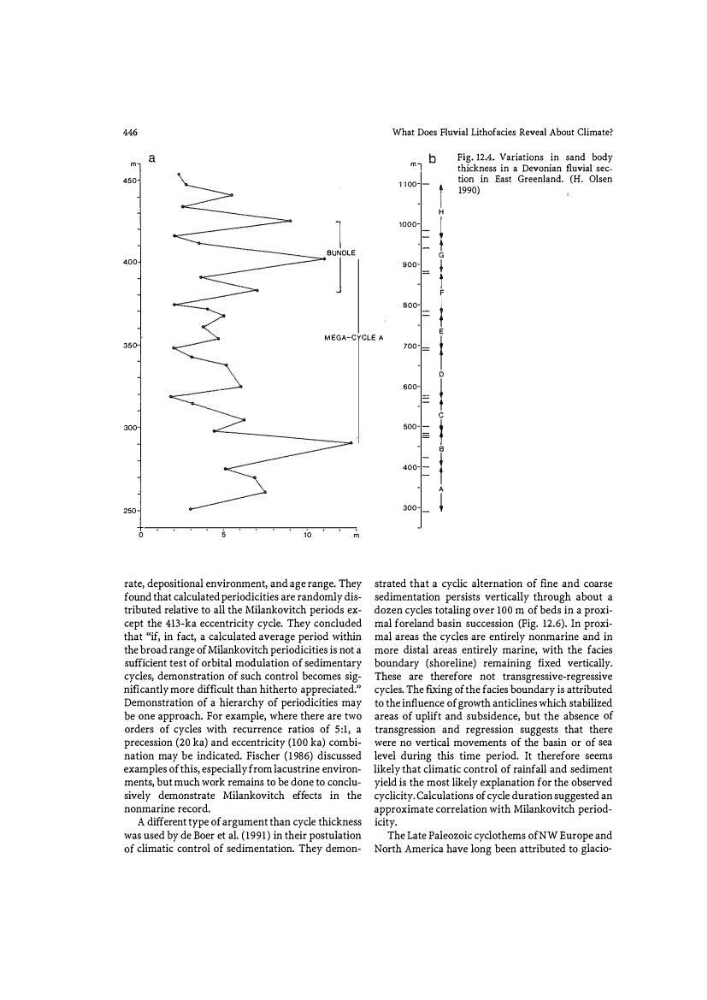
Fig. 12.4. Variations in sand body
thickness in a Devonian fluvial sec450
1100
tion in East Greenland. (H. Olsen
1
1990)
H
l
1000
j t
BUNDLE
G
400J
900
I
t F
800
j
E
MEGA-CYCLE A
j
350
300
250
0
5
10
m
rate, depositional environment, and age range. They
found that calculated periodicities are randomly distributed relative to all the Milankovitch periods except the 413-ka eccentricity cycle. They concluded
that "if, in fact, a calculated average period within
the broad range of Milankovitch periodicities is not a
sufficient test of orbital mo4ulation of sedimentary
cycles, demonstration of such control becomes signifi cantly more diffi cult than hitherto appreciated.))
Demonstration of a hierarchy of periodicities may
be one approach. For example, where there are two
orders of cycles with recurrence ratios of 5:1, a
precession (20 ka) and eccentricity (100 ka) combination may be indicated. Fischer (1986) discussed
examples of this, especially from lacustrine environments, but much work remains to be done to conclusively demonstrate Milankovitch effects in the
nonmarine record.
A different type of argument than cycle thickness
was used by de Boer et a!. (1991) in their postulation
of climatic control of sedimentation. They demon700
0
600
I
c
500
I
8
400
j
A
300
I
strated that a cyclic alternation of fine and coarse
sedimentation persists vertically through about a
dozen cycles totaling over 100 m of beds in a proximal foreland basin succession (Fig. 12.6). In proximal areas the cycles are entirely nonmarine and in
more distal areas entirely marine, with the facies
boundary (shoreline) remaining fixed vertically.
These are therefore not transgressive-regressive
cycles. The fixing of the facies boundary is attributed
to the influence of growth anticlines which stabilized
areas of uplift and subsidence, but the absence of
transgression and regression suggests that there
were no vertical movements of the basin or of sea
level during this time period. It therefore seems
likely that climatic control of rainfall and sediment
yield is the most likely explanation for the observed
cyclicity. Calculations of cycle duration suggested an
approximate correlation with Milankovitch periodicity.
The Late Paleozoic cyclothems ofNW Europe and
North America have long been attributed to glacio-
What Does Fluvial Lithofacies Reveal About Climate?
m
a
m
b
Fig. 12.4. Variations in sand body
thickness in a Devonian fluvial sec450
1100
tion in East Greenland. (H. Olsen
1
1990)
H
l
1000
j t
BUNDLE
G
400J
900
I
t F
800
j
E
MEGA-CYCLE A
j
350
300
250
0
5
10
m
rate, depositional environment, and age range. They
found that calculated periodicities are randomly distributed relative to all the Milankovitch periods except the 413-ka eccentricity cycle. They concluded
that "if, in fact, a calculated average period within
the broad range of Milankovitch periodicities is not a
sufficient test of orbital mo4ulation of sedimentary
cycles, demonstration of such control becomes signifi cantly more diffi cult than hitherto appreciated.))
Demonstration of a hierarchy of periodicities may
be one approach. For example, where there are two
orders of cycles with recurrence ratios of 5:1, a
precession (20 ka) and eccentricity (100 ka) combination may be indicated. Fischer (1986) discussed
examples of this, especially from lacustrine environments, but much work remains to be done to conclusively demonstrate Milankovitch effects in the
nonmarine record.
A different type of argument than cycle thickness
was used by de Boer et a!. (1991) in their postulation
of climatic control of sedimentation. They demon700
0
600
I
c
500
I
8
400
j
A
300
I
strated that a cyclic alternation of fine and coarse
sedimentation persists vertically through about a
dozen cycles totaling over 100 m of beds in a proximal foreland basin succession (Fig. 12.6). In proximal areas the cycles are entirely nonmarine and in
more distal areas entirely marine, with the facies
boundary (shoreline) remaining fixed vertically.
These are therefore not transgressive-regressive
cycles. The fixing of the facies boundary is attributed
to the influence of growth anticlines which stabilized
areas of uplift and subsidence, but the absence of
transgression and regression suggests that there
were no vertical movements of the basin or of sea
level during this time period. It therefore seems
likely that climatic control of rainfall and sediment
yield is the most likely explanation for the observed
cyclicity. Calculations of cycle duration suggested an
approximate correlation with Milankovitch periodicity.
The Late Paleozoic cyclothems ofNW Europe and
North America have long been attributed to glacio-