

Cong lomerates: The Significance of Texture and Petrology
429
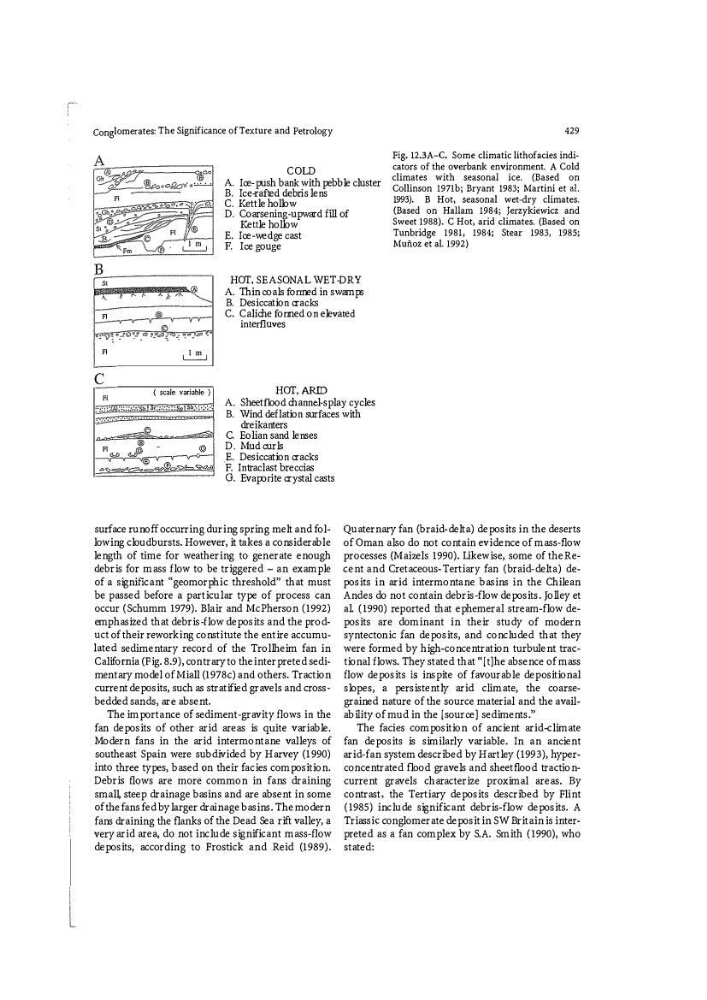
COLD
A. Ice-push bank with pebble cluster
Fig. 12.3A-C. Some climatic lithofacies indicators of the overbank environment. A Cold
climates with seasonal ice. (Based on
Collinson 197lb; Bryant 1983; Martini et al.
1993). B Hot, seasonal wet-dry climates.
(Based on Hallam 1984; Jerzykiewicz and
Sweet 1988). C Hot, arid climates. (Based on
Tunbridge 1981, 1984; Stear 1983, 1985;
Munoz et al. 1992)
B. Ic e-rafted debri s lens
C. Kettle hollow
D. Coarsening -upward fill of
Kettle hollow
E. Ice-wedge cast
F. Ice gouge
B
HOT, SEASONAL WET-DRY
A. Thin coals fonned in swamps
B. Desiccation cracks
A
@
C. Caliche fonned on elevated
interfluves
A
c
( scale variable )
HOT, ARID
Fl
A. Sheetflood channel-splay cycles
B. Wind deflation surfac es with
dreikanters
C. Eolian sand lenses
D. Mud curls
E. Desiccation cracks
· F. Intraclast breccias
G. Evapori te cry stal casts
surface runoff occurrin g during sp rin g melt and following cloudbursts. However, it ta kes a consid erabl e
length of ti me for weathering to gen erate enough
debris for mass flow to be triggered an example
of a signi ficant "geomorphi c threshold" that must
be passed before a particular type of process can
occur (Schumm 1979). Blair and McPherson (1992)
emp hasized that debris-flow deposits and the product of their reworking consti tute the en tire accumulated sedi mentary record of the Trollheim fan in
California (Fig. 8.9), con trary to the interpreted sedimen tary model ofMiall (1978c) and others. Traction
current deposits, such as stratified gravels and crossbedded sands, are absent.
The importance of sedi ment-gravity fl ows in the
fan deposits of other arid areas is quite variable.
Modern fans in the arid intermontane valleys of
southeast Spain were subdivided by Harvey (1990)
into three types, based on their fa cies composition.
Debris fl ows are more common in fans draining
small, steep drainage basin s and are absent in some
of the fans fed by larger drainage basins. The modern
fans draining the flan ks of the Dead Sea rift valley, a
very arid area, do not include significant mass-fl ow
deposits, accordin g to Frostick and Reid (1989).
Quaternary fan (braid-delta) deposits in the deserts
of Oman also do not contain evidence of mass-flow
processes (Maizels 1990). Li kewise, some of theRecent and Cretaceous-Tertiary fan (braid-delta ) deposits in arid intermontane basins in the Chilean
And es do not contain debris-flow deposits. jolley et
al. (1990) rep orted that ephemeral stream-flow deposits are dominant in their study of modern
syntectonic fan deposits, and concluded that they
were formed by high-concentration turbulent tractional flows. They stated that "[ t] he absence of mass
fl ow deposits is inspite of favourable dep ositional
slopes, a persistently arid cli mate, the coa rsegrained nature of the source ma terial and the avail
ability of mud in the [source] sediments."
The fa ci es composition of ancient arid-climate
fan deposits is simila rl y variable. In an ancient
arid-fan system described by Hartley (1993), hyp ercon centrated flood gra vels and sheetflood tra ctioncurrent gravels characterize proximal areas. By
contrast, the Tertiary deposits described by Flint
(1985) include sign ificant debris-flow deposits. A
Triassic con glomerate deposit in SW Britain is interpreted as a fan complex by S.A. Smith (1990), who
stated:
429
COLD
A. Ice-push bank with pebble cluster
Fig. 12.3A-C. Some climatic lithofacies indicators of the overbank environment. A Cold
climates with seasonal ice. (Based on
Collinson 197lb; Bryant 1983; Martini et al.
1993). B Hot, seasonal wet-dry climates.
(Based on Hallam 1984; Jerzykiewicz and
Sweet 1988). C Hot, arid climates. (Based on
Tunbridge 1981, 1984; Stear 1983, 1985;
Munoz et al. 1992)
B. Ic e-rafted debri s lens
C. Kettle hollow
D. Coarsening -upward fill of
Kettle hollow
E. Ice-wedge cast
F. Ice gouge
B
HOT, SEASONAL WET-DRY
A. Thin coals fonned in swamps
B. Desiccation cracks
A
@
C. Caliche fonned on elevated
interfluves
A
c
( scale variable )
HOT, ARID
Fl
A. Sheetflood channel-splay cycles
B. Wind deflation surfac es with
dreikanters
C. Eolian sand lenses
D. Mud curls
E. Desiccation cracks
· F. Intraclast breccias
G. Evapori te cry stal casts
surface runoff occurrin g during sp rin g melt and following cloudbursts. However, it ta kes a consid erabl e
length of ti me for weathering to gen erate enough
debris for mass flow to be triggered an example
of a signi ficant "geomorphi c threshold" that must
be passed before a particular type of process can
occur (Schumm 1979). Blair and McPherson (1992)
emp hasized that debris-flow deposits and the product of their reworking consti tute the en tire accumulated sedi mentary record of the Trollheim fan in
California (Fig. 8.9), con trary to the interpreted sedimen tary model ofMiall (1978c) and others. Traction
current deposits, such as stratified gravels and crossbedded sands, are absent.
The importance of sedi ment-gravity fl ows in the
fan deposits of other arid areas is quite variable.
Modern fans in the arid intermontane valleys of
southeast Spain were subdivided by Harvey (1990)
into three types, based on their fa cies composition.
Debris fl ows are more common in fans draining
small, steep drainage basin s and are absent in some
of the fans fed by larger drainage basins. The modern
fans draining the flan ks of the Dead Sea rift valley, a
very arid area, do not include significant mass-fl ow
deposits, accordin g to Frostick and Reid (1989).
Quaternary fan (braid-delta) deposits in the deserts
of Oman also do not contain evidence of mass-flow
processes (Maizels 1990). Li kewise, some of theRecent and Cretaceous-Tertiary fan (braid-delta ) deposits in arid intermontane basins in the Chilean
And es do not contain debris-flow deposits. jolley et
al. (1990) rep orted that ephemeral stream-flow deposits are dominant in their study of modern
syntectonic fan deposits, and concluded that they
were formed by high-concentration turbulent tractional flows. They stated that "[ t] he absence of mass
fl ow deposits is inspite of favourable dep ositional
slopes, a persistently arid cli mate, the coa rsegrained nature of the source ma terial and the avail
ability of mud in the [source] sediments."
The fa ci es composition of ancient arid-climate
fan deposits is simila rl y variable. In an ancient
arid-fan system described by Hartley (1993), hyp ercon centrated flood gra vels and sheetflood tra ctioncurrent gravels characterize proximal areas. By
contrast, the Tertiary deposits described by Flint
(1985) include sign ificant debris-flow deposits. A
Triassic con glomerate deposit in SW Britain is interpreted as a fan complex by S.A. Smith (1990), who
stated: