

406
th rust belt le ading to a mig ration and offlapping of
depocenters (Fig. 1!.69). However, in the second
paper, it is claimed th at correlation of the sequences
with the Haq et al. (1987, 1988) chart can be carrie d
out) and the authors interpreted eustasy as the mai n
drivi ng me chanism.
An idealized cross section of the Eocene-Oligocene section is shown in Fig. 11.69. The overa ll
structure of the sequences is that of a coa rse,
nonmarine clastic wedge prograding southward
from the thrus t front into basin-center ma rine
ma rls. Sha llow-water carb onate deposits are forme d
on the dis tal ramp and forebulge of the foreland
basin, away from the influence of the fold-thrustbelt clastic source. Carb onates are found in the
transgressive stage of each sequence. They may be
associated with evaporites formed during the subsequent regressive stage. Careful dating of these
sequences by Burbank et al. (1992) using
magnetostratigraph y indicated that "progradation
was controlle d primari ly by subsidence rather tha n
sediment supply or base-level changes".
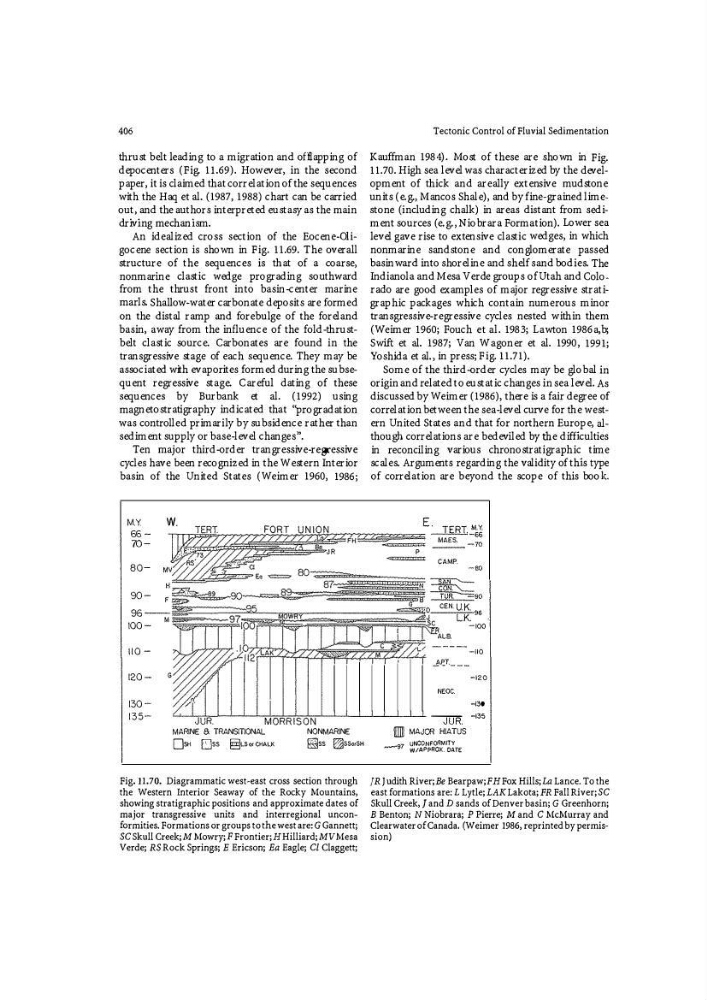
Te n ma jor thi rd-order trangressive-regressive
cycles have been recogni zed in the Western Interior
basin of the Unite d States (Weimer 1960, 1986;
M.Y
W.
66 -
80100 -
110 -
120 -
Tectonic Control of Fluvial Sedimentation
Kauffman 1984). Most of these are shown in Fig.
11.70. High sea level was ch aracterized by the deve lopment of th ick and areally extensive mudstone
units (e.g., Mancos Sh ale), and by fine-grained limestone (i ncluding ch alk) in areas dis tant from sediment sources ( e.g.1 Niobrara Forma tion). Lowe r sea
le vel gave rise to extensive clasti c wedges, in which
nonmarine sandstone and conglomerate passed
basinward into shoreline and shelf sand bodies. The
Indianola and Mesa Verde groups of Utah and Colorado are good examples of major regressive stratigraphic packages which contain nume rous minor
transg re ssive-regressive cycles nes te d within them
(Weimer 1960; Fouch et al. 1983; Lawton 1986a,b;
Swift et al. 1987; Van Wagoner et al. 1990, 1991;
Yoshida et al., in press; Fig. 11.71).
Some of the th ird-order cycles may be global in
origi n and re late d to eustatic changes in sea level. As
dis cussed by We imer (1986), there is a fai r degree of
correlation between the sea-level curve for the western Unite d States and tha t for northe rn Europe, alth ough correlations are bedeviled by the difficulties
in re conciling various ch ronostratigraphic time
scales. Arguments re garding the vali dity of this type
of correlation are beyond the scope of this book
-110
-120
NEOC.
-130
130 -
135"-'--' '-Tclo_j _j_ __j_� ��_L_l_J _l_j_ _L_ _cLJ_j_ JDR.
-135
MARINE B TRANSITIONAL
OsH Oss §LS
gss �SSorSH
Fig. 11.70. Diagrammatic west-east cross section through
the Western Interior Seaway of the Rocky Mountains,
showing stratigraphic positions and approximate dates of
major transgressive units and interregional unconfo rmities. Formations or groups to the west are: G Gannett;
SC Skull Creek; M Mowry; F Frontier; H Hilliard; MV Mesa
Verde; RS Rock Springs; E Ericson; Ea Eagle; Cl Claggett;
IIII I MAJOR HIATUS
_.-s?
���f> N:RogXM I 61rE
]R ] udith River; Be Bearpaw; PH Fox Hills; La Lance. To the
east formations are: L Lytle; LAK Lakota; FR Fall River; SC
Skull Creek, ] and D sands of Denver basin; G Greenhorn;
B Benton; N Niobrara; P Pierre; M and C McMurray and
Clearwater of Canada, (Weimer 1986, reprinted by permis�
sion)
th rust belt le ading to a mig ration and offlapping of
depocenters (Fig. 1!.69). However, in the second
paper, it is claimed th at correlation of the sequences
with the Haq et al. (1987, 1988) chart can be carrie d
out) and the authors interpreted eustasy as the mai n
drivi ng me chanism.
An idealized cross section of the Eocene-Oligocene section is shown in Fig. 11.69. The overa ll
structure of the sequences is that of a coa rse,
nonmarine clastic wedge prograding southward
from the thrus t front into basin-center ma rine
ma rls. Sha llow-water carb onate deposits are forme d
on the dis tal ramp and forebulge of the foreland
basin, away from the influence of the fold-thrustbelt clastic source. Carb onates are found in the
transgressive stage of each sequence. They may be
associated with evaporites formed during the subsequent regressive stage. Careful dating of these
sequences by Burbank et al. (1992) using
magnetostratigraph y indicated that "progradation
was controlle d primari ly by subsidence rather tha n
sediment supply or base-level changes".
Te n ma jor thi rd-order trangressive-regressive
cycles have been recogni zed in the Western Interior
basin of the Unite d States (Weimer 1960, 1986;
M.Y
W.
66 -
80100 -
110 -
120 -
Tectonic Control of Fluvial Sedimentation
Kauffman 1984). Most of these are shown in Fig.
11.70. High sea level was ch aracterized by the deve lopment of th ick and areally extensive mudstone
units (e.g., Mancos Sh ale), and by fine-grained limestone (i ncluding ch alk) in areas dis tant from sediment sources ( e.g.1 Niobrara Forma tion). Lowe r sea
le vel gave rise to extensive clasti c wedges, in which
nonmarine sandstone and conglomerate passed
basinward into shoreline and shelf sand bodies. The
Indianola and Mesa Verde groups of Utah and Colorado are good examples of major regressive stratigraphic packages which contain nume rous minor
transg re ssive-regressive cycles nes te d within them
(Weimer 1960; Fouch et al. 1983; Lawton 1986a,b;
Swift et al. 1987; Van Wagoner et al. 1990, 1991;
Yoshida et al., in press; Fig. 11.71).
Some of the th ird-order cycles may be global in
origi n and re late d to eustatic changes in sea level. As
dis cussed by We imer (1986), there is a fai r degree of
correlation between the sea-level curve for the western Unite d States and tha t for northe rn Europe, alth ough correlations are bedeviled by the difficulties
in re conciling various ch ronostratigraphic time
scales. Arguments re garding the vali dity of this type
of correlation are beyond the scope of this book
-110
-120
NEOC.
-130
130 -
135"-'--' '-Tclo_j _j_ __j_� ��_L_l_J _l_j_ _L_ _cLJ_j_ JDR.
-135
MARINE B TRANSITIONAL
OsH Oss §LS
gss �SSorSH
Fig. 11.70. Diagrammatic west-east cross section through
the Western Interior Seaway of the Rocky Mountains,
showing stratigraphic positions and approximate dates of
major transgressive units and interregional unconfo rmities. Formations or groups to the west are: G Gannett;
SC Skull Creek; M Mowry; F Frontier; H Hilliard; MV Mesa
Verde; RS Rock Springs; E Ericson; Ea Eagle; Cl Claggett;
IIII I MAJOR HIATUS
_.-s?
���f> N:RogXM I 61rE
]R ] udith River; Be Bearpaw; PH Fox Hills; La Lance. To the
east formations are: L Lytle; LAK Lakota; FR Fall River; SC
Skull Creek, ] and D sands of Denver basin; G Greenhorn;
B Benton; N Niobrara; P Pierre; M and C McMurray and
Clearwater of Canada, (Weimer 1986, reprinted by permis�
sion)