

I
Plate-Tectonic Setting of Alluvial Basins
I LEGEND\
!MARINE!
l/1
ShO
§ Nedtlc deposito
� Bothyol S Aby,.ol deposito
� S"bmod"' foo '""' "
� D•llolc '''"'"
[TI]] Coo"'''"'' Zooo
� � Paleobathymoatry In matera
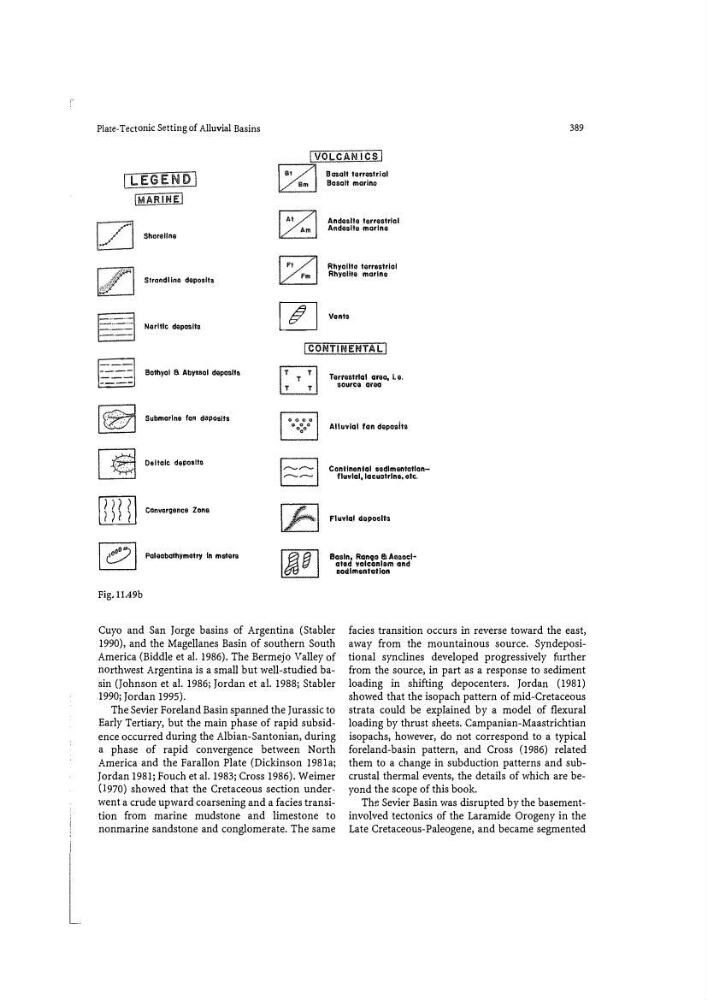
Fig.IL49b
!VOLCANICS!
�m Basalt terrestrial
� Boaolt marin0
Andealie tarreatrlol
Andeali!B marine
Rhyollto terrt&striol
Rhyoll�e marina
0 .... .
!CONTINENTAL I
fT:Tl
�
r:==: ::l
t::: :.=J
[EJ
Terveatvlal area, I. e.
sourclll area
Alluvial fen deposita
Conilnlll nicl tradlmentotlonfluvlcl, lacuGtrlna, etc.
Fluvla.f doi�poolta
Bcaln. Rcn9Q) l3i Aenocl·
atrad \lolecnlam and
aodlnumtotlon
389
Cuyo and San jorge basins of Argentina (Stabler
1990), and the Magellanes Basin of southern South
America (Biddle et aL 1986). The Bermejo Valley of
northwest Argentina is a small but well-studied basin (Johnson et aL 1986; jordan et aL 1988; Stabler
1990; jordan 1995).
facies transition occurs in reverse toward the east,
away from the mountainous source. Syndepositional synclines developed progressively further
from the source, in part as a response to sediment
loading in shifting depocenters. Jordan (1981)
showed that the isopach pattern of mid-Cretaceous
strata could be explained by a model of flexural
loading by thrust sheets .. campanian-Maastrichtian
isopachs, however, do not correspond to a typical
foreland-basin pattern, and Cross (1986) related
them to a change in subduction patterns and subcrustal thermal events, the details of which are beyond the scope of this book.
The Sevier Foreland Basin spanned the Jurassic to
Early Tertiary, but the main phase of rapid subsidence occurred during the Albian-Santonian, during
a phase of rapid convergence between North
America and the Farallon Plate (Dickinson 198la;
Jordan 1981; Fouch et aL 1983; Cross 1986). Weimer
0970) showed that the Cretaceous section underwent a crude upward coarsening and a facies transition from marine mudstone and limestone to
nonmarine sandstone and conglomerate. The same
The Sevier Basin was disrupted by the basementinvolved tectonics of the Laramide Orogeny in the
Late Cretaceous-Paleogene, and became segmented
Plate-Tectonic Setting of Alluvial Basins
I LEGEND\
!MARINE!
l/1
ShO
§ Nedtlc deposito
� Bothyol S Aby,.ol deposito
� S"bmod"' foo '""' "
� D•llolc '''"'"
[TI]] Coo"'''"'' Zooo
� � Paleobathymoatry In matera
Fig.IL49b
!VOLCANICS!
�m Basalt terrestrial
� Boaolt marin0
Andealie tarreatrlol
Andeali!B marine
Rhyollto terrt&striol
Rhyoll�e marina
0 .... .
!CONTINENTAL I
fT:Tl
�
r:==: ::l
t::: :.=J
[EJ
Terveatvlal area, I. e.
sourclll area
Alluvial fen deposita
Conilnlll nicl tradlmentotlonfluvlcl, lacuGtrlna, etc.
Fluvla.f doi�poolta
Bcaln. Rcn9Q) l3i Aenocl·
atrad \lolecnlam and
aodlnumtotlon
389
Cuyo and San jorge basins of Argentina (Stabler
1990), and the Magellanes Basin of southern South
America (Biddle et aL 1986). The Bermejo Valley of
northwest Argentina is a small but well-studied basin (Johnson et aL 1986; jordan et aL 1988; Stabler
1990; jordan 1995).
facies transition occurs in reverse toward the east,
away from the mountainous source. Syndepositional synclines developed progressively further
from the source, in part as a response to sediment
loading in shifting depocenters. Jordan (1981)
showed that the isopach pattern of mid-Cretaceous
strata could be explained by a model of flexural
loading by thrust sheets .. campanian-Maastrichtian
isopachs, however, do not correspond to a typical
foreland-basin pattern, and Cross (1986) related
them to a change in subduction patterns and subcrustal thermal events, the details of which are beyond the scope of this book.
The Sevier Foreland Basin spanned the Jurassic to
Early Tertiary, but the main phase of rapid subsidence occurred during the Albian-Santonian, during
a phase of rapid convergence between North
America and the Farallon Plate (Dickinson 198la;
Jordan 1981; Fouch et aL 1983; Cross 1986). Weimer
0970) showed that the Cretaceous section underwent a crude upward coarsening and a facies transition from marine mudstone and limestone to
nonmarine sandstone and conglomerate. The same
The Sevier Basin was disrupted by the basementinvolved tectonics of the Laramide Orogeny in the
Late Cretaceous-Paleogene, and became segmented