

384
,
.
3'
s ·
7' ••
Tectonic Control of Fluvial Sedimentation
®
EARLY TRIASSIC
RIFT SYSTEM
(SCYTHIAN)
�PROBABLE
� HINTERLAND
�PROXIMAL
�ALLUVIUM
®
� MAINLY STREAM AND
� STREAM FLOOD DEPOSITS
� MAINLY FLOOOBASIN AND
L.:::. .. ..J LACUSTRINE DEPOSITS
� INLAND SABKHA OR
� LAGOONAL DEPOSITS
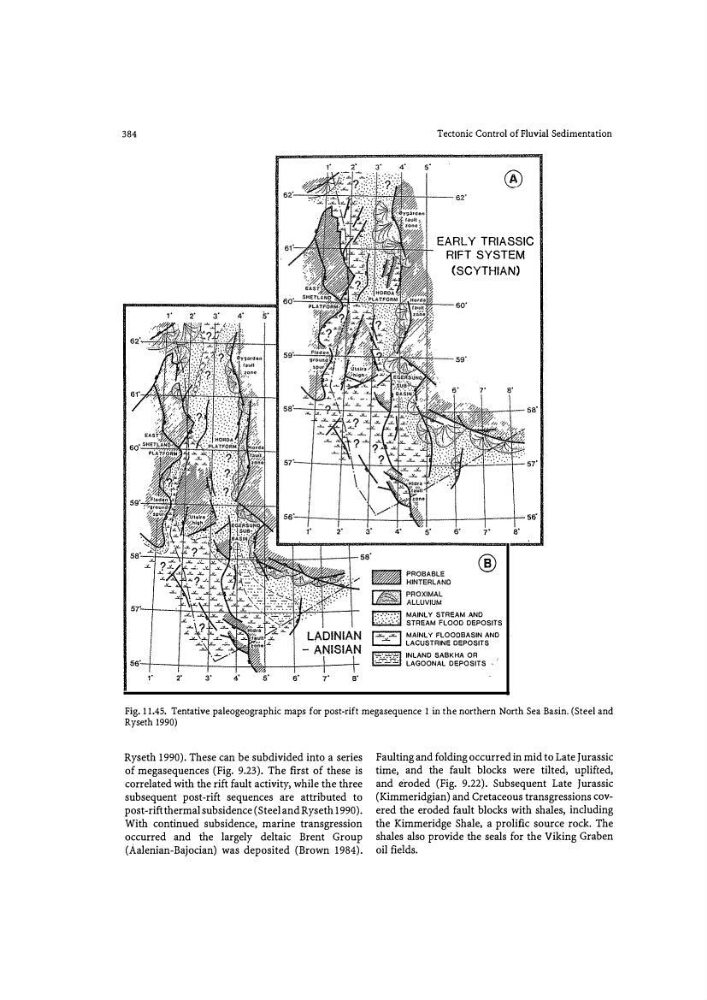
Fig. 11.45. Tentative paleogeographic maps for post�rift megasequence 1 in the northern North Sea Basin. (Steel and
Ryseth 1990)
Ryseth 1990). These can be subdivided into a series
of megasequences (Fig. 9.23). The fi rst of these is
correlated with the rift fault activity, while the three
subsequent post�rift sequences are attributed to
post-riftthermal subsidence (Steel and Ryseth 1990).
With continued subsidence, marine transgression
occurred and the largely deltaic Brent Group
(Aalenian-Bajocian) was deposited (Brown 1984).
Faulting and folding occurred in mid to Late Jurassic
time, and the fault blocks were tilted, uplifted,
and eroded (Fig. 9.22). Subsequent Late jurassic
(Kimmeridgian) and Cretaceous transgressions covered the eroded fault blocks with shales, including
the Kimmeridge Shale, a prolific source rock. The
shales also provide the seals for the Viking Graben
oil fields.
,
.
3'
s ·
7' ••
Tectonic Control of Fluvial Sedimentation
®
EARLY TRIASSIC
RIFT SYSTEM
(SCYTHIAN)
�PROBABLE
� HINTERLAND
�PROXIMAL
�ALLUVIUM
®
� MAINLY STREAM AND
� STREAM FLOOD DEPOSITS
� MAINLY FLOOOBASIN AND
L.:::. .. ..J LACUSTRINE DEPOSITS
� INLAND SABKHA OR
� LAGOONAL DEPOSITS
Fig. 11.45. Tentative paleogeographic maps for post�rift megasequence 1 in the northern North Sea Basin. (Steel and
Ryseth 1990)
Ryseth 1990). These can be subdivided into a series
of megasequences (Fig. 9.23). The fi rst of these is
correlated with the rift fault activity, while the three
subsequent post�rift sequences are attributed to
post-riftthermal subsidence (Steel and Ryseth 1990).
With continued subsidence, marine transgression
occurred and the largely deltaic Brent Group
(Aalenian-Bajocian) was deposited (Brown 1984).
Faulting and folding occurred in mid to Late Jurassic
time, and the fault blocks were tilted, uplifted,
and eroded (Fig. 9.22). Subsequent Late jurassic
(Kimmeridgian) and Cretaceous transgressions covered the eroded fault blocks with shales, including
the Kimmeridge Shale, a prolific source rock. The
shales also provide the seals for the Viking Graben
oil fields.