

Tectonic Control of Basin Style and Basin-Scale Fluvial Patterns
373
:;
;;
�
•
1•
•
�
"'
(Mf,lf,Q)
(Mf,Mm,U) Q rb
IO,c) Qst
(S,If,C) Q af
0 ccp
(Q) Oecp
(lf,Q) 0 wlp
to·e l--�-�- -�-. ..,.-�
10"4
10"2
1
Sedimentation rate (mt 10
3 yr)
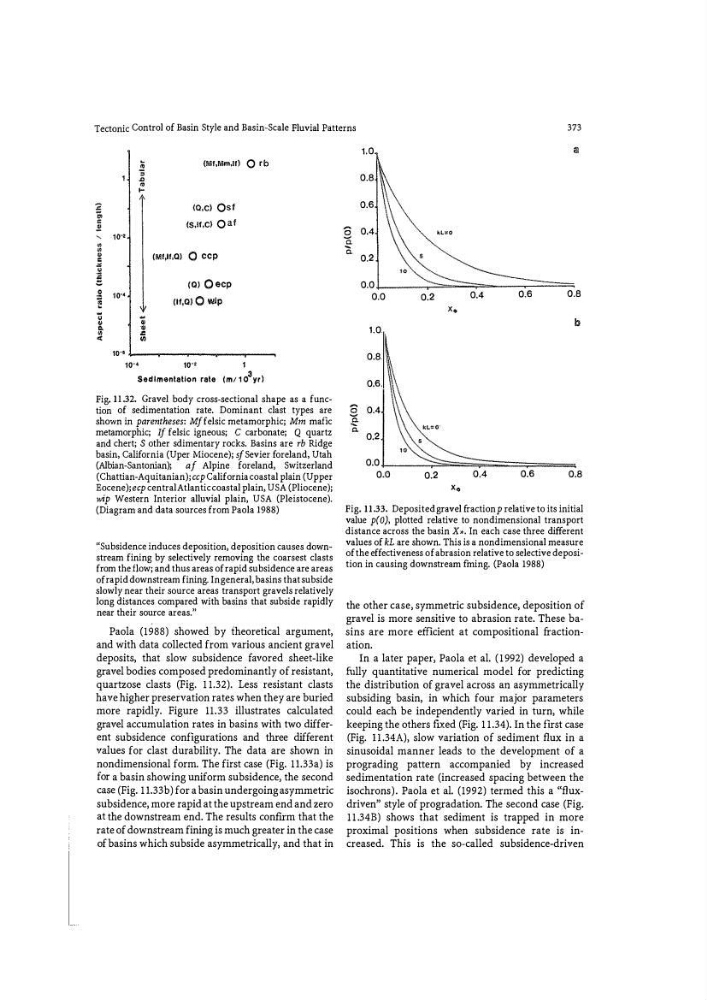
Fig. 11.32. Gravel body cross-sectional shape as a function of sedimentation rate. Dominant clast types are
shown in parentheses: Mf felsic metamorphic; Mm mafic
metamorphic; If felsic igneous; C carbonate; Q quartz
and chert; S other sdimentary rocks. Basins are rb Ridge
basin, California (Uper Miocene); sf Sevier fo reland, Utah
(Albian-Santonian); af Alpine foreland, Switzerland
( Chattian-Aquitanian); ccp California coastal plain (Upper
Eocene);ecp central Atlantic coastal plain, USA (Pliocene);
wip Western Interior alluvial plain, USA (Pleistocene).
(Diagram and data sources from Paola 1988)
"Subsidence induces deposition, deposition causes downstream fining by selectively removing the coarsest clasts
from the flow; and thus areas of rapid subsidence are areas
of rapid downstream fining. In general, basins that subside
slowly near their source areas transport gravels relatively
long distances compared with basins that subside rapidly
near their source areas."
Paola (1988) showed by theoretical argument,
and with data collected from various ancient gravel
deposits, that slow subsidence favored sheet-like
gravel bodies composed predominantly of resistant,
quartzose clasts (Fig. 11.32). Less resistant clasts
have higher preservation rates when they are buried
more rapidly. Figure 11.33 illustrates calculated
gravel accumulation rates in basins with two different subsidence configurations and three different
values for clast durability. The data are shown in
nondimensional form. The first case (Fig. 1 J.33a) is
for a basin showing uniform subsidence, the second
case (Fig. 1 J.33b) for a basin undergoing asymmetric
subsidence, more rapid at the upstream end and zero
at the downstream end. The results confirm that the
rate of downstream fining is much greater in the case
of basins which subside asymmetrically, and that in
1.0
0.8
0.6
-
0.4
s
kt=o
0.
a. 0.2
"
0.0
0.0
0.2
0.4
0.6
0.8
x •
1.0
0.8
0.6
§ 0.4
�
0. 0.2
0.0
0.0
0.2
0.4
0.6
0.8
x.
Fig. 11.33. Deposited gravel fr action p relative to its initial
value p(O), plotted relative to nondimensional transport
distance across the basin X*. In each case three different
values of kL are shown. This is a nondimensional measure
of the effectiveness of abrasion relative to selective deposition in causing downstream fm ing. (Paola 1988)
the other case, symmetric subsidence, deposition of
gravel is more sensitive to abrasion rate. These basins are more efficient at compositional fr actionation.
In a later paper, Paola et al. (1992) developed a
fully quantitative numerical model for predicting
the distribution of gravel across an asymmetrically
subsiding basin, in which four major parameters
could each be independently varied in turn, while
keeping the others fixed (Fig. 11.34). In the first case
(Fig. ll.34A), slow variation of sediment flux in a
sinusoidal manner leads to the development of a
prograding pattern accompanied by increased
sedimentation rate (increased spacing between the
isochrons). Paola et al. (1992) termed this a "fl uxdriven" style of progradation. The second case (Fig.
11.34B) shows that sediment is trapped in more
proximal positions when subsidence rate is increased. This is the so-called subsidence-driven
373
:;
;;
�
•
1•
•
�
"'
(Mf,lf,Q)
(Mf,Mm,U) Q rb
IO,c) Qst
(S,If,C) Q af
0 ccp
(Q) Oecp
(lf,Q) 0 wlp
to·e l--�-�- -�-. ..,.-�
10"4
10"2
1
Sedimentation rate (mt 10
3 yr)
Fig. 11.32. Gravel body cross-sectional shape as a function of sedimentation rate. Dominant clast types are
shown in parentheses: Mf felsic metamorphic; Mm mafic
metamorphic; If felsic igneous; C carbonate; Q quartz
and chert; S other sdimentary rocks. Basins are rb Ridge
basin, California (Uper Miocene); sf Sevier fo reland, Utah
(Albian-Santonian); af Alpine foreland, Switzerland
( Chattian-Aquitanian); ccp California coastal plain (Upper
Eocene);ecp central Atlantic coastal plain, USA (Pliocene);
wip Western Interior alluvial plain, USA (Pleistocene).
(Diagram and data sources from Paola 1988)
"Subsidence induces deposition, deposition causes downstream fining by selectively removing the coarsest clasts
from the flow; and thus areas of rapid subsidence are areas
of rapid downstream fining. In general, basins that subside
slowly near their source areas transport gravels relatively
long distances compared with basins that subside rapidly
near their source areas."
Paola (1988) showed by theoretical argument,
and with data collected from various ancient gravel
deposits, that slow subsidence favored sheet-like
gravel bodies composed predominantly of resistant,
quartzose clasts (Fig. 11.32). Less resistant clasts
have higher preservation rates when they are buried
more rapidly. Figure 11.33 illustrates calculated
gravel accumulation rates in basins with two different subsidence configurations and three different
values for clast durability. The data are shown in
nondimensional form. The first case (Fig. 1 J.33a) is
for a basin showing uniform subsidence, the second
case (Fig. 1 J.33b) for a basin undergoing asymmetric
subsidence, more rapid at the upstream end and zero
at the downstream end. The results confirm that the
rate of downstream fining is much greater in the case
of basins which subside asymmetrically, and that in
1.0
0.8
0.6
-
0.4
s
kt=o
0.
a. 0.2
"
0.0
0.0
0.2
0.4
0.6
0.8
x •
1.0
0.8
0.6
§ 0.4
�
0. 0.2
0.0
0.0
0.2
0.4
0.6
0.8
x.
Fig. 11.33. Deposited gravel fr action p relative to its initial
value p(O), plotted relative to nondimensional transport
distance across the basin X*. In each case three different
values of kL are shown. This is a nondimensional measure
of the effectiveness of abrasion relative to selective deposition in causing downstream fm ing. (Paola 1988)
the other case, symmetric subsidence, deposition of
gravel is more sensitive to abrasion rate. These basins are more efficient at compositional fr actionation.
In a later paper, Paola et al. (1992) developed a
fully quantitative numerical model for predicting
the distribution of gravel across an asymmetrically
subsiding basin, in which four major parameters
could each be independently varied in turn, while
keeping the others fixed (Fig. 11.34). In the first case
(Fig. ll.34A), slow variation of sediment flux in a
sinusoidal manner leads to the development of a
prograding pattern accompanied by increased
sedimentation rate (increased spacing between the
isochrons). Paola et al. (1992) termed this a "fl uxdriven" style of progradation. The second case (Fig.
11.34B) shows that sediment is trapped in more
proximal positions when subsidence rate is increased. This is the so-called subsidence-driven