

'
l
Tectonic Control of Basin Style and Basin-Scale Fluvial Patterns
365
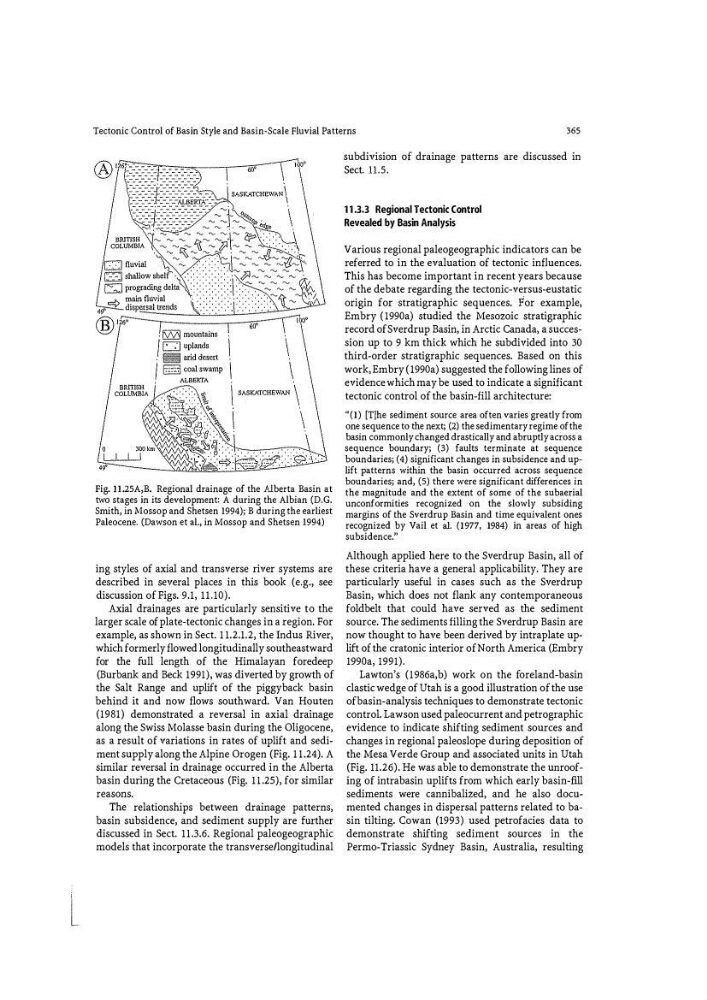
Fig. 11.25A,B. Regional drainage of the Alberta Basin at
two stages in its development: A during the Albian (D.G.
Smith, in Mossop and Shetsen 1994); B during the earliest
Paleocene. (Dawson et al., in Mossop and Shetsen 1994)
ing styles of axial and transverse river systems are
described in several places in this book (e.g., see
discussion of Figs. 9.1, 11.10).
Axial drainages are particularly sensitive to the
larger scale of plate-tectonic changes in a region. For
example, as shown in Sect. 1 1.2.1.2, the Indus River,
which formerly flowed longitudinally southeastward
for the fu ll length of the Himalayan foredeep
(Burbank and Beck 1991), was diverted by growth of
the Salt Range and uplift of the piggyback basin
behind it and now flows southward. Van Houten
(1981) demonstrated a reversal in axial drainage
along the Swiss Molasse basin during the Oligocene,
as a result of variations in rates of uplift and sediment supply along the Alpine Orogen (Fig. 11.24). A
similar reversal in drainage occurred in the Alberta
basin during the Cretaceous (Fig. 11.25), for similar
reasons.
The relationships between drainage patterns,
basin subsidence, and sediment supply are further
discussed in Sect. 11.3.6. Regional paleogeographic
models that incorporate the transverse/longitudinal
subdivision of drainage patterns are discussed in
Sect. ll.S.
11.3,3 Regional Tectonic Control
Revealed by Basin Analysis
Various regional paleogeographic indicators can be
referred to in the evaluation of tectonic influences.
This has become important in recent years because
of the debate regarding the tectonic-versus-eustatic
origin for stratigraphic sequences. For example,
Embry (1990a) studied the Mesozoic stratigraphic
record of Sverdrup Basin, in Arctic Canada, a succession up to 9 km thick which he subdivided into 30
third-order stratigraphic sequences. Based on this
work, Embry (1990a) suggested the following lines of
evidence which may be used to indicate a significant
tectonic control of the basin-fill architecture:
"(1) [Tjhe sediment source area often varies greatly from
one sequence to the next; (2) the sedimentary regime of the
basin commonly changed drastically and abruptly across a
sequence boundary; (3) faults terminate at sequence
boundaries; (4) significant changes in subsidence and uplift patterns within the basin occurred across sequence
boundaries; and, (5) there were significant differences in
the magnitude and the extent of some of the subaerial
unconformities recognized on the slowly subsiding
margins of the Sverdrup Basin and time equivalent ones
recognized by Vail et al. (1977, 1984) in areas of high
subsidence."
Although applied here to the Sverdrup Basin, all of
these criteria have a general applicability. They are
particularly useful in cases such as the Sverdrup
Basin, which does not flank any contemporaneous
foldbelt that could have served as the sediment
source. The sediments filling the Sverdrup Basin are
now thought to have been derived by intraplate uplift of the cratonic interior of North America (Embry
1990a, 1991).
Lawton's (1986a,b) work on the fo reland-basin
clastic wedge of Utah is a good illustration of the use
ofbasin-analysis techniques to demonstrate tectonic
control. Lawson used paleocurrent and petrographic
evidence to indicate shifting sediment sources and
changes in regional paleoslope during deposition of
the Mesa Verde Group and associated units in Utah
(Fig. 11.26). He was able to demonstrate the unroofing of intrabasin uplifts from which early basin-fill
sediments were cannibalized, and he also documented changes in dispersal patterns related to basin tilting. Cowan (1993) used petrofacies data to
demonstrate shifting sediment sources in the
Permo-Triassic Sydney Basin, Australia, resulting
l
Tectonic Control of Basin Style and Basin-Scale Fluvial Patterns
365
Fig. 11.25A,B. Regional drainage of the Alberta Basin at
two stages in its development: A during the Albian (D.G.
Smith, in Mossop and Shetsen 1994); B during the earliest
Paleocene. (Dawson et al., in Mossop and Shetsen 1994)
ing styles of axial and transverse river systems are
described in several places in this book (e.g., see
discussion of Figs. 9.1, 11.10).
Axial drainages are particularly sensitive to the
larger scale of plate-tectonic changes in a region. For
example, as shown in Sect. 1 1.2.1.2, the Indus River,
which formerly flowed longitudinally southeastward
for the fu ll length of the Himalayan foredeep
(Burbank and Beck 1991), was diverted by growth of
the Salt Range and uplift of the piggyback basin
behind it and now flows southward. Van Houten
(1981) demonstrated a reversal in axial drainage
along the Swiss Molasse basin during the Oligocene,
as a result of variations in rates of uplift and sediment supply along the Alpine Orogen (Fig. 11.24). A
similar reversal in drainage occurred in the Alberta
basin during the Cretaceous (Fig. 11.25), for similar
reasons.
The relationships between drainage patterns,
basin subsidence, and sediment supply are further
discussed in Sect. 11.3.6. Regional paleogeographic
models that incorporate the transverse/longitudinal
subdivision of drainage patterns are discussed in
Sect. ll.S.
11.3,3 Regional Tectonic Control
Revealed by Basin Analysis
Various regional paleogeographic indicators can be
referred to in the evaluation of tectonic influences.
This has become important in recent years because
of the debate regarding the tectonic-versus-eustatic
origin for stratigraphic sequences. For example,
Embry (1990a) studied the Mesozoic stratigraphic
record of Sverdrup Basin, in Arctic Canada, a succession up to 9 km thick which he subdivided into 30
third-order stratigraphic sequences. Based on this
work, Embry (1990a) suggested the following lines of
evidence which may be used to indicate a significant
tectonic control of the basin-fill architecture:
"(1) [Tjhe sediment source area often varies greatly from
one sequence to the next; (2) the sedimentary regime of the
basin commonly changed drastically and abruptly across a
sequence boundary; (3) faults terminate at sequence
boundaries; (4) significant changes in subsidence and uplift patterns within the basin occurred across sequence
boundaries; and, (5) there were significant differences in
the magnitude and the extent of some of the subaerial
unconformities recognized on the slowly subsiding
margins of the Sverdrup Basin and time equivalent ones
recognized by Vail et al. (1977, 1984) in areas of high
subsidence."
Although applied here to the Sverdrup Basin, all of
these criteria have a general applicability. They are
particularly useful in cases such as the Sverdrup
Basin, which does not flank any contemporaneous
foldbelt that could have served as the sediment
source. The sediments filling the Sverdrup Basin are
now thought to have been derived by intraplate uplift of the cratonic interior of North America (Embry
1990a, 1991).
Lawton's (1986a,b) work on the fo reland-basin
clastic wedge of Utah is a good illustration of the use
ofbasin-analysis techniques to demonstrate tectonic
control. Lawson used paleocurrent and petrographic
evidence to indicate shifting sediment sources and
changes in regional paleoslope during deposition of
the Mesa Verde Group and associated units in Utah
(Fig. 11.26). He was able to demonstrate the unroofing of intrabasin uplifts from which early basin-fill
sediments were cannibalized, and he also documented changes in dispersal patterns related to basin tilting. Cowan (1993) used petrofacies data to
demonstrate shifting sediment sources in the
Permo-Triassic Sydney Basin, Australia, resulting