

Avulsion in Fluvial Systems and Its Effe ct on Alluvial Stratigraphy
321
� � - - - . .
· · ·
·
··
·
� ····... . .
.
.
.::
' , :
::;
' '·.
-;; ': . ' ; - · · · .. ,
"' _,
'
·,
r:;
.
-
',
:; -
',
Plan view
I Hypoth,;;,;, s 1, D
I l;; YPOthes is a
��
Cross-sec tional view
I Hypothesis 5 p
j�
Cross�sec tional view
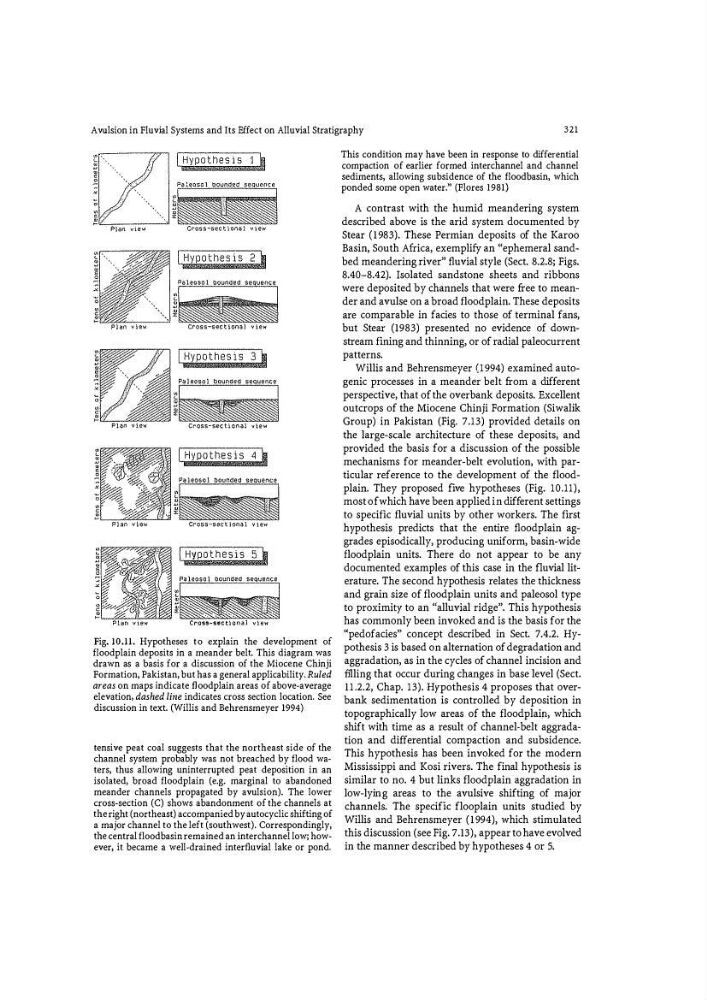
Fig. lO.ll. Hypotheses to explain the development of
floodplain deposits in a meander belt. This diagram was
drawn as a basis for a discussion of the Miocene Chinji
Formation, Pakistan, but has a general applicability. Ruled
areas on maps indicate floodplain areas of above�average
elevation, dashed line indicates cross section location. See
discussion in text. (Willis and Behrensmeyer 1994)
tensive peat coal suggests that the northeast side of the
channel system probably was not breached by flood wa�
ters, thus allowing uninterrupted peat deposition in an
isolated, broad floodplain (e.g. marginal to abandoned
meander channels propagated by avulsion). The lower
cross�section (C) shows abandonment of the channels at
the right (northeast) accompanied by autocyclic shifting of
a major channel to the left (southwest). Correspondingly,
the central floodbasin remained an interchannel low; how�
ever, it became a well¥drained interfluvial lake or pond.
This condition may have been in response to differential
compaction of earlier formed interchannel and channel
sediments, allowing subsidence of the floodbasin, which
ponded some open water." (Flores 1981}
A contrast with the humid meandering system
described above is the arid system documented by
Stear (1983). These Permian deposits of the Karoo
Basin, South Africa, exemplify an <'ephemeral sandbed meandering river" fluvial style (Sect. 8.2.8; Figs.
8.40-8.42). Isolated sandstone sheets and ribbons
were deposited by channels that were fr ee to meander and avulse on a broad floodplain. These deposits
are comparable in facies to those of terminal fans,
but Stear (1983) presented no evidence of downstream fining and thinning, or of radial paleocurrent
patterns.
Willis and Behrensmeyer (!994) examined autogenic processes in a meander belt fr om a different
perspective, that of the overbank deposits. Excellent
outcrops of the Miocene Chinji Formation (Siwalik
Group) in Pakistan (Fig. 7.!3) provided details on
the large-scale architecture of these deposits, and
provided the basis for a discussion of the possible
mechanisms for meander-belt evolution, with particular reference to the development of the floodplain. They proposed five hypotheses (Fig. !0.!!),
most of which have been applied in different settings
to specific fluvial units by other workers. The first
hypothesis predicts that the entire floodplain aggrades episodically, producing uniform, basin-wide
floodplain units. There do not appear to be any
documented examples of this case in the fluvial literature. The second hypothesis relates the thickness
and grain size of floodplain units and paleosol type
to proximity to an "alluvial ridge". This hypothesis
has commonly been invoked and is the basis for the
"pedofacies" concept described in Sect. 7.4.2. Hypothesis 3 is based on alternation of degradation and
aggradation, as in the cycles of channel incision and
fi lling that occur during changes in base level (Sect.
1!.2.2, Chap. !3). Hypothesis 4 proposes that overbank sedimentation is controlled by deposition in
topographically low areas of the floodplain, which
shift with time as a result of channel-belt aggradation and differential compaction and subsidence.
This hypothesis has been invoked for the modern
Mississippi and Kosi rivers. The final hypothesis is
similar to no. 4 but links floodplain aggradation in
low-lying areas to the avulsive shifting of major
channels. The specific flooplain units studied by
Willis and Behrensmeyer (1994), which stimulated
this discussion (see Fig. 7.13), appear to have evolved
in the manner described by hypotheses 4 or 5.
321
� � - - - . .
· · ·
·
··
·
� ····... . .
.
.
.::
' , :
::;
' '·.
-;; ': . ' ; - · · · .. ,
"' _,
'
·,
r:;
.
-
',
:; -
',
Plan view
I Hypoth,;;,;, s 1, D
I l;; YPOthes is a
��
Cross-sec tional view
I Hypothesis 5 p
j�
Cross�sec tional view
Fig. lO.ll. Hypotheses to explain the development of
floodplain deposits in a meander belt. This diagram was
drawn as a basis for a discussion of the Miocene Chinji
Formation, Pakistan, but has a general applicability. Ruled
areas on maps indicate floodplain areas of above�average
elevation, dashed line indicates cross section location. See
discussion in text. (Willis and Behrensmeyer 1994)
tensive peat coal suggests that the northeast side of the
channel system probably was not breached by flood wa�
ters, thus allowing uninterrupted peat deposition in an
isolated, broad floodplain (e.g. marginal to abandoned
meander channels propagated by avulsion). The lower
cross�section (C) shows abandonment of the channels at
the right (northeast) accompanied by autocyclic shifting of
a major channel to the left (southwest). Correspondingly,
the central floodbasin remained an interchannel low; how�
ever, it became a well¥drained interfluvial lake or pond.
This condition may have been in response to differential
compaction of earlier formed interchannel and channel
sediments, allowing subsidence of the floodbasin, which
ponded some open water." (Flores 1981}
A contrast with the humid meandering system
described above is the arid system documented by
Stear (1983). These Permian deposits of the Karoo
Basin, South Africa, exemplify an <'ephemeral sandbed meandering river" fluvial style (Sect. 8.2.8; Figs.
8.40-8.42). Isolated sandstone sheets and ribbons
were deposited by channels that were fr ee to meander and avulse on a broad floodplain. These deposits
are comparable in facies to those of terminal fans,
but Stear (1983) presented no evidence of downstream fining and thinning, or of radial paleocurrent
patterns.
Willis and Behrensmeyer (!994) examined autogenic processes in a meander belt fr om a different
perspective, that of the overbank deposits. Excellent
outcrops of the Miocene Chinji Formation (Siwalik
Group) in Pakistan (Fig. 7.!3) provided details on
the large-scale architecture of these deposits, and
provided the basis for a discussion of the possible
mechanisms for meander-belt evolution, with particular reference to the development of the floodplain. They proposed five hypotheses (Fig. !0.!!),
most of which have been applied in different settings
to specific fluvial units by other workers. The first
hypothesis predicts that the entire floodplain aggrades episodically, producing uniform, basin-wide
floodplain units. There do not appear to be any
documented examples of this case in the fluvial literature. The second hypothesis relates the thickness
and grain size of floodplain units and paleosol type
to proximity to an "alluvial ridge". This hypothesis
has commonly been invoked and is the basis for the
"pedofacies" concept described in Sect. 7.4.2. Hypothesis 3 is based on alternation of degradation and
aggradation, as in the cycles of channel incision and
fi lling that occur during changes in base level (Sect.
1!.2.2, Chap. !3). Hypothesis 4 proposes that overbank sedimentation is controlled by deposition in
topographically low areas of the floodplain, which
shift with time as a result of channel-belt aggradation and differential compaction and subsidence.
This hypothesis has been invoked for the modern
Mississippi and Kosi rivers. The final hypothesis is
similar to no. 4 but links floodplain aggradation in
low-lying areas to the avulsive shifting of major
channels. The specific flooplain units studied by
Willis and Behrensmeyer (1994), which stimulated
this discussion (see Fig. 7.13), appear to have evolved
in the manner described by hypotheses 4 or 5.