

Avulsion in Fluvial Systems and Its Effect on Alluvial Stratigraphy
3!9
steeper course along the Atchafalaya relative to the
main Mississippi, and it was estimated that once the
flow reached 40% of the total, complete diversion
would be accomplished rapidly. Large new deltaic
deposits developed very rapidly in the Gulf of Mexico
at the mouth of the river (Shlemon 1975). In 1963,
engineering control works were completed which
maintain the diversion at no more than 30% of MissiSsippi flow, and in this way New Orleans, one of the
great port cities of the United States, has been at least
temporarily saved fr om the fa te that befell Ur and
other ancient cities when their navigable waterways
were abandoned.
The development of crevasses in rivers such as the
Mississippi is not thought to lead to avulsion in the
normal tourse of events (Fisk 1952; Schumm 1977).
Crevasse splays may form (Sect. 7.2.3), but unless
there is a gradient away from the main channel there
is no force to drive the diversion further, and the
crevasse channel will simply become plugged with
sediment and abandoned. Only where the channel
--- - Stage 3
------ S tage 4
�M iss. R.
•······················
Atchafaloya R.
floor is aggraded by bedload sedimentation is there
likely to be a significant elevation diffe rence between the channel and its floodplain, providing a
force to drive flow diversion. However, this is an
important cause of diversion in some braided river
systems, as discussed in the next section.
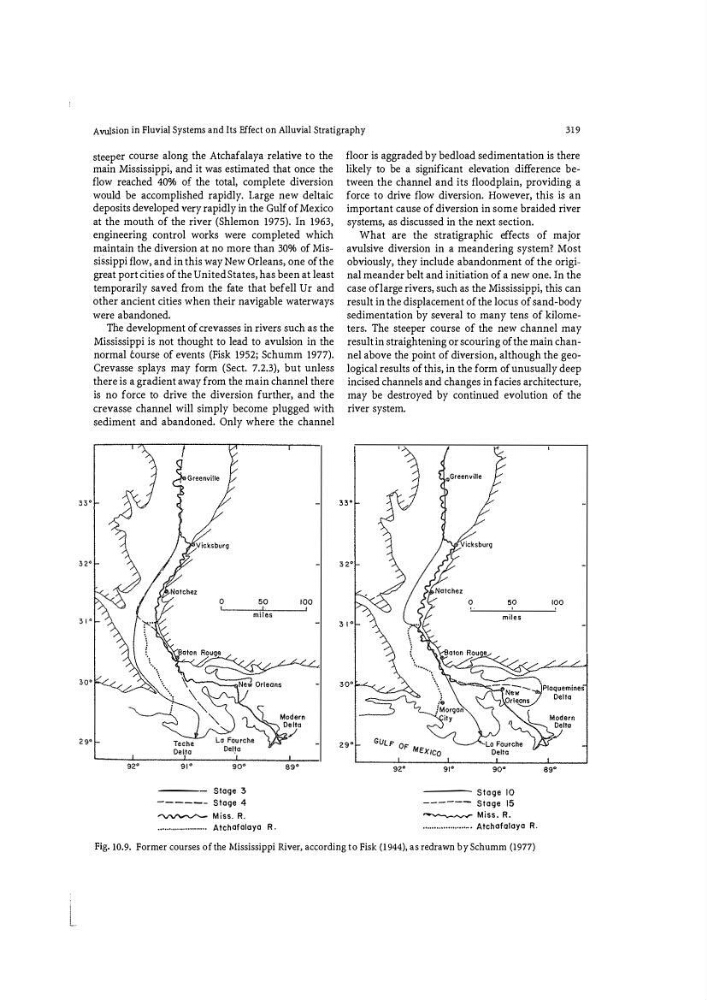
What are the stratigraphic effe cts of major
avulsive diversion in a meandering system? Most
obviously, they include abandonment of the original meander belt and initiation of a new one. In the
case oflarge rivers, such as the Mississippi, this can
result in the displacement of the locus of sand-body
sedimentation by several to many tens of kilometers. The steeper course of the new channel may
result in straightening or scouring of the main channel above the point of diversion, although the geological results of this, in the form of unusually deep
incised channels and changes in facies architecture,
may be destroyed by continued evolution of the
river system.
0Greenville
33"
0
50
100
miles
,.
2S"
92"
Sl"
so•
as•
---- Stage 10
------ Stage 15
�M lss. R.
. .................. -. Atchofaloya R.
Fig. 10.9. Former courses of the Mississippi River, according to Fisk (1944), as redrawn by Schumm (1977)
3!9
steeper course along the Atchafalaya relative to the
main Mississippi, and it was estimated that once the
flow reached 40% of the total, complete diversion
would be accomplished rapidly. Large new deltaic
deposits developed very rapidly in the Gulf of Mexico
at the mouth of the river (Shlemon 1975). In 1963,
engineering control works were completed which
maintain the diversion at no more than 30% of MissiSsippi flow, and in this way New Orleans, one of the
great port cities of the United States, has been at least
temporarily saved fr om the fa te that befell Ur and
other ancient cities when their navigable waterways
were abandoned.
The development of crevasses in rivers such as the
Mississippi is not thought to lead to avulsion in the
normal tourse of events (Fisk 1952; Schumm 1977).
Crevasse splays may form (Sect. 7.2.3), but unless
there is a gradient away from the main channel there
is no force to drive the diversion further, and the
crevasse channel will simply become plugged with
sediment and abandoned. Only where the channel
--- - Stage 3
------ S tage 4
�M iss. R.
•······················
Atchafaloya R.
floor is aggraded by bedload sedimentation is there
likely to be a significant elevation diffe rence between the channel and its floodplain, providing a
force to drive flow diversion. However, this is an
important cause of diversion in some braided river
systems, as discussed in the next section.
What are the stratigraphic effe cts of major
avulsive diversion in a meandering system? Most
obviously, they include abandonment of the original meander belt and initiation of a new one. In the
case oflarge rivers, such as the Mississippi, this can
result in the displacement of the locus of sand-body
sedimentation by several to many tens of kilometers. The steeper course of the new channel may
result in straightening or scouring of the main channel above the point of diversion, although the geological results of this, in the form of unusually deep
incised channels and changes in facies architecture,
may be destroyed by continued evolution of the
river system.
0Greenville
33"
0
50
100
miles
,.
2S"
92"
Sl"
so•
as•
---- Stage 10
------ Stage 15
�M lss. R.
. .................. -. Atchofaloya R.
Fig. 10.9. Former courses of the Mississippi River, according to Fisk (1944), as redrawn by Schumm (1977)