

308
The Stratigraphic Architecture of Fluvial Depositional Systems
A
fJ. �'£5:1 BROWN i;lll
���� �� �� GRAY SilT
[::J SANOY fACIES
- PEORIA lOfSS
I •. ' '
' .\ PRAUUE COMPtEX
---.... .. . ���J :��MATION
BOUNDARY
apply. Groups 1-7, bounded by surfaces offirst- to
fifth�order rank, represent the smaller-scale stratigraphic features, not shown in Fig. 9.73. Sequence
stratigraphy focuses on the larger-scale features of
this subdivision and interprets them in a genetic
context, as discussed in Chap. 11.
Several groups of workers are now explicitly employing an allostratigraphic methodology. Walker
and james (1992) recommended the general use of
allostratigraphic methods in stratigraphic and facies
studies. A few examples of the application of the
technique to fluvial and deltaic deposits are now
available. For example, Bhattacharya (1991) subdivided the deltaic Dunvegan Formation of west-central Alberta into a series of allomembers using
mappable fl ooding surfaces (Fig. 9.17). Autin (1992)
subdivided the postglacial terraces and associated
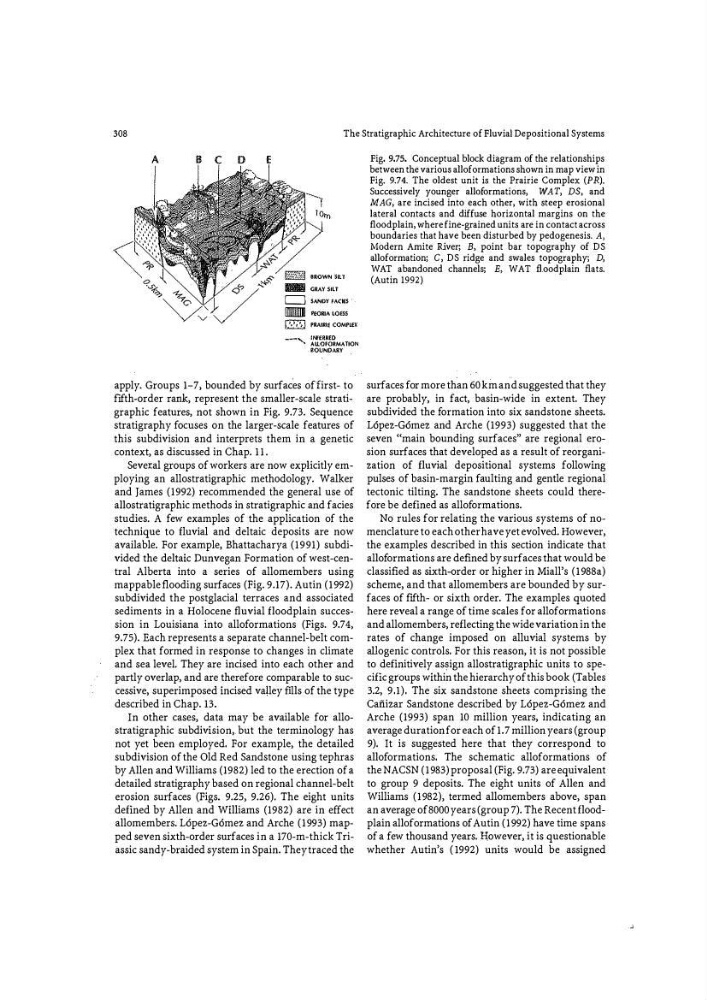
sediments in a Holocene fluvial floodplain succession in Louisiana into alloformations (Figs. 9.74,
9.75). Each represents a separate channel-belt complex that formed in response to changes in climate
and sea level. They are incised into each other and
partly overlap, and are therefore comparable to successive, superimposed incised valley fi lls of the type
described in Chap. 13.
In other cases, data may be available for allostratigraphic subdivision,. but the terminology has
not yet been employed. For example, the detailed
subdivision of the Old Red Sandstone using tephras
by Allen and Williams (1982) led to the erection of a
detailed stratigraphy based on regional channel-belt
erosion surfaces (Figs. 9.25, 9.26). The eight units
defined by Allen and Williams (1982) are in effect
allomembers. L6pez-G6mez and Arche (1993) mapped seven sixth-order surfaces in a 170-m-thick Triassic sandy-braided system in Spain. They traced the
Fig. 9.75. Conceptual block diagram of the relationships
between the various alloformations shown in map view in
Fig. 9.74. The oldest unit is the Prairie Complex (PR).
Successively younger alloformations, WA T, DS, and
MAG, are incised into each other, with steep erosional
lateral contacts and diffuse horizontal margins on the
floodplain, where fine-grained units are in contact across
boundaries that have been disturbed by pedogenesis. A,
Modern Amite River; B, point bar topography of DS
alloformation; C, DS ridge and swales topography; D,
WAT abandoned channels; E, WAT floodplain flats.
(Autin 1992)
surfaces for more than 60 km and suggested that they
are probably, in fact, basin-wide in extent. They
subdivided the fo rmation into six sandstone sheets.
L6pez-G6mez and Arche (1993) suggested that the
seven < pulses of basin-margin faulting and gentle regional
tectonic tilting. The sandstone sheets could therefore be defined as alloformations.
No rules for relating the various systems of nomenclature to each other have yet evolved. However,
the examples described in this section indicate that
alloformations are defined by surfaces that would be
classified as sixth-order or higher in Miall's (1988a)
scheme, and that allomembers are bounded by surfaces of fifth- or sixth order. The examples quoted
here reveal a range of time scales for alloformations
and allomembers, reflecting the wide variation in the
rates of change imposed on alluvial systems by
all ogenic controls. For this reason, it is not possible
to definitively as�ign allostratigraphic units to specific groups within the hierarchy of this book (Tables
3.2, 9.1). The six sandstone sheets comprising the
Caiiizar Sandstone described by L6pez-G6mez and
Arche ( 1993) span 10 million years, indicating an
average duration for each of 1.7 million years (group
9). It is suggested here that they correspond to
alloformations. The schematic alloformations of
the NACSN (1983) proposal (Fig. 9.73) are equivalent
to group 9 deposits. The eight units of Allen and
Williams (1982), termed allomembers above, span
an average of 8000 years (group 7). The Recent floodplain alloformations of Autin (1992) have time spans
of a few thousand years. H;owever, it is questionable
whether Autin's (1992) units would be assigned
The Stratigraphic Architecture of Fluvial Depositional Systems
A
fJ. �'£5:1 BROWN i;lll
���� �� �� GRAY SilT
[::J SANOY fACIES
- PEORIA lOfSS
I •. ' '
' .\ PRAUUE COMPtEX
---.... .. . ���J :��MATION
BOUNDARY
apply. Groups 1-7, bounded by surfaces offirst- to
fifth�order rank, represent the smaller-scale stratigraphic features, not shown in Fig. 9.73. Sequence
stratigraphy focuses on the larger-scale features of
this subdivision and interprets them in a genetic
context, as discussed in Chap. 11.
Several groups of workers are now explicitly employing an allostratigraphic methodology. Walker
and james (1992) recommended the general use of
allostratigraphic methods in stratigraphic and facies
studies. A few examples of the application of the
technique to fluvial and deltaic deposits are now
available. For example, Bhattacharya (1991) subdivided the deltaic Dunvegan Formation of west-central Alberta into a series of allomembers using
mappable fl ooding surfaces (Fig. 9.17). Autin (1992)
subdivided the postglacial terraces and associated
sediments in a Holocene fluvial floodplain succession in Louisiana into alloformations (Figs. 9.74,
9.75). Each represents a separate channel-belt complex that formed in response to changes in climate
and sea level. They are incised into each other and
partly overlap, and are therefore comparable to successive, superimposed incised valley fi lls of the type
described in Chap. 13.
In other cases, data may be available for allostratigraphic subdivision,. but the terminology has
not yet been employed. For example, the detailed
subdivision of the Old Red Sandstone using tephras
by Allen and Williams (1982) led to the erection of a
detailed stratigraphy based on regional channel-belt
erosion surfaces (Figs. 9.25, 9.26). The eight units
defined by Allen and Williams (1982) are in effect
allomembers. L6pez-G6mez and Arche (1993) mapped seven sixth-order surfaces in a 170-m-thick Triassic sandy-braided system in Spain. They traced the
Fig. 9.75. Conceptual block diagram of the relationships
between the various alloformations shown in map view in
Fig. 9.74. The oldest unit is the Prairie Complex (PR).
Successively younger alloformations, WA T, DS, and
MAG, are incised into each other, with steep erosional
lateral contacts and diffuse horizontal margins on the
floodplain, where fine-grained units are in contact across
boundaries that have been disturbed by pedogenesis. A,
Modern Amite River; B, point bar topography of DS
alloformation; C, DS ridge and swales topography; D,
WAT abandoned channels; E, WAT floodplain flats.
(Autin 1992)
surfaces for more than 60 km and suggested that they
are probably, in fact, basin-wide in extent. They
subdivided the fo rmation into six sandstone sheets.
L6pez-G6mez and Arche (1993) suggested that the
seven < pulses of basin-margin faulting and gentle regional
tectonic tilting. The sandstone sheets could therefore be defined as alloformations.
No rules for relating the various systems of nomenclature to each other have yet evolved. However,
the examples described in this section indicate that
alloformations are defined by surfaces that would be
classified as sixth-order or higher in Miall's (1988a)
scheme, and that allomembers are bounded by surfaces of fifth- or sixth order. The examples quoted
here reveal a range of time scales for alloformations
and allomembers, reflecting the wide variation in the
rates of change imposed on alluvial systems by
all ogenic controls. For this reason, it is not possible
to definitively as�ign allostratigraphic units to specific groups within the hierarchy of this book (Tables
3.2, 9.1). The six sandstone sheets comprising the
Caiiizar Sandstone described by L6pez-G6mez and
Arche ( 1993) span 10 million years, indicating an
average duration for each of 1.7 million years (group
9). It is suggested here that they correspond to
alloformations. The schematic alloformations of
the NACSN (1983) proposal (Fig. 9.73) are equivalent
to group 9 deposits. The eight units of Allen and
Williams (1982), termed allomembers above, span
an average of 8000 years (group 7). The Recent floodplain alloformations of Autin (1992) have time spans
of a few thousand years. H;owever, it is questionable
whether Autin's (1992) units would be assigned