

288
The Stratigraphic Architecture of Fluvial Depositional Systems
w
t
§
·3�00 ----+- -- -- -- -- -- -- -- --t- -- -- - ·-0
�
A -lG�o �--- -- -- -- -- -- -- -- -- -- -- -- - ·><�
B
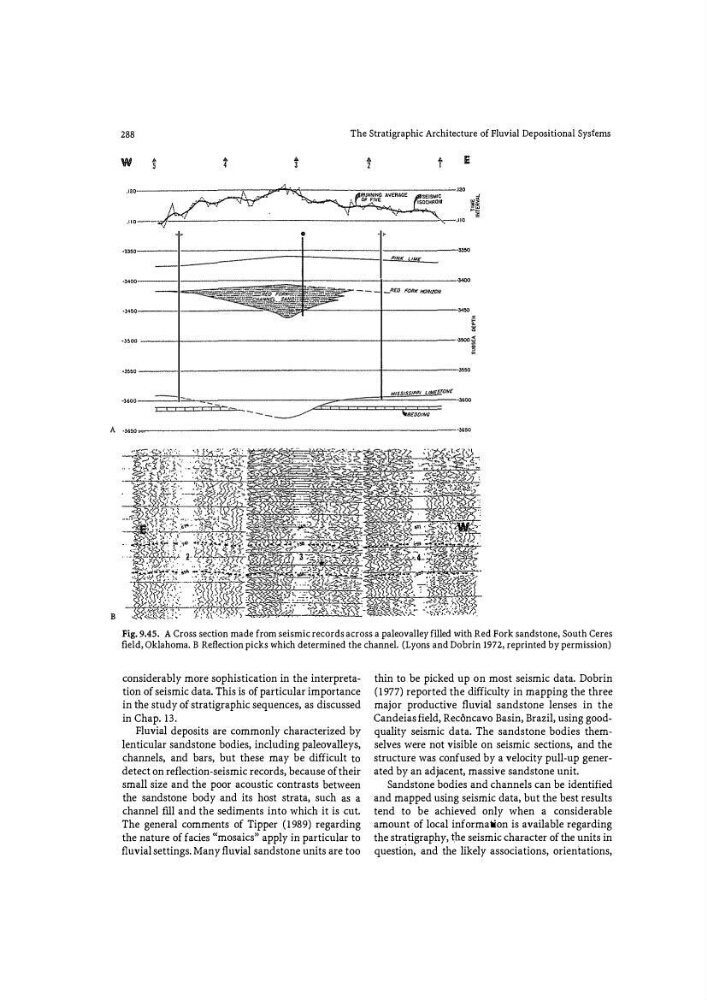
Fig. 9.45. A Cross section made from seismic records across a paleovalley fllled with Red Fork sandstone, South Ceres
field, Oklahoma. B Reflection picks which determined the channeL (Lyons and Dobrin 1972, reprinted by permission)
considerably more sophistication in the interpretation of seismic data. This is of particular importance
in the study of stratigraphic sequences, as discussed
in Chap. 13.
Fluvial deposits are commonly characterized by
lenticular sandstone bodies, including paleovalleys,
channels, and bars, but these may be difficult to
detect on reflection-seismic records, because of their
small size and the poor acoustic contrasts between
the sandstone body and its host strata, such as a
channel fill and the sediments into which it is cut.
The general comments of Tipper (1989) regarding
the nature of facies "mosaics )) apply in particular to
fluvial settings. Many fluvial sandstone units are too
thin to be picked up on most seismic data. Dobrin
(1977) reported the difficulty in mapping the three
major productive fl uvial sandstone lenses in the
Candeias field, RecOncavo Basin, Brazil, using good�
quality seismic data. The sandstone bodies themselves were not visible on seismic sections, and the
structure was confused by a velocity pull-up generated by an adjacent, massive sandstone unit.
Sandstone bodies and channels can be identified
and mapped using seismic data, but the best results
tend to be achieved only when a considerable
amount of local information is available regarding
the stratigraphy, t;he seismic character of the units in
questiOn, and the likely associations, orientations,
The Stratigraphic Architecture of Fluvial Depositional Systems
w
t
§
·3�00 ----+- -- -- -- -- -- -- -- --t- -- -- - ·-0
�
A -lG�o �--- -- -- -- -- -- -- -- -- -- -- -- - ·><�
B
Fig. 9.45. A Cross section made from seismic records across a paleovalley fllled with Red Fork sandstone, South Ceres
field, Oklahoma. B Reflection picks which determined the channeL (Lyons and Dobrin 1972, reprinted by permission)
considerably more sophistication in the interpretation of seismic data. This is of particular importance
in the study of stratigraphic sequences, as discussed
in Chap. 13.
Fluvial deposits are commonly characterized by
lenticular sandstone bodies, including paleovalleys,
channels, and bars, but these may be difficult to
detect on reflection-seismic records, because of their
small size and the poor acoustic contrasts between
the sandstone body and its host strata, such as a
channel fill and the sediments into which it is cut.
The general comments of Tipper (1989) regarding
the nature of facies "mosaics )) apply in particular to
fluvial settings. Many fluvial sandstone units are too
thin to be picked up on most seismic data. Dobrin
(1977) reported the difficulty in mapping the three
major productive fl uvial sandstone lenses in the
Candeias field, RecOncavo Basin, Brazil, using good�
quality seismic data. The sandstone bodies themselves were not visible on seismic sections, and the
structure was confused by a velocity pull-up generated by an adjacent, massive sandstone unit.
Sandstone bodies and channels can be identified
and mapped using seismic data, but the best results
tend to be achieved only when a considerable
amount of local information is available regarding
the stratigraphy, t;he seismic character of the units in
questiOn, and the likely associations, orientations,