

Depositional Systems
261
a
b
m l
m
450
1100
l
H
l
1000
l
BUNDLE
t
400
J
G
900
l
1
F
800
I
E
MEGA-CYCLE A
I
350
I
p
600
l
c
300
500
l
t 8
400
j A
250
300
!
0
5
10
m
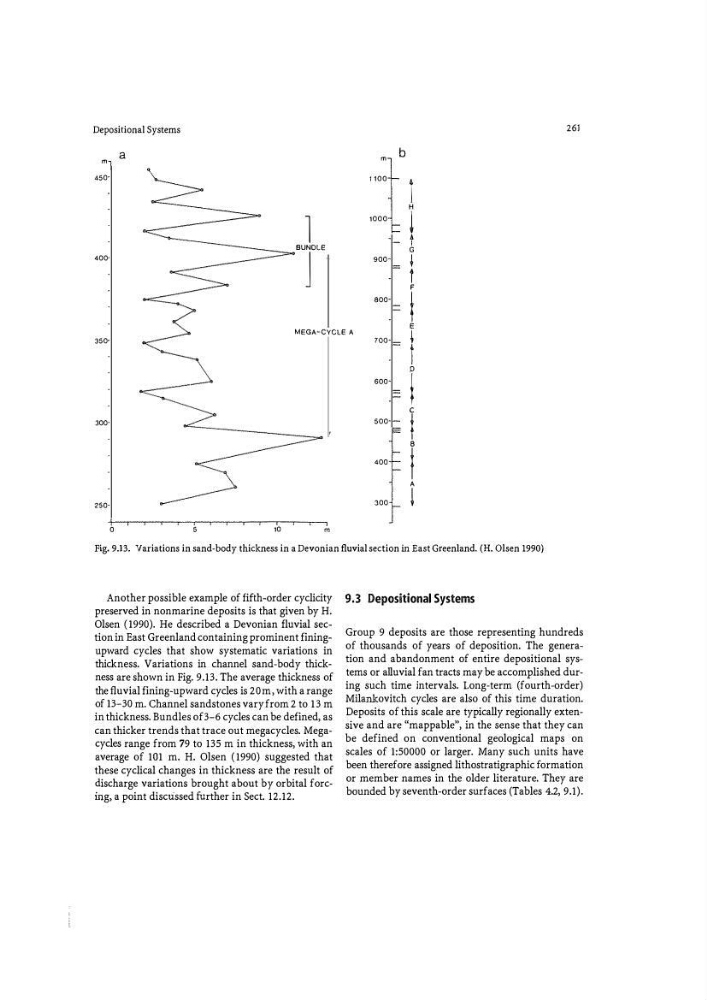
Fig. 9.13. Variations in sand-body thickness in a Devonian fluvial section in East Greenland. (H. Olsen 1990)
Another possible example of fifth-order cyclicity
preserved in nonmarine deposits is that given by H.
Olsen (1990). He described a Devonian fluvial section in East Greenland containing prominent finingupward cycles that show systematic variations in
thickness. Variations in channel sand-body thickness are shown in Fig. 9.13. The average thickness of
the fluvial fining-upward cycles is 20m, with a range
of 13-30 m. Channel sandstones vary from 2 to 13 m
in thickness. Bundles of3-6 cycles can be defined, as
can thicker trends that trace out megacycles. Megacycles range from 79 to 135 m in thickness, with an
average of 101 m. H. Olsen (1990) suggested that
these cyclical changes in thickness are the result of
�ischarge variations brought about by orbital forcmg, a point discUssed further in Sect. 12.12.
9.3 Depositional Systems
Group 9 deposits are those representing hundreds
of thousands of years of deposition. The generation and abandonment of entire depositional systems or alluvial fan tracts may be accomplished during such time intervals. Long-term (fourth-order)
Milanlc.ovitch cycles are also of this time duration.
Deposits of this scale are typically regionally extensive and are "mappable", in the sense that they can
be defined on conventional geological maps on
scales of 1:50000 or larger. Many such units have
been therefore assigned lithostratigraphic fo rmation
or member names in the older literature. They are
bounded by seventh-order surfaces (Tables 4.2, 9.1).
261
a
b
m l
m
450
1100
l
H
l
1000
l
BUNDLE
t
400
J
G
900
l
1
F
800
I
E
MEGA-CYCLE A
I
350
I
p
600
l
c
300
500
l
t 8
400
j A
250
300
!
0
5
10
m
Fig. 9.13. Variations in sand-body thickness in a Devonian fluvial section in East Greenland. (H. Olsen 1990)
Another possible example of fifth-order cyclicity
preserved in nonmarine deposits is that given by H.
Olsen (1990). He described a Devonian fluvial section in East Greenland containing prominent finingupward cycles that show systematic variations in
thickness. Variations in channel sand-body thickness are shown in Fig. 9.13. The average thickness of
the fluvial fining-upward cycles is 20m, with a range
of 13-30 m. Channel sandstones vary from 2 to 13 m
in thickness. Bundles of3-6 cycles can be defined, as
can thicker trends that trace out megacycles. Megacycles range from 79 to 135 m in thickness, with an
average of 101 m. H. Olsen (1990) suggested that
these cyclical changes in thickness are the result of
�ischarge variations brought about by orbital forcmg, a point discUssed further in Sect. 12.12.
9.3 Depositional Systems
Group 9 deposits are those representing hundreds
of thousands of years of deposition. The generation and abandonment of entire depositional systems or alluvial fan tracts may be accomplished during such time intervals. Long-term (fourth-order)
Milanlc.ovitch cycles are also of this time duration.
Deposits of this scale are typically regionally extensive and are "mappable", in the sense that they can
be defined on conventional geological maps on
scales of 1:50000 or larger. Many such units have
been therefore assigned lithostratigraphic fo rmation
or member names in the older literature. They are
bounded by seventh-order surfaces (Tables 4.2, 9.1).