

Chan nel Belts
dreds of meters. The examples illustrated in Fig. 9.9
are upward coarsening in type. Those in Fig. 9.10 are
upward fining. They are bounded at the base by erosion surfaces with up to several meters of relief. The
top of each sequence may be marked by a thick siltstone unit several meters thick, which may contain
pedogenic features.
Thicker successions, termed megasequences by
H eward (!978a), are also common in alluvial fan
deposits. Figure 9.9 shows that the entire succession
of the Hjortestegvatnet fan in Norway constitutes a
megasequence 250 m thick, which coarsens upwards
through the first 200 m of the section and then fines
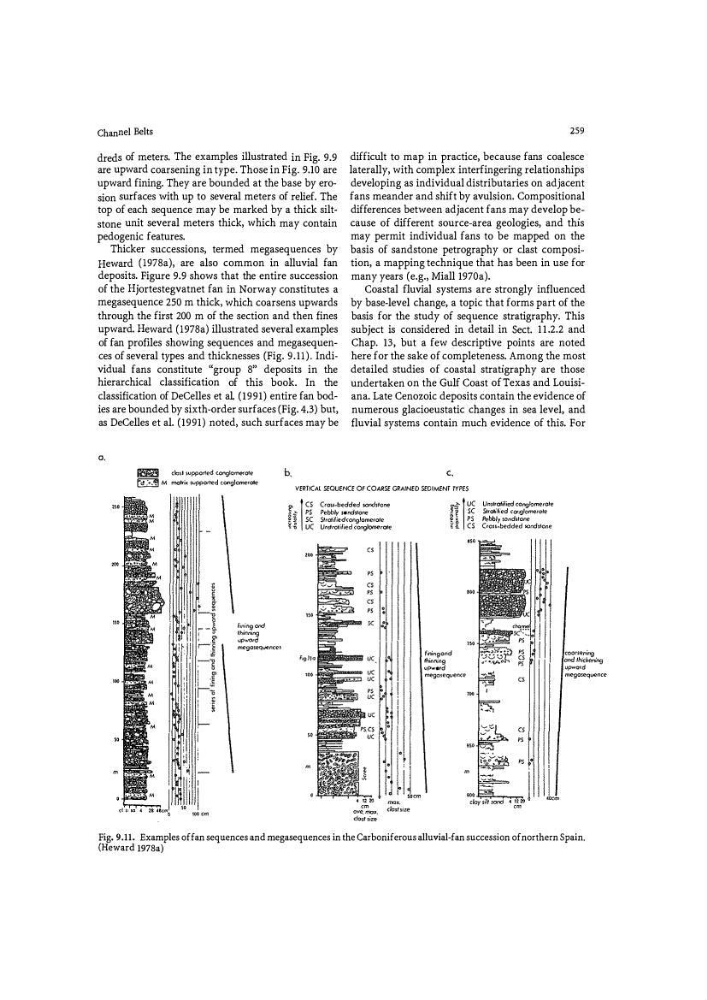
upward. Heward (!978a) illustrated several examples
of fan profiles showing sequences and megasequences of several types and thicknesses (Fig. 9.1!). Individual fans constitute "group 8" deposits in the
hierarchical classification of this book. In the
classification of DeCelles et al. (1991) entire fan bodies are bounded by sixth-order surfaces (Fig. 4.3) but,
as DeCelles et al. (1991) noted, such surfaces may be
a.
259
difficult to map in practice, because fans coalesce
laterally, with complex interfingering relationships
developing as individual distributaries on adjacent
fans meander and shift by avulsion. Compositional
differences between adjacent fans may develop because of different source-area geologies, and this
may permit individual fans to be mapped on the
basis of sandstone petrography or clast composition, a mapping technique that has been in use for
many years (e.g., Miall 1970a).
Coastal fluvial systems are strongly influenced
by base-level change, a topic that forms part of the
basis for the study of sequence stratigraphy. This
subject is considered in detail in Sect. 11.2.2 and
Chap. 13, but a few descriptive points are noted
here for the sake of completeness. Among the most
detailed studies of coastal stratigraphy are those
undertaken on the Gulf Coast of Texas and Louisiana. Late Cenozoic deposits contain the evidence of
numerous glacioeustatic changes in sea level, and
fluvial systems contain much evidence of this. For
6m dmt 1upported eongiQme
VERTICAl SEQUENCE OF COARSE GRAINED SEDIMENT TYPE$
lot>ing ond
thinning
''""'"'
megose
' � � PS Pebbly sandstone
� 'l! SC StroMied(onglomerote
� .S UC Umlrolilied congl0 'I UC UMtrolilicd conglom�uole
Ff SC Slroti�'ed conglomemte
� � PS Pebbly sandstone
S g_ CS CroH-bedded sorldstone
finingond
thinning
upward
megmeqvencc;
I
mc;gosequence
Fig. 9.11. Examples of fan sequences and megasequences in the Carboniferous alluvial-fan succession of northern Spain.
(Heward 1978a)
dreds of meters. The examples illustrated in Fig. 9.9
are upward coarsening in type. Those in Fig. 9.10 are
upward fining. They are bounded at the base by erosion surfaces with up to several meters of relief. The
top of each sequence may be marked by a thick siltstone unit several meters thick, which may contain
pedogenic features.
Thicker successions, termed megasequences by
H eward (!978a), are also common in alluvial fan
deposits. Figure 9.9 shows that the entire succession
of the Hjortestegvatnet fan in Norway constitutes a
megasequence 250 m thick, which coarsens upwards
through the first 200 m of the section and then fines
upward. Heward (!978a) illustrated several examples
of fan profiles showing sequences and megasequences of several types and thicknesses (Fig. 9.1!). Individual fans constitute "group 8" deposits in the
hierarchical classification of this book. In the
classification of DeCelles et al. (1991) entire fan bodies are bounded by sixth-order surfaces (Fig. 4.3) but,
as DeCelles et al. (1991) noted, such surfaces may be
a.
259
difficult to map in practice, because fans coalesce
laterally, with complex interfingering relationships
developing as individual distributaries on adjacent
fans meander and shift by avulsion. Compositional
differences between adjacent fans may develop because of different source-area geologies, and this
may permit individual fans to be mapped on the
basis of sandstone petrography or clast composition, a mapping technique that has been in use for
many years (e.g., Miall 1970a).
Coastal fluvial systems are strongly influenced
by base-level change, a topic that forms part of the
basis for the study of sequence stratigraphy. This
subject is considered in detail in Sect. 11.2.2 and
Chap. 13, but a few descriptive points are noted
here for the sake of completeness. Among the most
detailed studies of coastal stratigraphy are those
undertaken on the Gulf Coast of Texas and Louisiana. Late Cenozoic deposits contain the evidence of
numerous glacioeustatic changes in sea level, and
fluvial systems contain much evidence of this. For
6m dmt 1upported eongiQme
VERTICAl SEQUENCE OF COARSE GRAINED SEDIMENT TYPE$
lot>ing ond
thinning
''""'"'
megose
' � � PS Pebbly sandstone
� 'l! SC StroMied(onglomerote
� .S UC Umlrolilied congl0 'I UC UMtrolilicd conglom�uole
Ff SC Slroti�'ed conglomemte
� � PS Pebbly sandstone
S g_ CS CroH-bedded sorldstone
finingond
thinning
upward
megmeqvencc;
I
mc;gosequence
Fig. 9.11. Examples of fan sequences and megasequences in the Carboniferous alluvial-fan succession of northern Spain.
(Heward 1978a)