

258
The Stratigraphic Architecture of Fluvial Depositional Systems
r.:.<· . .':' l SHEET Flr:C.:D AND STREAM OEPOSilS
E FtoooaASIN OEPosns
I
� riJORTESTEGVAINET FAN
� f'LOODSASIN I OEPOSIIS
( [l Eill FlUVIAl
AXIAL SYSTEM
ITilli iil l STREAM CHANNEl OEPOSilS
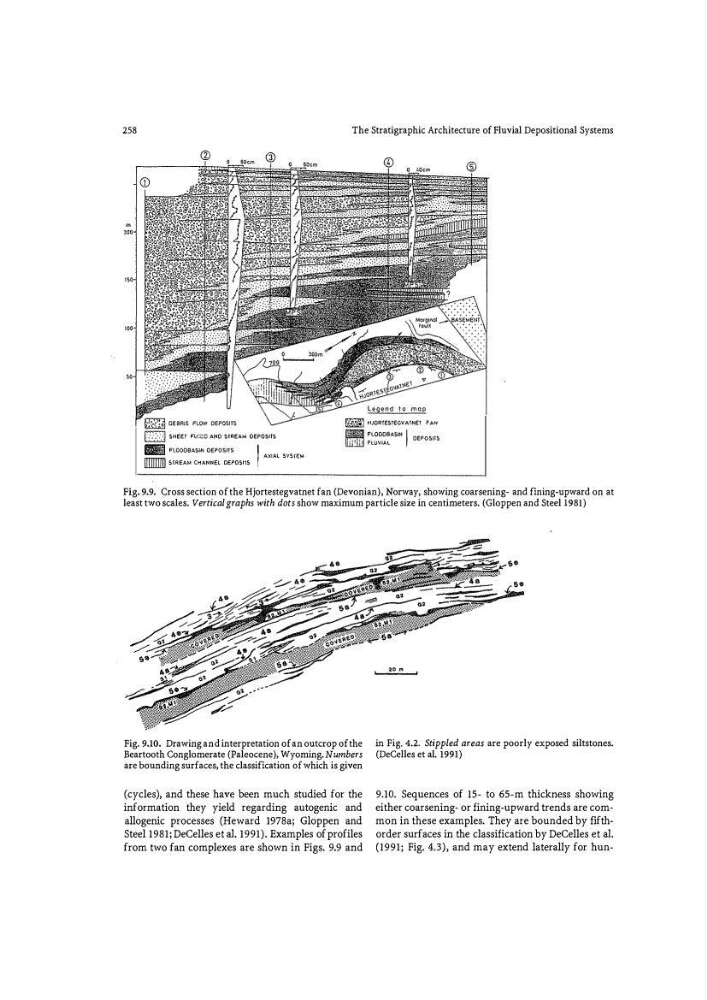
Fig. 9.9. Cross section of the Hjortestegvatnet fan (Devonian), Norway, showing coarsening- and fining-upward on at
least two scales. Vertical graphs with dots show maximum particle size in centimeters. (Gloppen and Steel l981)
Fig. 9.10. Drawing and interpretation of an outcrop of the
Beartooth Conglomerate (Paleocene), Wyoming. Numbers
are bounding surfaces, the classification of which is given
(cycles), and these have been much studied for the
information they yield regarding autogenic and
allogenic processes (Heward 1978a; Gloppen and
Steel 1981; DeCelles et al. 1991). Examples of profiles
from two fan complexes are shown in Figs. 9.9 and
in Fig. 4.2. Stippled areas are poorly exposed siltstones.
(DeCelles et al. 1991)
9.10. Sequences of 15- to 65-m thickness showing
either coarsening� or fining-upward trends are common in these examples. They are bounded by fifthorder surfaces in the classification by DeCelles et al.
(1991; Fig. 4.3), and may extend laterally for hun-
The Stratigraphic Architecture of Fluvial Depositional Systems
r.:.<· . .':' l SHEET Flr:C.:D AND STREAM OEPOSilS
E FtoooaASIN OEPosns
I
� riJORTESTEGVAINET FAN
� f'LOODSASIN I OEPOSIIS
( [l Eill FlUVIAl
AXIAL SYSTEM
ITilli iil l STREAM CHANNEl OEPOSilS
Fig. 9.9. Cross section of the Hjortestegvatnet fan (Devonian), Norway, showing coarsening- and fining-upward on at
least two scales. Vertical graphs with dots show maximum particle size in centimeters. (Gloppen and Steel l981)
Fig. 9.10. Drawing and interpretation of an outcrop of the
Beartooth Conglomerate (Paleocene), Wyoming. Numbers
are bounding surfaces, the classification of which is given
(cycles), and these have been much studied for the
information they yield regarding autogenic and
allogenic processes (Heward 1978a; Gloppen and
Steel 1981; DeCelles et al. 1991). Examples of profiles
from two fan complexes are shown in Figs. 9.9 and
in Fig. 4.2. Stippled areas are poorly exposed siltstones.
(DeCelles et al. 1991)
9.10. Sequences of 15- to 65-m thickness showing
either coarsening� or fining-upward trends are common in these examples. They are bounded by fifthorder surfaces in the classification by DeCelles et al.
(1991; Fig. 4.3), and may extend laterally for hun-