

Alluvial Fans and Other Fluvial Distributary Systems
(;
\�.
� Feecte•
c::: :: :: :: :J channel
� Oistrlbulary
c::: ::J ch�nnel
§Sheet flood
249
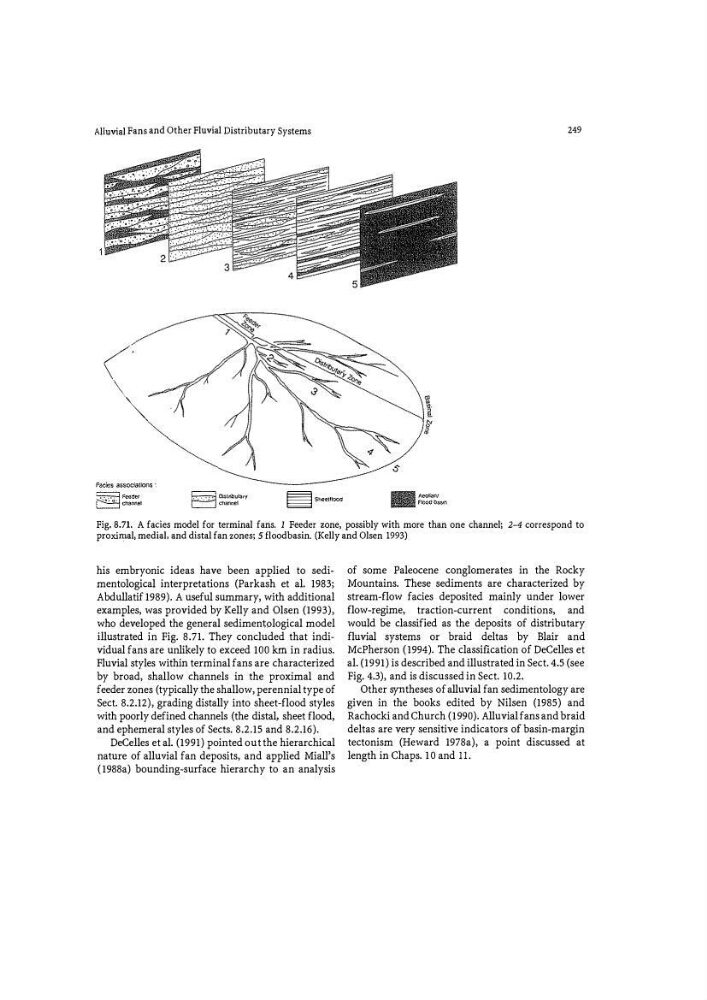
Fig. 8.71. A fades model for terminal fans. 1 Feeder zone, possibly with more than one channel; 2-4 correspond to
proxi�al, medial, and distal fan zones; 5 floodbasin. (Kelly and Olsen 1993)
his embryonic ideas have been applied to sedi�
mentological interpretations (Parkash et al. 1983;
Abdullatif 1989). A useful summary, with additional
examples, was provided by Kelly and Olsen (1993),
who developed the general sedimen!ological model
illustrated in Fig. 8.71. They concluded that individual fans are unlikely to exceed 100 km in radius.
Fluvial styles within terminal fans are characterized
by broad, shallow channels in the proximal and
feeder zones (typically the shallow, perennial type of
Sect. 8.2.12), grading distally into sheet-flood styles
with poorly defined channels (the distal, sheet flood,
and ephemeral styles of Sects. 8.2.15 and 8.2.16).
DeCelles et al. (1991) pointed out the hierarchical
nature of alluvial fan deposits, and applied Miall's
(1988a) bounding-surface hierarchy to an analysis
of some Paleocene conglomerates in the Rocky
Mountains. These sediments are characterized by
stream-flow facies deposited mainly under lower
flow-regime, traction-current conditions, and
would be classified as the deposits of distributary
fluvial systems or brald deltas by Blair and
McPherson (1994). The classification of DeCelles et
al. (1991) is described and illustrated in Sect. 4.5 (see
Fig. 4.3), and is discussed in Sect. 10.2.
Other syntheses of alluvial fan sedimentology are
given in the books edited by Nilsen (1985) and
Rachocki and Church (1990). Alluvial fans and braid
deltas are very sensitive indicators of basin-margin
tectonism (Heward 1978a), a point discussed at
length in Chaps. 10 and II.
(;
\�.
� Feecte•
c::: :: :: :: :J channel
� Oistrlbulary
c::: ::J ch�nnel
§Sheet flood
249
Fig. 8.71. A fades model for terminal fans. 1 Feeder zone, possibly with more than one channel; 2-4 correspond to
proxi�al, medial, and distal fan zones; 5 floodbasin. (Kelly and Olsen 1993)
his embryonic ideas have been applied to sedi�
mentological interpretations (Parkash et al. 1983;
Abdullatif 1989). A useful summary, with additional
examples, was provided by Kelly and Olsen (1993),
who developed the general sedimen!ological model
illustrated in Fig. 8.71. They concluded that individual fans are unlikely to exceed 100 km in radius.
Fluvial styles within terminal fans are characterized
by broad, shallow channels in the proximal and
feeder zones (typically the shallow, perennial type of
Sect. 8.2.12), grading distally into sheet-flood styles
with poorly defined channels (the distal, sheet flood,
and ephemeral styles of Sects. 8.2.15 and 8.2.16).
DeCelles et al. (1991) pointed out the hierarchical
nature of alluvial fan deposits, and applied Miall's
(1988a) bounding-surface hierarchy to an analysis
of some Paleocene conglomerates in the Rocky
Mountains. These sediments are characterized by
stream-flow facies deposited mainly under lower
flow-regime, traction-current conditions, and
would be classified as the deposits of distributary
fluvial systems or brald deltas by Blair and
McPherson (1994). The classification of DeCelles et
al. (1991) is described and illustrated in Sect. 4.5 (see
Fig. 4.3), and is discussed in Sect. 10.2.
Other syntheses of alluvial fan sedimentology are
given in the books edited by Nilsen (1985) and
Rachocki and Church (1990). Alluvial fans and braid
deltas are very sensitive indicators of basin-margin
tectonism (Heward 1978a), a point discussed at
length in Chaps. 10 and II.