

Alluvial Fans and Other Fluvial Distributary Systems
type are those constructed mainly of sediment gravity-flow deposits, together with colluvial slides,
bedrock slides, rock avalanches, and rockfalls.
Sandy interbeds are not common. Secondary processes, including overbank sheet flow, wind erosion,
weathering, bioturbation, soil development, and
case hardening are common. The second variety is
built primarily of sheet flow, and hyperconcentrated
flow deposits. Sandy overbank deposits are common, and a distal sand fringe may also be present.
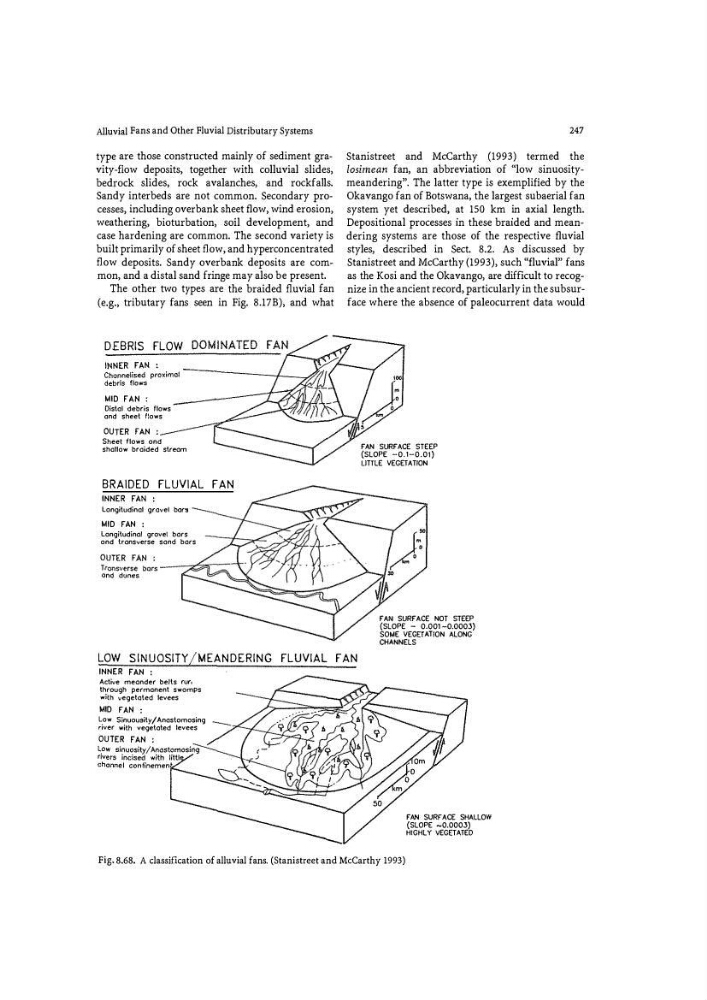
The other two types are the braided fluvial fan
(e.g., tributary fans seen in Fig. 8.17B), and what
DEBRIS FLOW
MID FAN '
Distal debris flows
and sheet f:ows
OUTER fAN '
Sheet flows ond
shallow braided stream
BRAIDED FLUVIAL FAN
INNER FAN :
longitudinal grave! bars
MID FAN :
longitudinal grove! bars
ond transverse sand bars
247
Stanistreet and McCarthy (1993) termed the
losimean fan, an abbreviation of "low sinuositymeandering". The latter type is exemplified by the
Okavango fan of Botswana, the largest subaerial fan
system yet described, at 150 km in axial length.
Depositional processes in these braided and meandering systems are those of the respective fluvial
styles, described in Sect. 8.2. As discussed by
Stanistreet and McCarthy (1993), such "fluvial" fans
as the Kosi and the Okavango, are difficult to recognize in the ancient record, particularly in the subsurface where the absence of paleocurrent data would
FAN SURFACE STEEP
(SLOPE -0.1-0.01)
UTILE VEGETATION
FAN SURFACE NOT STEEP
(SLOPE - 0.001 -0.0003)
SOME VEGETATION ALONG
CHANNELS
LOW SINUOSITY /MEANDERING FLUVIAL FAN
INNER FAN :
Active meander belts rur.
through permanent swomps
with vegetated levees
MID FAN :
Low Sinuousity /Anastomosing
river with vegetated levees
OUTER FAN '
Fig. 8.68. A classification of alluvial fans. (Stanistreet and McCarthy 1993)
FAN SURFACE SHALLOW
(SLOPE -0.0003)
HIGHLY VEGETATED
type are those constructed mainly of sediment gravity-flow deposits, together with colluvial slides,
bedrock slides, rock avalanches, and rockfalls.
Sandy interbeds are not common. Secondary processes, including overbank sheet flow, wind erosion,
weathering, bioturbation, soil development, and
case hardening are common. The second variety is
built primarily of sheet flow, and hyperconcentrated
flow deposits. Sandy overbank deposits are common, and a distal sand fringe may also be present.
The other two types are the braided fluvial fan
(e.g., tributary fans seen in Fig. 8.17B), and what
DEBRIS FLOW
MID FAN '
Distal debris flows
and sheet f:ows
OUTER fAN '
Sheet flows ond
shallow braided stream
BRAIDED FLUVIAL FAN
INNER FAN :
longitudinal grave! bars
MID FAN :
longitudinal grove! bars
ond transverse sand bars
247
Stanistreet and McCarthy (1993) termed the
losimean fan, an abbreviation of "low sinuositymeandering". The latter type is exemplified by the
Okavango fan of Botswana, the largest subaerial fan
system yet described, at 150 km in axial length.
Depositional processes in these braided and meandering systems are those of the respective fluvial
styles, described in Sect. 8.2. As discussed by
Stanistreet and McCarthy (1993), such "fluvial" fans
as the Kosi and the Okavango, are difficult to recognize in the ancient record, particularly in the subsurface where the absence of paleocurrent data would
FAN SURFACE STEEP
(SLOPE -0.1-0.01)
UTILE VEGETATION
FAN SURFACE NOT STEEP
(SLOPE - 0.001 -0.0003)
SOME VEGETATION ALONG
CHANNELS
LOW SINUOSITY /MEANDERING FLUVIAL FAN
INNER FAN :
Active meander belts rur.
through permanent swomps
with vegetated levees
MID FAN :
Low Sinuousity /Anastomosing
river with vegetated levees
OUTER FAN '
Fig. 8.68. A classification of alluvial fans. (Stanistreet and McCarthy 1993)
FAN SURFACE SHALLOW
(SLOPE -0.0003)
HIGHLY VEGETATED