

240
Fluvial Styles and Facies Models
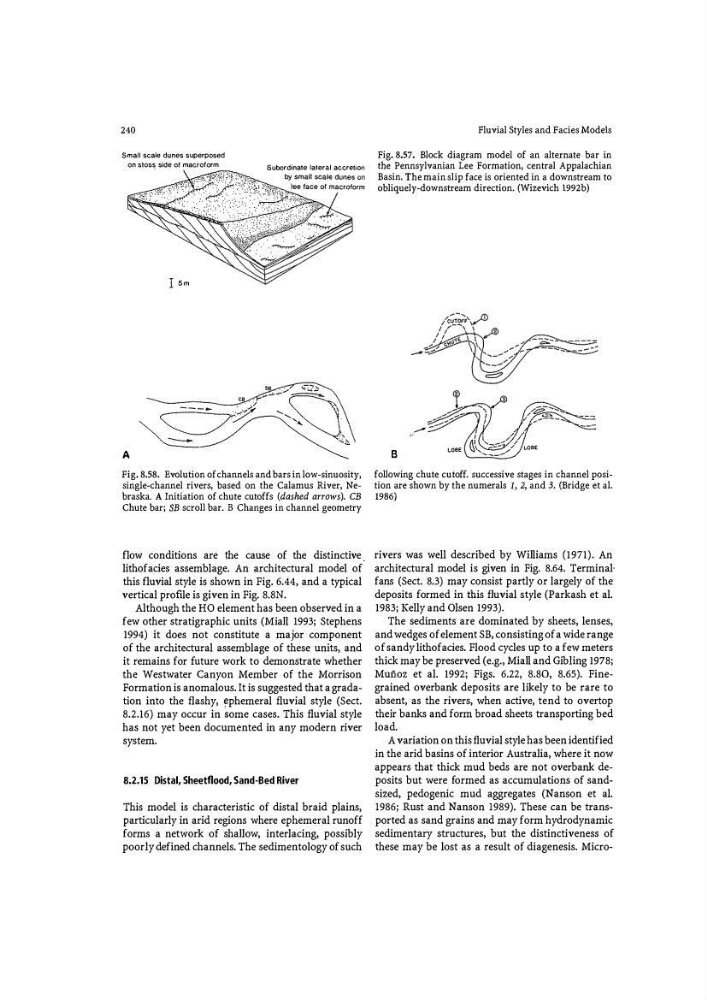
Small scale dunes superposed
on stos� side ol macroform
Fig. 8.57. Block diagram model of an alternate bar in
Subordinate lateral accretion
the Pennsylvanian Lee Formation, central Appalachian
I Sm
A
Fig. 8.58. Evolution of channels and bars in low-sinuosity,
single-channel rivers, based on the Calamus River, Nebraska. A Initiation of chute cutoffs (dashed arrows). CB
Chute bar; SB scroll bar. B Changes in channel geometry
flow conditions are the cause of the distinctive .
lithofacies assemblage. An architectural model of
this fluvial style is shown in Fig. 6.44, and a typical
vertical profile is given in Fig. 8.8N.
Although the HO element has been observed in a
few other stratigraphic units (M iall 1993; Stephens
1994) it does not constitute a major component
of the architectural assemblage of these units, and
it remains for future work to demonstrate whether
the Westwater Canyon Member of the Morrison
Formation is anomalous. It is suggested that a gradation into the flashy, �phemeral fluvial style (Sect.
8.2.16) may occur in some cases. This fluvial style
has not yet been documented in any modern river
system.
8.2.15 Distal, Sheetflood, Sand-Bed River
This model is characteristic of distal braid plains,
particularly in arid regions where ephemeral runoff
forms a network of shallow, interlacing, possibly
poorly defined channels. The sedimentology of such
Basin. The main slip face is oriented in a downstream to
obliquely-downstream direction. (Wizevich 1992b)
B
following chute cutoff. successive stages in channel position are shown by the numerals I, 2, and 3. (Bridge et al.
1986)
rivers was well described by Williams (1971). An
architectural model is given in Fig. 8.64. Terminal
fans (Sect. 8.3) may consist partly or largely of the
deposits formed in this fluvial style (Parkash et al.
1983; Kelly and Olsen 1993).
The sediments are dominated by sheets, lenses,
and wedges of element SB, consisting of a wide range
of sandy lithofacies. Flood cycles up to a few meters
thick may be preserved (e.g., Miall and Gibling 1978;
Mufioz et al. 1992; Figs. 6.22, 8.80, 8.65). Finegrained overbank deposits are likely to be rare to
absent, as the rivers, when active, tend to overtop
their banks and form broad sheets transporting bed
load.
A variation on this fluvial style has been identified
in the arid basins of interior Australia, where it now
appears that thick mud beds are not overbank deposits but were fo rmed as accumulations of sandsized, pedogenic mud aggregates (Nanson et al.
1986; Rust and Nanson 1989). These can be transported as sand grains and may form hydrodynamic
sedimentary structures, but the distinctiveness of
these may be lost as a result of diagenesis. Micro-
Fluvial Styles and Facies Models
Small scale dunes superposed
on stos� side ol macroform
Fig. 8.57. Block diagram model of an alternate bar in
Subordinate lateral accretion
the Pennsylvanian Lee Formation, central Appalachian
I Sm
A
Fig. 8.58. Evolution of channels and bars in low-sinuosity,
single-channel rivers, based on the Calamus River, Nebraska. A Initiation of chute cutoffs (dashed arrows). CB
Chute bar; SB scroll bar. B Changes in channel geometry
flow conditions are the cause of the distinctive .
lithofacies assemblage. An architectural model of
this fluvial style is shown in Fig. 6.44, and a typical
vertical profile is given in Fig. 8.8N.
Although the HO element has been observed in a
few other stratigraphic units (M iall 1993; Stephens
1994) it does not constitute a major component
of the architectural assemblage of these units, and
it remains for future work to demonstrate whether
the Westwater Canyon Member of the Morrison
Formation is anomalous. It is suggested that a gradation into the flashy, �phemeral fluvial style (Sect.
8.2.16) may occur in some cases. This fluvial style
has not yet been documented in any modern river
system.
8.2.15 Distal, Sheetflood, Sand-Bed River
This model is characteristic of distal braid plains,
particularly in arid regions where ephemeral runoff
forms a network of shallow, interlacing, possibly
poorly defined channels. The sedimentology of such
Basin. The main slip face is oriented in a downstream to
obliquely-downstream direction. (Wizevich 1992b)
B
following chute cutoff. successive stages in channel position are shown by the numerals I, 2, and 3. (Bridge et al.
1986)
rivers was well described by Williams (1971). An
architectural model is given in Fig. 8.64. Terminal
fans (Sect. 8.3) may consist partly or largely of the
deposits formed in this fluvial style (Parkash et al.
1983; Kelly and Olsen 1993).
The sediments are dominated by sheets, lenses,
and wedges of element SB, consisting of a wide range
of sandy lithofacies. Flood cycles up to a few meters
thick may be preserved (e.g., Miall and Gibling 1978;
Mufioz et al. 1992; Figs. 6.22, 8.80, 8.65). Finegrained overbank deposits are likely to be rare to
absent, as the rivers, when active, tend to overtop
their banks and form broad sheets transporting bed
load.
A variation on this fluvial style has been identified
in the arid basins of interior Australia, where it now
appears that thick mud beds are not overbank deposits but were fo rmed as accumulations of sandsized, pedogenic mud aggregates (Nanson et al.
1986; Rust and Nanson 1989). These can be transported as sand grains and may form hydrodynamic
sedimentary structures, but the distinctiveness of
these may be lost as a result of diagenesis. Micro-