

214
andering rivers have not received much attention by
sedimentologists, but increasing use of architectural
methods to study conglomerate deposits is showing
that they are relatively common in the stratigraphic
record (Ori 1979; Arche 1983; Ramos and Sopefia
1983). One of the first studies of this environment
was by Bluck (1971), who examined the modern
Endrick River, Scotland.
There is typically one main, active channel, with
scattered bars and islands, and occasional subsidiary
channels (Figs. 8.22, 8.24). New channels are commonly initiated as chute channels, as modeled in the
flume experiments by Ashmore (1991; see Fig. 6.13).
Sedimentation occurs on large, flat�topped point
Fluvial Styles and Facies Models
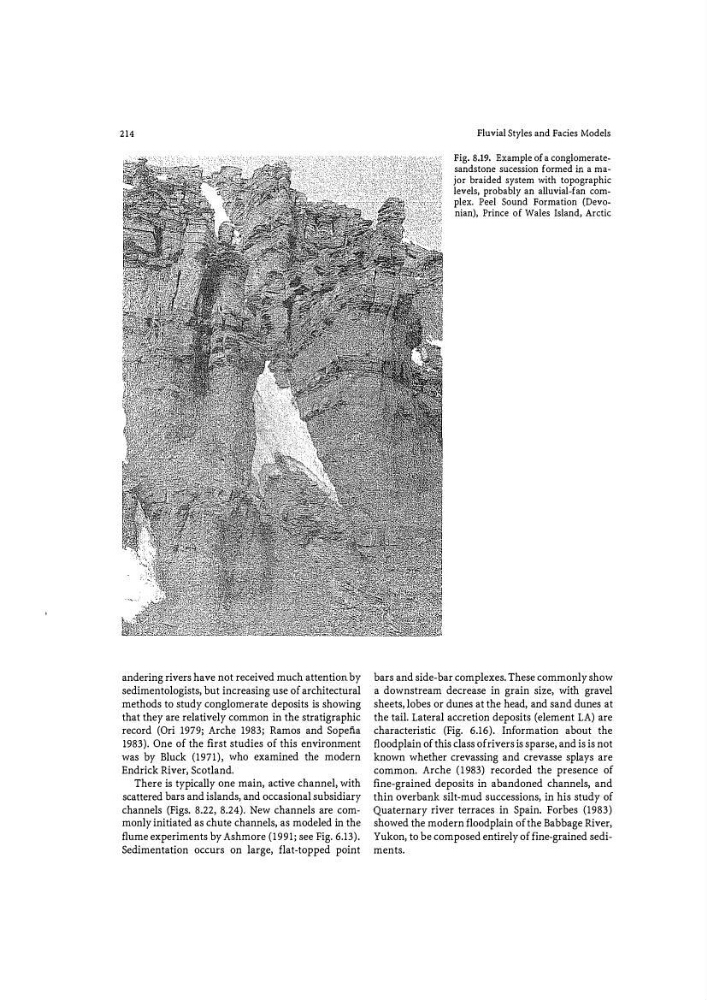
Fig. 8.19. Example of a conglomerate�
sandstone sucession formed in a major braided system with topographic
levels, probably an alluvial-fan com�
plex. Peel Sound Formation (Devo�
nian), Prince of Wales Island, Arctic
bars and side-bar complexes. These commonly show
a downstream decrease in grain size, with gravel
sheets, lobes or dunes at the head, and sand dunes at
the tail. Lateral accretion deposits (element LA) are
characteristic (Fig. 6.16). Information about the
floodplain of this class of rivers is sparse, and is is not
known whether crevassing and crevasse splays are
common. Arche (1983) recorded the presence of
fine-grained deposits in abandoned channels, and
thin overbank silt�mud successions, in his study of
Quaternary river terraces in Spain. Forbes (1983)
showed the modern floodplain of the Babbage River,
Yukon, to be composed entirely of fine-grained sediments.
andering rivers have not received much attention by
sedimentologists, but increasing use of architectural
methods to study conglomerate deposits is showing
that they are relatively common in the stratigraphic
record (Ori 1979; Arche 1983; Ramos and Sopefia
1983). One of the first studies of this environment
was by Bluck (1971), who examined the modern
Endrick River, Scotland.
There is typically one main, active channel, with
scattered bars and islands, and occasional subsidiary
channels (Figs. 8.22, 8.24). New channels are commonly initiated as chute channels, as modeled in the
flume experiments by Ashmore (1991; see Fig. 6.13).
Sedimentation occurs on large, flat�topped point
Fluvial Styles and Facies Models
Fig. 8.19. Example of a conglomerate�
sandstone sucession formed in a major braided system with topographic
levels, probably an alluvial-fan com�
plex. Peel Sound Formation (Devo�
nian), Prince of Wales Island, Arctic
bars and side-bar complexes. These commonly show
a downstream decrease in grain size, with gravel
sheets, lobes or dunes at the head, and sand dunes at
the tail. Lateral accretion deposits (element LA) are
characteristic (Fig. 6.16). Information about the
floodplain of this class of rivers is sparse, and is is not
known whether crevassing and crevasse splays are
common. Arche (1983) recorded the presence of
fine-grained deposits in abandoned channels, and
thin overbank silt�mud successions, in his study of
Quaternary river terraces in Spain. Forbes (1983)
showed the modern floodplain of the Babbage River,
Yukon, to be composed entirely of fine-grained sediments.