

I '
I
Chapter 8
Fiuviai Sty!!!S ami!! Fad!!s Mlli!l!!ls
8.1 Controls on Channel Style
The development of end-member facies models for a
few distinctive fluvial styles has obscured the continuum t;hat exists between fluvial channel patterns.
The fourfold classification of channel styles discussed in Sect. 2.3.6.5 (Fig. 2.18) has served seclimentologists well, but should be replaced by a more
sophisticated approach to channel classification.
This needs to be based on an understanding of the
controls that determine channel style.
Considerable theoretical and experimental work
has been carried out to explore the causes of meandering and braiding. The natural meandering of
channels, in particular, has received much attention.
It is now known that meandering occurs in all fluid
systems as a result of turbulence, internal shear, and
bank and bed friction. Straight channels, including
canals and channels in flumes, commonly develop
meanders because of these controls. Air and ocean
currents meander despite the absence of banks to
impose a frictional shear. Threads of water flowing
down � mooth surfaces of glacial ice and tilted glass
plates m a laboratory also develop meanders. Details
of the mathematical and hydraulic models that have
bee � developed to quantify the meandering process
m nvers are beyond the scope of this book. We are
concerned here with what can be determined about
channel style ·from the geological record� because
this provides information about the architecture of
the beds, and about the basin controls that were
operating during deposition.
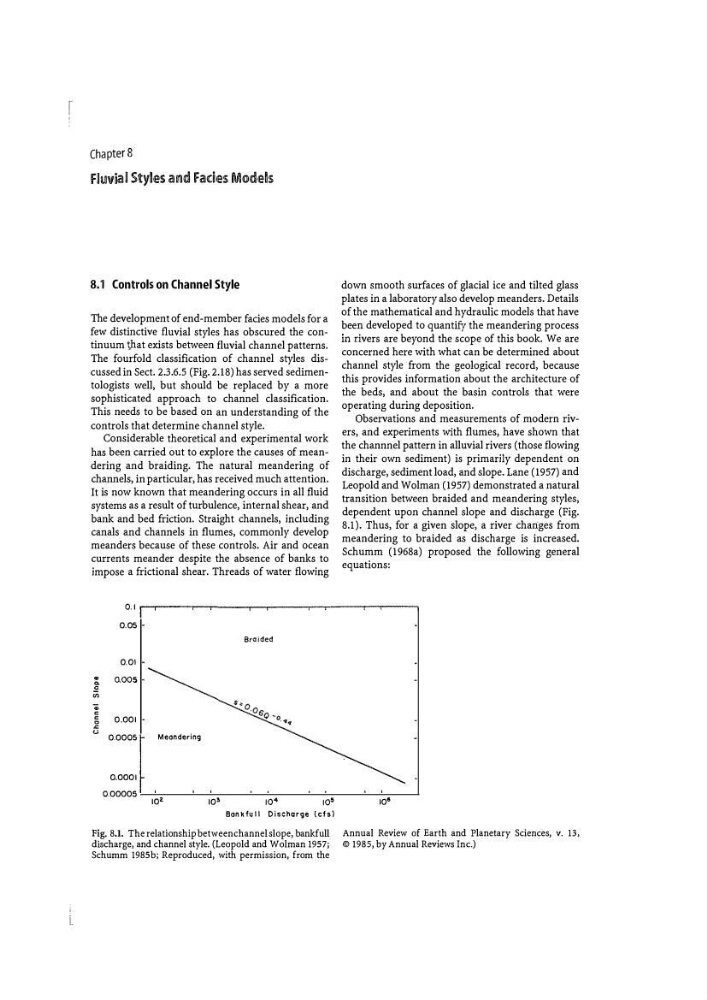
Observations and measurements of modern rivers, and experiments with flumes, have shown that
the channnel pattern in alluvial rivers (those flowing
in their own sediment) is primarily dependent on
discharge, sediment load, and slope. Lane (1957) and
Leopold and Wolman (1957) demonstrated a natural
transition between braided and meandering styles,
dependent upon channel slope and discharge (Fig.
8.1). Thus, for a given slope, a river changes from
meandering to braided as discharge is increased.
Schumm (1968a) proposed the following general
equations:
o.1 r--� �-. .. .,-. .. .,- -� �- -.,. .-�- --.
0.05
Braided
0.01
•
QOOS
�
0
;;;
•
•
•
0.001
0
�
u
0.0005
Meandering
0.0001
0.00005
10'
10'
IO•
IO'
Bankfull Discharge {cfs)
F�g. 8.1. The relationship between channel slope, bankfull
discharge, and channel style. (Leopold and Wolman 1957;
Schumm 1985b; Reproduced, with permission, from the
10'
Annual Review of Earth and Planetary Sciences, v. 13,
© 1985, by Annual Reviews Inc.)
I
Chapter 8
Fiuviai Sty!!!S ami!! Fad!!s Mlli!l!!ls
8.1 Controls on Channel Style
The development of end-member facies models for a
few distinctive fluvial styles has obscured the continuum t;hat exists between fluvial channel patterns.
The fourfold classification of channel styles discussed in Sect. 2.3.6.5 (Fig. 2.18) has served seclimentologists well, but should be replaced by a more
sophisticated approach to channel classification.
This needs to be based on an understanding of the
controls that determine channel style.
Considerable theoretical and experimental work
has been carried out to explore the causes of meandering and braiding. The natural meandering of
channels, in particular, has received much attention.
It is now known that meandering occurs in all fluid
systems as a result of turbulence, internal shear, and
bank and bed friction. Straight channels, including
canals and channels in flumes, commonly develop
meanders because of these controls. Air and ocean
currents meander despite the absence of banks to
impose a frictional shear. Threads of water flowing
down � mooth surfaces of glacial ice and tilted glass
plates m a laboratory also develop meanders. Details
of the mathematical and hydraulic models that have
bee � developed to quantify the meandering process
m nvers are beyond the scope of this book. We are
concerned here with what can be determined about
channel style ·from the geological record� because
this provides information about the architecture of
the beds, and about the basin controls that were
operating during deposition.
Observations and measurements of modern rivers, and experiments with flumes, have shown that
the channnel pattern in alluvial rivers (those flowing
in their own sediment) is primarily dependent on
discharge, sediment load, and slope. Lane (1957) and
Leopold and Wolman (1957) demonstrated a natural
transition between braided and meandering styles,
dependent upon channel slope and discharge (Fig.
8.1). Thus, for a given slope, a river changes from
meandering to braided as discharge is increased.
Schumm (1968a) proposed the following general
equations:
o.1 r--� �-. .. .,-. .. .,- -� �- -.,. .-�- --.
0.05
Braided
0.01
•
QOOS
�
0
;;;
•
•
•
0.001
0
�
u
0.0005
Meandering
0.0001
0.00005
10'
10'
IO•
IO'
Bankfull Discharge {cfs)
F�g. 8.1. The relationship between channel slope, bankfull
discharge, and channel style. (Leopold and Wolman 1957;
Schumm 1985b; Reproduced, with permission, from the
10'
Annual Review of Earth and Planetary Sciences, v. 13,
© 1985, by Annual Reviews Inc.)