

190
Architectural Elements of the Overbank Environment
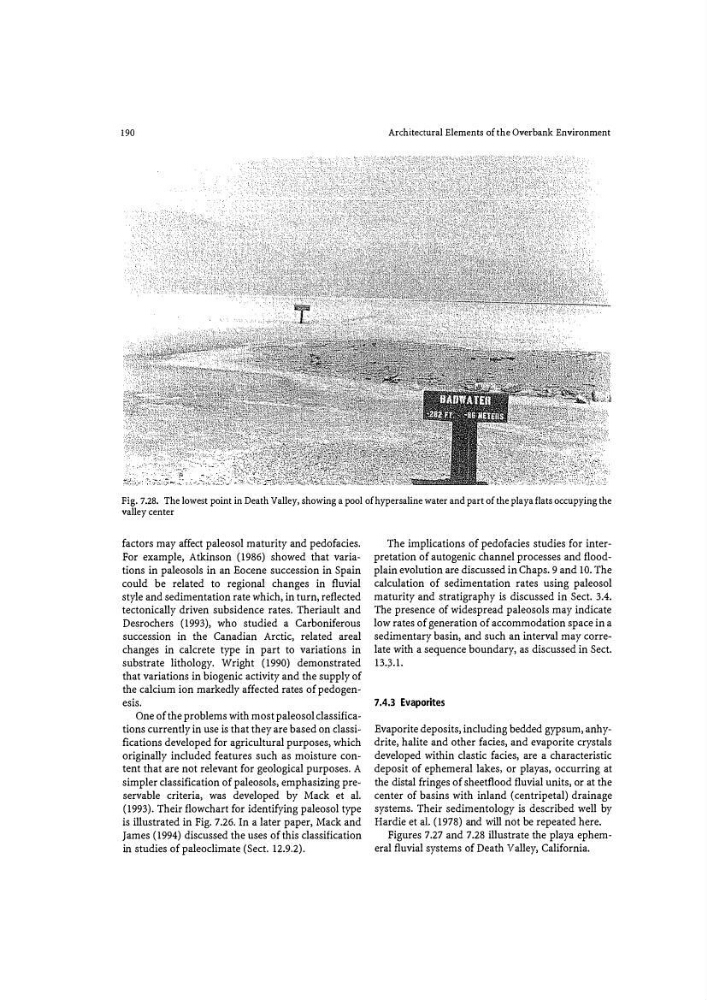
Fig. 7.28. The lowest point in Death Valley, showing a pool of hypersaline water and part of the playa flats occupying the
valley center
factors may affect paleosol maturity and pedofacies.
For example, Atkinson (1986) showed that variations in paleosols in an Eocene succession in Spain
could be related to regional changes in fluvial
style and sedimentation rate which, in turn, reflected
tectonically driven subsidence rates. Theriault and
Desrochers (1993), who studied a Carboniferous
succession in the Canadian Arctic, related areal
changes in calcrete type in part to variations in
substrate lithology. Wright (1990) demonstrated
that variations in biogenic activity and the supply of
the calcium ion markedly affected rates of pedogenesis.
One of the problems with most paleosol classifica�
tions currently in use is that they are based on dassi�
fications developed for agricultural purposes, which
originally included features such as moisture con�
tent that are not relevant for geological purposes. A
simpler classification of paleosols, emphasizing pre�
servable criteria, was developed by Mack et al.
(1993). Their flowchart for identifying paleosol type
is illustrated in Fig. 7.26. In a later paper, Mack and
james (1994) discussed the uses of this classification
in studies of paleoclimate (Sect. 12.9.2).
The implications of pedofacies studies for interpretation of autogenic channel processes and floodplain evolution are discussed in Chaps. 9 and 10. The
calculation of sedimentation rates using paleosol
maturity and stratigraphy is discussed in Sect. 3.4.
The presence of widespread paleosols may indicate
low rates of generation of accommodation space in a
sedimentary basin, and such an interval may correlate with a sequence boundary, as discussed in Sect.
13.3.1.
7 .4.3 Evaporites
Evaporite deposits, including bedded gypsum, anhydrite, halite and other fades, and evaporite crystals
developed within clastic facies, are a characteristic
deposit of ephemeral lakes, or playas, occurring at
the distal fringes of sheetflood fluvial units, or at the
center of basins with inland (centripetal) drainage
systems. Their sedimentology is described well by
Hardie et a!. (1978) and will not be repeated here.
Figures 7.27 and 7.28 illustrate the playa ephemeral fluvial systems of Death Valley, California.
Architectural Elements of the Overbank Environment
Fig. 7.28. The lowest point in Death Valley, showing a pool of hypersaline water and part of the playa flats occupying the
valley center
factors may affect paleosol maturity and pedofacies.
For example, Atkinson (1986) showed that variations in paleosols in an Eocene succession in Spain
could be related to regional changes in fluvial
style and sedimentation rate which, in turn, reflected
tectonically driven subsidence rates. Theriault and
Desrochers (1993), who studied a Carboniferous
succession in the Canadian Arctic, related areal
changes in calcrete type in part to variations in
substrate lithology. Wright (1990) demonstrated
that variations in biogenic activity and the supply of
the calcium ion markedly affected rates of pedogenesis.
One of the problems with most paleosol classifica�
tions currently in use is that they are based on dassi�
fications developed for agricultural purposes, which
originally included features such as moisture con�
tent that are not relevant for geological purposes. A
simpler classification of paleosols, emphasizing pre�
servable criteria, was developed by Mack et al.
(1993). Their flowchart for identifying paleosol type
is illustrated in Fig. 7.26. In a later paper, Mack and
james (1994) discussed the uses of this classification
in studies of paleoclimate (Sect. 12.9.2).
The implications of pedofacies studies for interpretation of autogenic channel processes and floodplain evolution are discussed in Chaps. 9 and 10. The
calculation of sedimentation rates using paleosol
maturity and stratigraphy is discussed in Sect. 3.4.
The presence of widespread paleosols may indicate
low rates of generation of accommodation space in a
sedimentary basin, and such an interval may correlate with a sequence boundary, as discussed in Sect.
13.3.1.
7 .4.3 Evaporites
Evaporite deposits, including bedded gypsum, anhydrite, halite and other fades, and evaporite crystals
developed within clastic facies, are a characteristic
deposit of ephemeral lakes, or playas, occurring at
the distal fringes of sheetflood fluvial units, or at the
center of basins with inland (centripetal) drainage
systems. Their sedimentology is described well by
Hardie et a!. (1978) and will not be repeated here.
Figures 7.27 and 7.28 illustrate the playa ephemeral fluvial systems of Death Valley, California.