

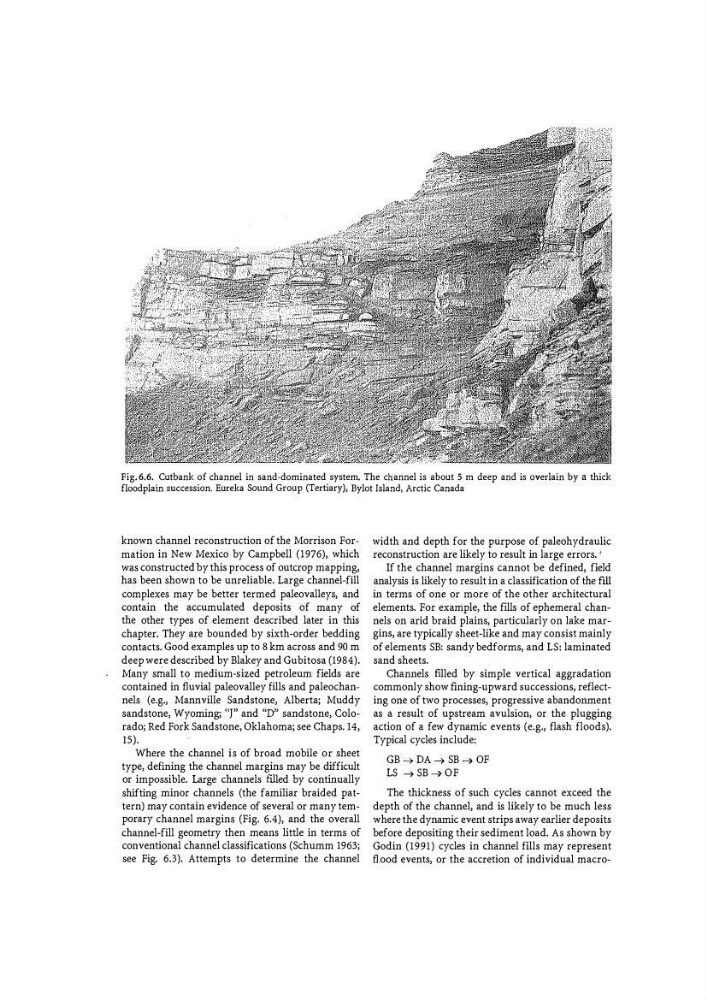
Fig. 6.6. Cutbank of channel in sand-dominated system. The channel is about 5 m deep and is overlain by a thick
floodplain succession. Eureka Sound Group (Tertiary), Bylot Island, Arctic Canada
known channel reconstruction of the Morrison Formation in New Mexico by Campbell (1976), which
was constructed by this process of outcrop mapping,
has been shown to be unreliable. Large channel-fill
complexes may be better termed paleovalleys, and
contain the accumulated deposits of many of
the other types of element described later in this
chapter. They are bounded by sixth-order bedding
contacts. Good examples up to 8 km across and 90 m
deep were described by Blakey and Gubitosa (1984).
Many s ff iall to medium-sized petroleum fields are
contained in fl uvial paleovalley fills and paleochannels (e.g., Mannville Sandstone, Alberta; Muddy
sandstone, Wyoming; ('yn and "D" sandstone, Colorado; Red Fork Sandstone, Oklahoma; see Chaps. 14,
15).
Where the channel is of broad mObile or sheet
type, defining the channel margins may be difficult
or impossible. Large channels ftlled by continually
shifting minor channels (the familiar braided pattern) may contain evidence of several or many temporary channel margins (Fig. 6.4), and the overall
channel-fill geometry then means little in terms of
conventional channel classifications {Schumm 1963;
see Fig. 6.3). Attempts to determine the channel
width and depth for the purpose of paleohydraulic
reconstruction are likely to result in large errors. 1
If the channel margins cannot be defined, field
analysis is likely to result in a classification of the fill
in terms of one or more of the other architectural
elements. For example, the ftlls of ephemeral channels on arid braid plains, particularly on lake margins, are typically sheet-like and may consist mainly
of elements SB: sandy bedforms, and LS: laminated
sand sheets.
Channels ftlled by simple vertical aggradation
commonly show fining-upward successions, reflecting one of two processes, progressive abandonment
as a result of upstream avulsion, or the plugging
action of a few dynamic events {e.g., flash floods).
Typical cycles include:
GB -c> DA -> SB -c> OF
LS -> SB -c> OF
The thickness of such cycles cannot exceed the
depth of the channel, and is likely to be much less
where the dynamic event strips away earlier deposits
before depositing their sediment load. As shown by
Godin (1991) cycles in channel fills may represent
flood events, or the accretion of individual macro-
floodplain succession. Eureka Sound Group (Tertiary), Bylot Island, Arctic Canada
known channel reconstruction of the Morrison Formation in New Mexico by Campbell (1976), which
was constructed by this process of outcrop mapping,
has been shown to be unreliable. Large channel-fill
complexes may be better termed paleovalleys, and
contain the accumulated deposits of many of
the other types of element described later in this
chapter. They are bounded by sixth-order bedding
contacts. Good examples up to 8 km across and 90 m
deep were described by Blakey and Gubitosa (1984).
Many s ff iall to medium-sized petroleum fields are
contained in fl uvial paleovalley fills and paleochannels (e.g., Mannville Sandstone, Alberta; Muddy
sandstone, Wyoming; ('yn and "D" sandstone, Colorado; Red Fork Sandstone, Oklahoma; see Chaps. 14,
15).
Where the channel is of broad mObile or sheet
type, defining the channel margins may be difficult
or impossible. Large channels ftlled by continually
shifting minor channels (the familiar braided pattern) may contain evidence of several or many temporary channel margins (Fig. 6.4), and the overall
channel-fill geometry then means little in terms of
conventional channel classifications {Schumm 1963;
see Fig. 6.3). Attempts to determine the channel
width and depth for the purpose of paleohydraulic
reconstruction are likely to result in large errors. 1
If the channel margins cannot be defined, field
analysis is likely to result in a classification of the fill
in terms of one or more of the other architectural
elements. For example, the ftlls of ephemeral channels on arid braid plains, particularly on lake margins, are typically sheet-like and may consist mainly
of elements SB: sandy bedforms, and LS: laminated
sand sheets.
Channels ftlled by simple vertical aggradation
commonly show fining-upward successions, reflecting one of two processes, progressive abandonment
as a result of upstream avulsion, or the plugging
action of a few dynamic events {e.g., flash floods).
Typical cycles include:
GB -c> DA -> SB -c> OF
LS -> SB -c> OF
The thickness of such cycles cannot exceed the
depth of the channel, and is likely to be much less
where the dynamic event strips away earlier deposits
before depositing their sediment load. As shown by
Godin (1991) cycles in channel fills may represent
flood events, or the accretion of individual macro-