

Channels (Element CH)
133
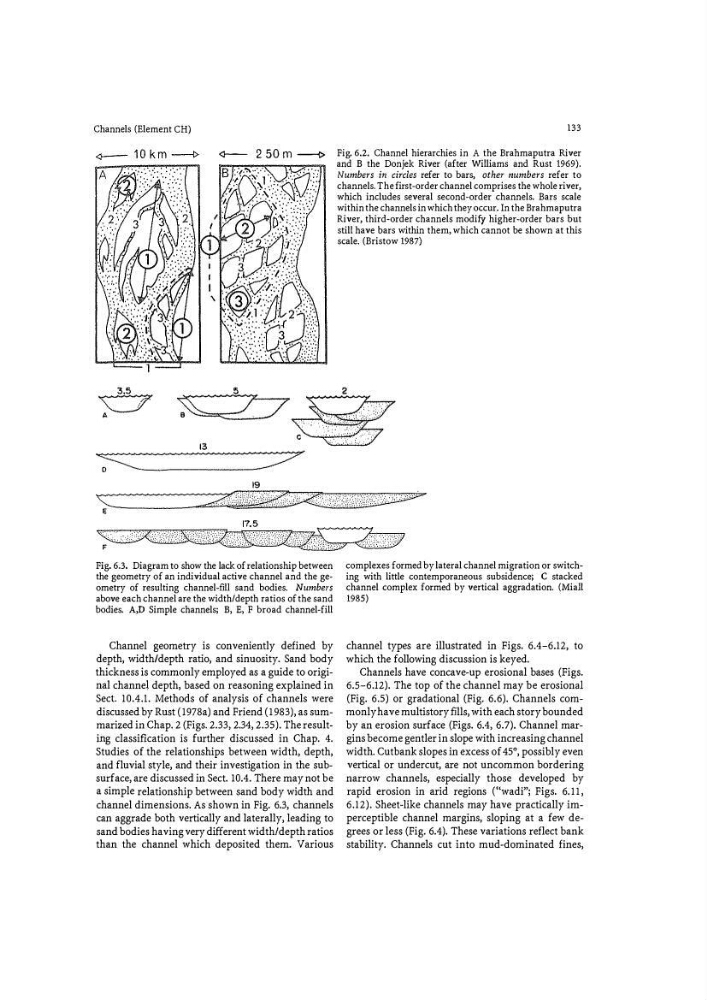
Fig. 6.2. Channel hierarchies in A the Brahmaputra River
and B the Donjek River (after Williams and Rust 1969).
Numbers in circles refer to bars, other numbers refer to
channels. The first-order channel comprises the whole river,
which includes several second-order channels. Bars scale
within the channels in which they occur. In the Brahmaputra
River, third-order channels modify higher-order bars but
still have bars within them, which cannot be shown at this
scale. (Bristow 1987)
5
2
�-= � : )� ' _/ i§;i �
13
�--- --:;? ·
19
Fi g. 6.3. Diagram to show the lack of relationship between
the geometry of an individual active channel and the geometry of resulting channel-flU sand bodies. Numbers
above each channel are the width/depth ratios of the sand
bodies. A,D Simple channels; B, E, F broad channel-fill
Channel geometry is conveniently defined by
depth, width/depth ratio, and sinuosity. Sand body
thickness is commonly employed as a guide to original channel depth, based on reasoning explained in
Sect 10.4.!. Methods of analysis of channels were
discussed by Rust (1978a) and Friend (1983), as summarized in Chap. 2 (Figs. 2.33, 2.34, 2.35). The resulting classification is further discussed in Chap. 4.
Studies of the relationships between width, depth,
and fluvial style, and their investigation in the subsurface, are discussed in Sect. 10.4. There may not be
a simple relationship between sand body width and
channel dimensions. As shown in Fig. 6.3, channels
can aggrade both vertically and laterally, leading to
sand bodies having very different width/depth ratios
than the channel which deposited them. Various
complexes formed by lateral channel migration or switching with little contemporaneous subsidence; C stacked
channel complex formed by vertical aggradation. (MiaJl
1985)
channel types are illustrated in Figs. 6.4-6.12, to
which the following discussion is keyed.
Channels have concave-up erosional bases (Figs.
6.5-6.12). The top of the channel may be erosional
(Fig. 6.5) or gradational (Fig. 6.6). Channels commonly have multistory fi lls, with each story bounded
by an erosion surface (Figs. 6.4, 6.7). Channel margins become gentler in slope with increasing channel
width. Cutbank slopes in excess of 45°, possibly even
vertical or undercut, are not uncommon bordering
narrow channels, especially those developed by
rapid erosion in arid regions C'wadi"; Figs. 6. 11,
6.12). Sheet-like channels may have practically imperceptible channel margins, sloping at a few degrees or less (Fig. 6.4). These variations reflect bank
stability. Channels cut into mud-dominated fines,
133
and B the Donjek River (after Williams and Rust 1969).
Numbers in circles refer to bars, other numbers refer to
channels. The first-order channel comprises the whole river,
which includes several second-order channels. Bars scale
within the channels in which they occur. In the Brahmaputra
River, third-order channels modify higher-order bars but
still have bars within them, which cannot be shown at this
scale. (Bristow 1987)
5
2
�-= � : )� ' _/ i§;i �
13
�--- --:;? ·
19
Fi g. 6.3. Diagram to show the lack of relationship between
the geometry of an individual active channel and the geometry of resulting channel-flU sand bodies. Numbers
above each channel are the width/depth ratios of the sand
bodies. A,D Simple channels; B, E, F broad channel-fill
Channel geometry is conveniently defined by
depth, width/depth ratio, and sinuosity. Sand body
thickness is commonly employed as a guide to original channel depth, based on reasoning explained in
Sect 10.4.!. Methods of analysis of channels were
discussed by Rust (1978a) and Friend (1983), as summarized in Chap. 2 (Figs. 2.33, 2.34, 2.35). The resulting classification is further discussed in Chap. 4.
Studies of the relationships between width, depth,
and fluvial style, and their investigation in the subsurface, are discussed in Sect. 10.4. There may not be
a simple relationship between sand body width and
channel dimensions. As shown in Fig. 6.3, channels
can aggrade both vertically and laterally, leading to
sand bodies having very different width/depth ratios
than the channel which deposited them. Various
complexes formed by lateral channel migration or switching with little contemporaneous subsidence; C stacked
channel complex formed by vertical aggradation. (MiaJl
1985)
channel types are illustrated in Figs. 6.4-6.12, to
which the following discussion is keyed.
Channels have concave-up erosional bases (Figs.
6.5-6.12). The top of the channel may be erosional
(Fig. 6.5) or gradational (Fig. 6.6). Channels commonly have multistory fi lls, with each story bounded
by an erosion surface (Figs. 6.4, 6.7). Channel margins become gentler in slope with increasing channel
width. Cutbank slopes in excess of 45°, possibly even
vertical or undercut, are not uncommon bordering
narrow channels, especially those developed by
rapid erosion in arid regions C'wadi"; Figs. 6. 11,
6.12). Sheet-like channels may have practically imperceptible channel margins, sloping at a few degrees or less (Fig. 6.4). These variations reflect bank
stability. Channels cut into mud-dominated fines,