

132
Architectural Elements Formed Within Channels
��
element CH: channel (side- filled, w/d =/2)
�� -:: �_ � � --::: :- -
-� � �
��� - , ' ::;:;;;: :element CH: channel (filled with increments of element SB)
"
element CH: channel (as above)
channel floor scours
=
element DA: downstream accretion mocroform
-== -...
=--- -:.;:; 3 ::.:::_
element OA: downstream accretion macrofor,i;
element LA: lateral accretion macroform
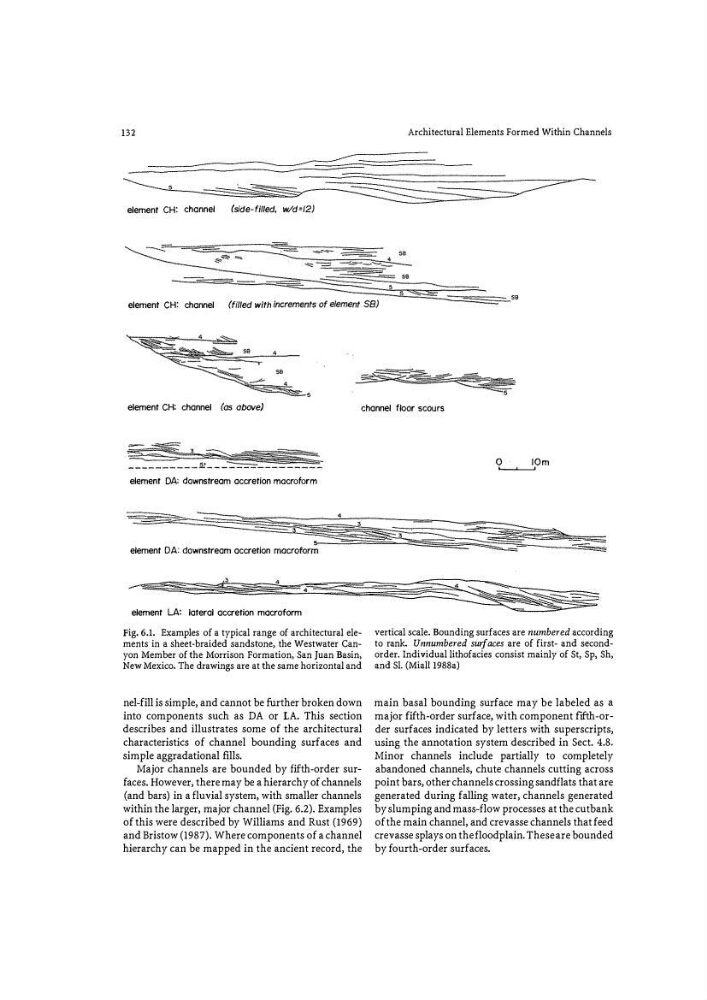
Fig. 6.1. Examples of a typical range of architectural elements in a sheet-braided sandstone, the Westwater Canyon Member of the Morrison Formation, San Juan Basin,
New Mexico. The drawings are at the same horizontal and
nel-fill is simple, and cannot be further broken down
into components such as DA or LA. This section
describes and illustrates some of the architectural
characteristics of channel bounding surfaces and
simple aggradational fills.
Major channels are bounded by fifth-order surfaces. However, there may be a hierarchy of channels
(and bars) in a fluvial system, with smaller channels
within the larger, major channel (Fig. 6.2). Examples
of this were described by Williams and Rust (1969)
and Bristow (1987). Where components of a channel
hierarchy can be mapped in the ancient record, the
0
10m
��
vertical scale. Bounding surfaces are numbered according
to rank. Unnumbered surfaces are of firstM and secondorder. Individual lithofacies consist mainly of St, Sp, Sh,
and Sl. (Miall 1988a)
main basal bounding surface may be labeled as a
major fifth-order surface, with component fifth-order surfaces indicated by letters with superscripts,
using the annotation system described in Sect. 4.8.
Minor channels include partially to completely
abandoned channels, chute channels cutting across
point bars, other channels crossing sandflats that are
generated during falling water, channels generated
by slumping and mass-flow processes at the cutbank
of the main channel, and crevasse channels that feed
crevasse splays on the floodplain. These are bounded
by fo urth-order surfaces.
Architectural Elements Formed Within Channels
��
element CH: channel (side- filled, w/d =/2)
�� -:: �_ � � --::: :- -
-� � �
��� - , ' ::;:;;;: :element CH: channel (filled with increments of element SB)
"
element CH: channel (as above)
channel floor scours
=
element DA: downstream accretion mocroform
-== -...
=--- -:.;:; 3 ::.:::_
element OA: downstream accretion macrofor,i;
element LA: lateral accretion macroform
Fig. 6.1. Examples of a typical range of architectural elements in a sheet-braided sandstone, the Westwater Canyon Member of the Morrison Formation, San Juan Basin,
New Mexico. The drawings are at the same horizontal and
nel-fill is simple, and cannot be further broken down
into components such as DA or LA. This section
describes and illustrates some of the architectural
characteristics of channel bounding surfaces and
simple aggradational fills.
Major channels are bounded by fifth-order surfaces. However, there may be a hierarchy of channels
(and bars) in a fluvial system, with smaller channels
within the larger, major channel (Fig. 6.2). Examples
of this were described by Williams and Rust (1969)
and Bristow (1987). Where components of a channel
hierarchy can be mapped in the ancient record, the
0
10m
��
vertical scale. Bounding surfaces are numbered according
to rank. Unnumbered surfaces are of firstM and secondorder. Individual lithofacies consist mainly of St, Sp, Sh,
and Sl. (Miall 1988a)
main basal bounding surface may be labeled as a
major fifth-order surface, with component fifth-order surfaces indicated by letters with superscripts,
using the annotation system described in Sect. 4.8.
Minor channels include partially to completely
abandoned channels, chute channels cutting across
point bars, other channels crossing sandflats that are
generated during falling water, channels generated
by slumping and mass-flow processes at the cutbank
of the main channel, and crevasse channels that feed
crevasse splays on the floodplain. These are bounded
by fo urth-order surfaces.