

120
Lithofacies
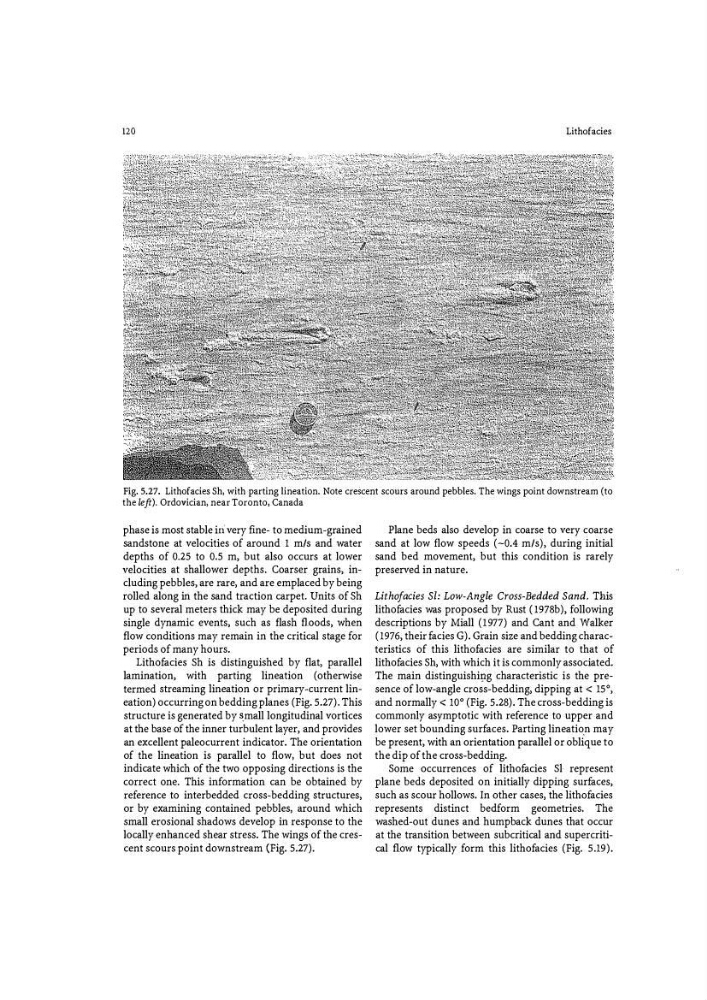
Fig. 5.27. Lithofacies Sh, with parting lineation. Note creScent scours around pebbles. The wings point downstream (to
the left). Ordovician, near Toronto, Canada
phase is most stable ill very fine- to medium-grained
sandstone at velocities of around 1 m/s and water
depths of 0.25 to 0.5 m, but also occurs at lower
velocities at shallower depths. Coarser grains, including pebbles, are rare, and are emplaced by being
rolled along in the sand traction carpet. Units of Sh
up to several meters thick may be deposited during
single dynamic events, such as flash floods, when
flow conditions may remain in the critical stage for
periods of many hours.
Lithofacies Sh is distinguished by flat, parallel
lamination, with parting lineation (otherwise
termed streaming lineation or primary-current lineation) occurring on bedding planes (Fig. 5.27). This
structure is generated by �mall longitudinal vortices
at the base of the inner turbulent layer, and provides
an excellent paleocurrent indicator. The orientation
of the lineation is parallel to flow, but does not
indicate which of the two opposing directions is the
correct one. This information can be obtained by
reference to interbedded cross-bedding structures,
or by examining contained pebbles, around which
small erosional shadows develop in response to the
locally enhanced shear stress. The wings of the crescent scours point downstream (Fig. 5.27).
Plane beds also develop in coarse to very coarse
sand at low flow speeds ( -0.4 m/s), during initial
sand bed movement, but this condition is rarely
preserved in nature.
Lithofa cies Sl: Low-Angle Cross-Bedded Sand. This
lithofacies was proposed by Rust (1978b), following
descriptions by Miall (1977) and Cant and Walker
(1976, their facies G). Grain size and bedding characteristics of this lithofacies are similar to that of
lithofacies Sh, with which it is commonly associated.
The main distinguishi;J.g characteristic is the presence of low-angle cross-bedding, dipping at < 15°,
and normally < 10° (Fig. 5.28). The cross-bedding is
commonly asymptotic with reference to upper and
lower set bounding surfaces. Parting lineation may
be present, with an orientation parallel or oblique to
the dip of the cross-bedding.
Some occurrences of lithofacies Sl- represent
plane beds deposited on initially dipping surfaces,
such as scour hollows. In other cases, the lithofacies
represents distinct bedform geometries. The
washed-out dunes and humpback dunes that occur
at the transition between subcritical and supercritical flow typically form this lithofacies (Fig. 5.19).
Lithofacies
Fig. 5.27. Lithofacies Sh, with parting lineation. Note creScent scours around pebbles. The wings point downstream (to
the left). Ordovician, near Toronto, Canada
phase is most stable ill very fine- to medium-grained
sandstone at velocities of around 1 m/s and water
depths of 0.25 to 0.5 m, but also occurs at lower
velocities at shallower depths. Coarser grains, including pebbles, are rare, and are emplaced by being
rolled along in the sand traction carpet. Units of Sh
up to several meters thick may be deposited during
single dynamic events, such as flash floods, when
flow conditions may remain in the critical stage for
periods of many hours.
Lithofacies Sh is distinguished by flat, parallel
lamination, with parting lineation (otherwise
termed streaming lineation or primary-current lineation) occurring on bedding planes (Fig. 5.27). This
structure is generated by �mall longitudinal vortices
at the base of the inner turbulent layer, and provides
an excellent paleocurrent indicator. The orientation
of the lineation is parallel to flow, but does not
indicate which of the two opposing directions is the
correct one. This information can be obtained by
reference to interbedded cross-bedding structures,
or by examining contained pebbles, around which
small erosional shadows develop in response to the
locally enhanced shear stress. The wings of the crescent scours point downstream (Fig. 5.27).
Plane beds also develop in coarse to very coarse
sand at low flow speeds ( -0.4 m/s), during initial
sand bed movement, but this condition is rarely
preserved in nature.
Lithofa cies Sl: Low-Angle Cross-Bedded Sand. This
lithofacies was proposed by Rust (1978b), following
descriptions by Miall (1977) and Cant and Walker
(1976, their facies G). Grain size and bedding characteristics of this lithofacies are similar to that of
lithofacies Sh, with which it is commonly associated.
The main distinguishi;J.g characteristic is the presence of low-angle cross-bedding, dipping at < 15°,
and normally < 10° (Fig. 5.28). The cross-bedding is
commonly asymptotic with reference to upper and
lower set bounding surfaces. Parting lineation may
be present, with an orientation parallel or oblique to
the dip of the cross-bedding.
Some occurrences of lithofacies Sl- represent
plane beds deposited on initially dipping surfaces,
such as scour hollows. In other cases, the lithofacies
represents distinct bedform geometries. The
washed-out dunes and humpback dunes that occur
at the transition between subcritical and supercritical flow typically form this lithofacies (Fig. 5.19).