

106
c
II
TURBIDITY FLOW
l<>w --- ���� doo,lly
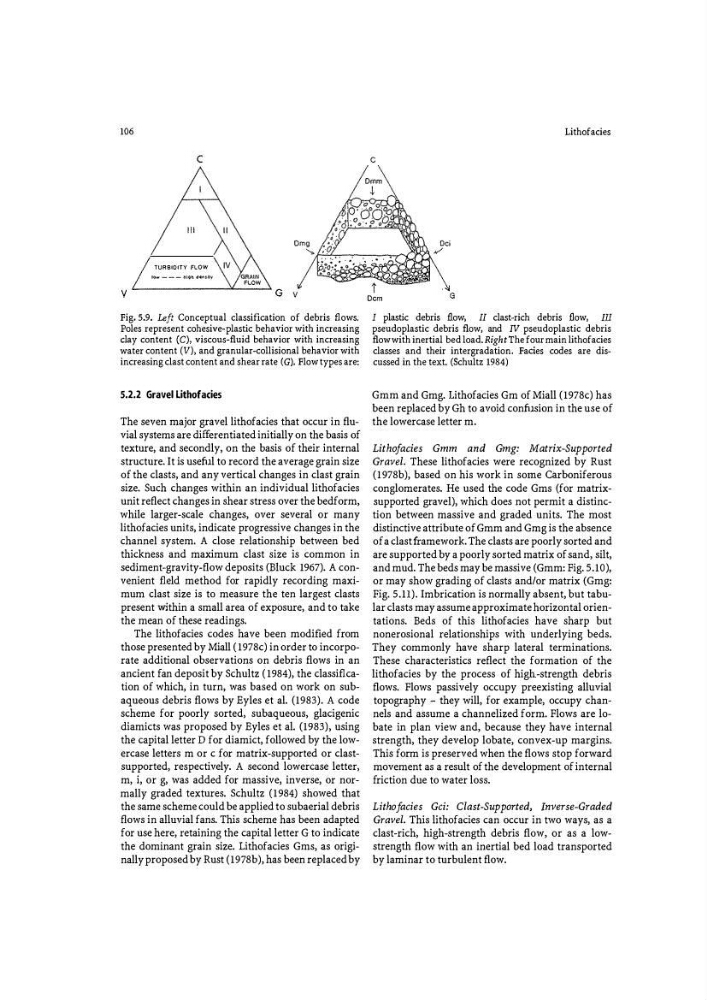
Fig. 5.9. Left Conceptual classification of debris fl ows.
Poles represent cohesive� plastic behavior with increasing
day content (C), viscous-fluid behavior with increasing
water content (V), and granular-collisional behavior with
increasing clast content and shear rate (G). Flow types are:
5.2.2 Gravel Lithofacies
The seven major gravel lithofacies that occur in fluvial systems are differentiated initially on the basis of
texture, and secondly, on the basis of their internal
structure. It is useful to record the average grain size
of the clasts, and any vertical changes in clast grain
size. Such changes within an individual lithofacies
unit reflect changes in shear stress over the bedform,
while larger-scale changes, over several or many
lithofacies units, indicate progressive changes in the
channel system. A close relationship between bed
thickness and maximum clast size is common in
sediment-gravity-flow deposits (Biuck 1967). A convenient fi eld method for rapidly recording maximum clast size is to measure the ten largest clasts
present "Within a small area of exposure, and to take
the mean of these readings.
The lithofacies codes have been modified from
those presented by Miall (1978c) in order to incorporate additional observations on debris flows in an
ancient fan deposit by Schultz (1984), the classification of which, in turn, was based on work on subaqueous debris flows by Byles et al. (1983). A code
scheme for poorly sorted, subaqueous, glacigenic
diamicts was proposed by Byles et al. (1983), using
the capital letter D for diamict, followed by the lowercase letters m or c for matrix-supported or clastsupported, respectively. A second lowercase letter,
m, i, or g, was added for massive, inverse, or normally graded textures. Schultz (1984) showed that
the same scheme could be applied to subaerial debris
flows in alluvial fans. This scheme has been adapted
for use here, retaining the capital letter G to indicate
the dominant grain size. Lithofacies Gms, as originally proposed by Rust (1978b), has been replaced by
Lithofacies
c
G
I plastic debris flow, II clast-rich debris fl ow, III
pseudoplastic debris flow, and IV pseudoplastic debris
flow with inertial bed load. Right The four main lithofacies
classes and their intergradation. Fades codes are discussed in the text. (Schultz 1984)
Gmm and Gmg. Lithofacies Gm of Miall (1978c) has
been replaced by Gh to avoid confusion in the use of
the lowercase letter m.
Lithofa cies Gmm and Gmg: Matrix-Supported
Gravel. These lithofacies were recognized by Rust
(1978b), based on his work in some Carboniferous
conglomerates. He used the code Gms (for matrixsupported gravel), which does not permit a distinction between massive and graded units. The most
distinctive attribute of Gmm and Gmg is the absence
of a clast framework. The clasts are poorly sorted and
are supported by a poorly sorted matrix of sand, silt,
and mud. The beds may be massive ( Gmm: Fig. 5.10 ),
or may show grading of clasts and/or matrix (Gmg:
Fig. 5.1!). Imbrication is normally absent, but tabular clasts may assume approximate horizontal orientations. Beds of this lithofacies have sharp but
nonerosional relationships with underlying beds.
They commonly have sharp lateral terminations.
These characteristics reflect the formation of the
lithofacies by the process of high-strength debris
flows. Flows passively occupy preexisting alluvial
topography - they will, for example, occupy channels and assume a channelized form. Flows are lobate in plan view and, because they have internal
strength, they develop lobate, convex-up margins.
This form is preserved when the flows stop forward
movement as a result of the development of internal
friction due to water loss.
Lithofacies Gci: Clast-Supported, In verse-Graded
Gravel. This lithofacies can occur in two ways, as a
clast-rich, high-strength debris flow, or as a low�
strength flow with an inertial bed load transported
by laminar to turbulent flow.
c
II
TURBIDITY FLOW
l<>w --- ���� doo,lly
Fig. 5.9. Left Conceptual classification of debris fl ows.
Poles represent cohesive� plastic behavior with increasing
day content (C), viscous-fluid behavior with increasing
water content (V), and granular-collisional behavior with
increasing clast content and shear rate (G). Flow types are:
5.2.2 Gravel Lithofacies
The seven major gravel lithofacies that occur in fluvial systems are differentiated initially on the basis of
texture, and secondly, on the basis of their internal
structure. It is useful to record the average grain size
of the clasts, and any vertical changes in clast grain
size. Such changes within an individual lithofacies
unit reflect changes in shear stress over the bedform,
while larger-scale changes, over several or many
lithofacies units, indicate progressive changes in the
channel system. A close relationship between bed
thickness and maximum clast size is common in
sediment-gravity-flow deposits (Biuck 1967). A convenient fi eld method for rapidly recording maximum clast size is to measure the ten largest clasts
present "Within a small area of exposure, and to take
the mean of these readings.
The lithofacies codes have been modified from
those presented by Miall (1978c) in order to incorporate additional observations on debris flows in an
ancient fan deposit by Schultz (1984), the classification of which, in turn, was based on work on subaqueous debris flows by Byles et al. (1983). A code
scheme for poorly sorted, subaqueous, glacigenic
diamicts was proposed by Byles et al. (1983), using
the capital letter D for diamict, followed by the lowercase letters m or c for matrix-supported or clastsupported, respectively. A second lowercase letter,
m, i, or g, was added for massive, inverse, or normally graded textures. Schultz (1984) showed that
the same scheme could be applied to subaerial debris
flows in alluvial fans. This scheme has been adapted
for use here, retaining the capital letter G to indicate
the dominant grain size. Lithofacies Gms, as originally proposed by Rust (1978b), has been replaced by
Lithofacies
c
G
I plastic debris flow, II clast-rich debris fl ow, III
pseudoplastic debris flow, and IV pseudoplastic debris
flow with inertial bed load. Right The four main lithofacies
classes and their intergradation. Fades codes are discussed in the text. (Schultz 1984)
Gmm and Gmg. Lithofacies Gm of Miall (1978c) has
been replaced by Gh to avoid confusion in the use of
the lowercase letter m.
Lithofa cies Gmm and Gmg: Matrix-Supported
Gravel. These lithofacies were recognized by Rust
(1978b), based on his work in some Carboniferous
conglomerates. He used the code Gms (for matrixsupported gravel), which does not permit a distinction between massive and graded units. The most
distinctive attribute of Gmm and Gmg is the absence
of a clast framework. The clasts are poorly sorted and
are supported by a poorly sorted matrix of sand, silt,
and mud. The beds may be massive ( Gmm: Fig. 5.10 ),
or may show grading of clasts and/or matrix (Gmg:
Fig. 5.1!). Imbrication is normally absent, but tabular clasts may assume approximate horizontal orientations. Beds of this lithofacies have sharp but
nonerosional relationships with underlying beds.
They commonly have sharp lateral terminations.
These characteristics reflect the formation of the
lithofacies by the process of high-strength debris
flows. Flows passively occupy preexisting alluvial
topography - they will, for example, occupy channels and assume a channelized form. Flows are lobate in plan view and, because they have internal
strength, they develop lobate, convex-up margins.
This form is preserved when the flows stop forward
movement as a result of the development of internal
friction due to water loss.
Lithofacies Gci: Clast-Supported, In verse-Graded
Gravel. This lithofacies can occur in two ways, as a
clast-rich, high-strength debris flow, or as a low�
strength flow with an inertial bed load transported
by laminar to turbulent flow.