

Gravel Facies
v.
--:::·.
. .
..
..
· ·
. . . .
·
· . .
. .
.. •.
· · . . ·· .
··.
Plane-bedded sandy fine
granules,
(4) Matrix-filled fine
'2
conglomerate.
"
'0
•
(2) Open-work
'0
coarse
'0
•
conglomerate.
.0
I
•
•
(3) Matrix-filled coarse E
.conglomerqte.
(.)
Plane-bedded sandy fine
1--- -- -- -- -' granules.
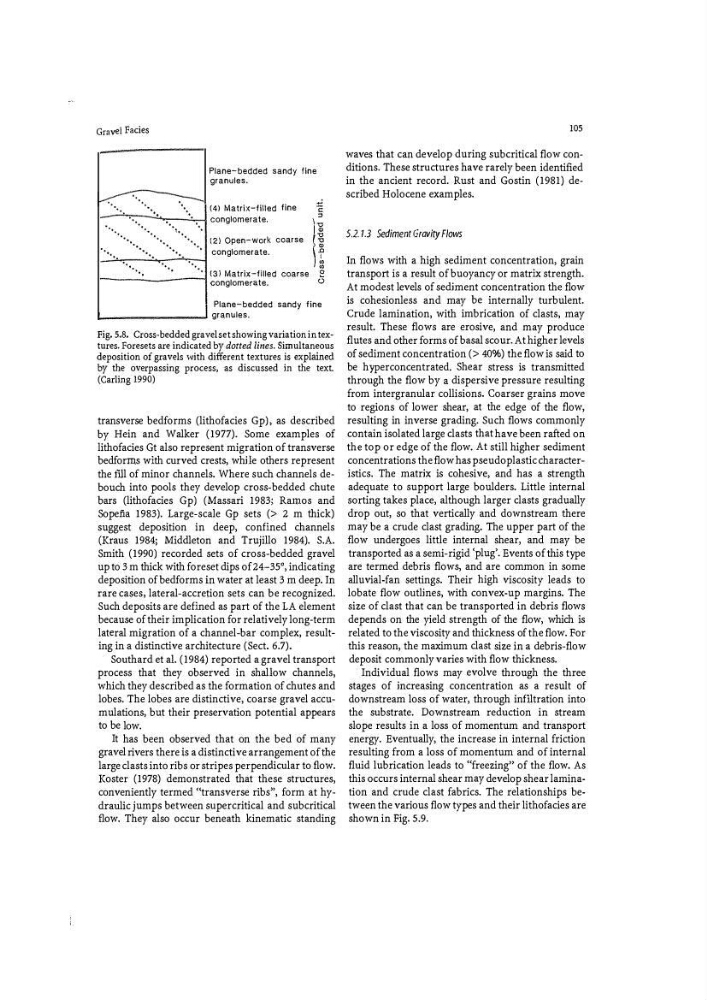
Fig. 5.8. Cross� bedded gravel set showing variation in textures. Foresets are indicated by dotted lines. Simultaneous
deposition of gravels Volith different textures is explained
by the overpassing process, as discussed in the text.
(Carling 1990)
transverse bedforms (lithofacies Gp ), as described
by Hein and Walker (1977). Some examples of
lithofacies Gt also represent migration of transverse
bedforms with curved crests, while others represent
the fll l of minor channels. Where such channels debouch into pools they develop cross-bedded chute
bars (lithofacies Gp) (Massari 1983; Ramos and
Sopena 1983). Large-scale Gp sets (> 2 m thick)
suggest deposition in deep, confined channels
(Kraus 1984; Middleton and Trujillo 1984). S.A.
Smith (1990) recorded sets of cross-bedded gravel
up to 3m thick with foreset dips of 24-35°, indicating
deposition of bedforms in water at least 3m deep. In
rare cases, lateral-accretion sets can be recognized.
Such deposits are defined as part of the LA element
because of their implication for relatively long-term
lateral migration of a channel-bar complex, resulting in a distinctive architecture (Sect. 6.7).
Southard et a!. (1984) reported a gravel transport
process that they observed in shallow channels,
which they described as the formation of chutes and
lobes. The lobes are distinctive, coarse gravel accumulations, but their preservation potential appears
to be low.
It has been observed that on the bed of many
gravel rivers there js a distinctive arrangement of the
large clasts into ribs or stripes perpen d icular to flow.
Koster (1978) demonstrated that these structures,
conveniently termed <'transverse ribs", form at hydraulic jumps between supercritical and subcritical
flow. They also occur beneath kinematic standing
105
waves that can develop during subcritical flow conditions. These structures have rarely been identified
in the ancient record. Rust and Gostin (1981} described Holocene examples.
5.2.1.3 Sediment Gravity Flows
In flows with a high sediment concentration, grain
transport is a result of buoyancy or matrix strength.
At modest levels of sediment concentration the flow
is cohesionless and may be internally turbulent.
Crude lamination, with imbrication of clasts, may
result. These flows are erosive, and may produce
flutes and other forms of basal scour. At higher levels
of sediment concentration (> 40%) the flow is said to
be hyperconcentrated. Shear stress is transmitted
through the flow by a dispersive pressure resulting
from intergranular collisions. Coarser grains move
to regions of lower shear, at the edge of the flow,
resulting in inverse grading. Such flows commonly
contain isolated large clasts that have been rafted on
the top or edge of the flow. At still higher sediment
concentrations the flow has pseudoplastic characteristics. The matrix is cohesive, and has a strength
adequate to support large boulders. Little internal
sorting takes place, although larger clasts gradually
drop out, so that vertically and downstream there
may be a crude clast grading. The upper part of the
flow undergoes little internal shear, and may be
transported as a semi-rigid 'plug'. Events of this type
are termed debris flows, and are common in some
alluvial�fan settings. Their high viscosity leads to
lobate flow outlines, with convex�up margins. The
size of clast that can be transported in debris flows
depends on the yield strength of the flow, which is
related to the viscosity and thickness of the flow. For
this reason, the maximum clast size in a debris� flow
deposit commonly varies with flow thickness.
Individual flows may evolve through the three
stages of increasing concentration as a result of
downstream loss of water, through infiltration into
the substrate. Downstream reduction in stream
slope results in a loss of momentum and transport
energy. Eventually, the increase in internal friction
resulting from a loss of momentum and of internal
fluid lubrication leads to ''freezing'' of the flow. As
this occurs internal shear may develop shear lamina�
tion and crude clast fabrics. The relationships be�
tween the various flow types and their lithofacies are
shown in Fig. 5.9.
v.
--:::·.
. .
..
..
· ·
. . . .
·
· . .
. .
.. •.
· · . . ·· .
··.
Plane-bedded sandy fine
granules,
(4) Matrix-filled fine
'2
conglomerate.
"
'0
•
(2) Open-work
'0
coarse
'0
•
conglomerate.
.0
I
•
•
(3) Matrix-filled coarse E
.conglomerqte.
(.)
Plane-bedded sandy fine
1--- -- -- -- -' granules.
Fig. 5.8. Cross� bedded gravel set showing variation in textures. Foresets are indicated by dotted lines. Simultaneous
deposition of gravels Volith different textures is explained
by the overpassing process, as discussed in the text.
(Carling 1990)
transverse bedforms (lithofacies Gp ), as described
by Hein and Walker (1977). Some examples of
lithofacies Gt also represent migration of transverse
bedforms with curved crests, while others represent
the fll l of minor channels. Where such channels debouch into pools they develop cross-bedded chute
bars (lithofacies Gp) (Massari 1983; Ramos and
Sopena 1983). Large-scale Gp sets (> 2 m thick)
suggest deposition in deep, confined channels
(Kraus 1984; Middleton and Trujillo 1984). S.A.
Smith (1990) recorded sets of cross-bedded gravel
up to 3m thick with foreset dips of 24-35°, indicating
deposition of bedforms in water at least 3m deep. In
rare cases, lateral-accretion sets can be recognized.
Such deposits are defined as part of the LA element
because of their implication for relatively long-term
lateral migration of a channel-bar complex, resulting in a distinctive architecture (Sect. 6.7).
Southard et a!. (1984) reported a gravel transport
process that they observed in shallow channels,
which they described as the formation of chutes and
lobes. The lobes are distinctive, coarse gravel accumulations, but their preservation potential appears
to be low.
It has been observed that on the bed of many
gravel rivers there js a distinctive arrangement of the
large clasts into ribs or stripes perpen d icular to flow.
Koster (1978) demonstrated that these structures,
conveniently termed <'transverse ribs", form at hydraulic jumps between supercritical and subcritical
flow. They also occur beneath kinematic standing
105
waves that can develop during subcritical flow conditions. These structures have rarely been identified
in the ancient record. Rust and Gostin (1981} described Holocene examples.
5.2.1.3 Sediment Gravity Flows
In flows with a high sediment concentration, grain
transport is a result of buoyancy or matrix strength.
At modest levels of sediment concentration the flow
is cohesionless and may be internally turbulent.
Crude lamination, with imbrication of clasts, may
result. These flows are erosive, and may produce
flutes and other forms of basal scour. At higher levels
of sediment concentration (> 40%) the flow is said to
be hyperconcentrated. Shear stress is transmitted
through the flow by a dispersive pressure resulting
from intergranular collisions. Coarser grains move
to regions of lower shear, at the edge of the flow,
resulting in inverse grading. Such flows commonly
contain isolated large clasts that have been rafted on
the top or edge of the flow. At still higher sediment
concentrations the flow has pseudoplastic characteristics. The matrix is cohesive, and has a strength
adequate to support large boulders. Little internal
sorting takes place, although larger clasts gradually
drop out, so that vertically and downstream there
may be a crude clast grading. The upper part of the
flow undergoes little internal shear, and may be
transported as a semi-rigid 'plug'. Events of this type
are termed debris flows, and are common in some
alluvial�fan settings. Their high viscosity leads to
lobate flow outlines, with convex�up margins. The
size of clast that can be transported in debris flows
depends on the yield strength of the flow, which is
related to the viscosity and thickness of the flow. For
this reason, the maximum clast size in a debris� flow
deposit commonly varies with flow thickness.
Individual flows may evolve through the three
stages of increasing concentration as a result of
downstream loss of water, through infiltration into
the substrate. Downstream reduction in stream
slope results in a loss of momentum and transport
energy. Eventually, the increase in internal friction
resulting from a loss of momentum and of internal
fluid lubrication leads to ''freezing'' of the flow. As
this occurs internal shear may develop shear lamina�
tion and crude clast fabrics. The relationships be�
tween the various flow types and their lithofacies are
shown in Fig. 5.9.