

Cla ssifi cation of Architectural Elements
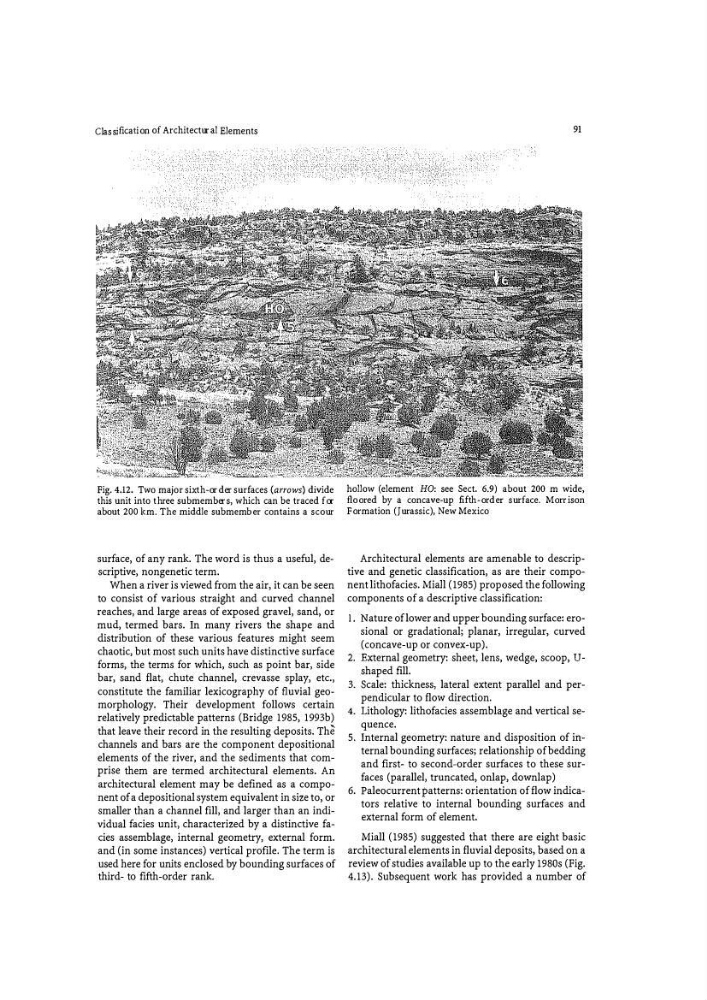
Fig. 4.12. Two majo r sixth-order su rfaces (arrows) divide
this unit into three submembers, which can be traced for
about 200 km. The middle submember contains a scour
surface, of any rank. The word is thus a useful, descriptive, nongenetic term.
When a river is viewed from the air, it can be seen
to consist of various straight and curved channel
reaches, and large areas of exposed gravel, sand, or
mud, termed bars. In many rivers the shape and
distribution of these various features might seem
chaotic, but most such units have distinctive surface
forms, the terms for which, such as point bar, side
bar, sand flat, chute channel, crevasse splay, etc.,
constitute the familiar lexicography of fluvial geomorphology. Their development follows certain
relatively predictable patterns (Bridge 1985, 1993b)
that leave their record in the resulting deposits. The
channels and bars are the component depositional
elements of the river, and the sediments that comprise them are termed architectural elements. An
architectural element may be defined as a component of a depositional system equivalent in size to, or
smaller than a channel fill, and larger than an individual facies unit, characterized by a distinctive facies assemblage, internal geometry, external form.
and (in some instances) vertical profile. The term is
used here for units enclosed by bounding surfaces of
third- to fifth-order rank.
91
hollow (element HO: see Sect. 6.9) about 200 m wide,
fl oored by a concave-up fifth-order surface. Morrison
Formation (Jurassic), New Mexico
Architectural elements are amenable to descriptive and genetic classification, as are their component lithofacies. Miall (1985) proposed the following
components of a descriptive classification:
l. Nature of lower and upper bounding surface: erosional or gradational; planar, irregular, curved
(concave-up or convex-up).
2. External geometry: sheet, lens, wedge, scoop, Ushaped fill.
3. Scale: thickness, lateral extent parallel and perpendicular to flow direction.
4. Lithology: lithofacies assemblage and vertical sequence.
5. Internal geometry: nature and disposition of internal bounding surfaces; relationship of bedding
and first- to second-order surfaces to these surfaces (parallel, truncated, onlap, downlap)
6. Paleocurrent patterns: orientation of flow indicators relative to internal bounding surfaces and
external form of element.
Miall (1985) suggested that there are eight basic
architectural elements in fluvial deposits, based on a
review of studies available up to the early 1980s (Fig.
4.13). Subsequent work has provided a number of
Fig. 4.12. Two majo r sixth-order su rfaces (arrows) divide
this unit into three submembers, which can be traced for
about 200 km. The middle submember contains a scour
surface, of any rank. The word is thus a useful, descriptive, nongenetic term.
When a river is viewed from the air, it can be seen
to consist of various straight and curved channel
reaches, and large areas of exposed gravel, sand, or
mud, termed bars. In many rivers the shape and
distribution of these various features might seem
chaotic, but most such units have distinctive surface
forms, the terms for which, such as point bar, side
bar, sand flat, chute channel, crevasse splay, etc.,
constitute the familiar lexicography of fluvial geomorphology. Their development follows certain
relatively predictable patterns (Bridge 1985, 1993b)
that leave their record in the resulting deposits. The
channels and bars are the component depositional
elements of the river, and the sediments that comprise them are termed architectural elements. An
architectural element may be defined as a component of a depositional system equivalent in size to, or
smaller than a channel fill, and larger than an individual facies unit, characterized by a distinctive facies assemblage, internal geometry, external form.
and (in some instances) vertical profile. The term is
used here for units enclosed by bounding surfaces of
third- to fifth-order rank.
91
hollow (element HO: see Sect. 6.9) about 200 m wide,
fl oored by a concave-up fifth-order surface. Morrison
Formation (Jurassic), New Mexico
Architectural elements are amenable to descriptive and genetic classification, as are their component lithofacies. Miall (1985) proposed the following
components of a descriptive classification:
l. Nature of lower and upper bounding surface: erosional or gradational; planar, irregular, curved
(concave-up or convex-up).
2. External geometry: sheet, lens, wedge, scoop, Ushaped fill.
3. Scale: thickness, lateral extent parallel and perpendicular to flow direction.
4. Lithology: lithofacies assemblage and vertical sequence.
5. Internal geometry: nature and disposition of internal bounding surfaces; relationship of bedding
and first- to second-order surfaces to these surfaces (parallel, truncated, onlap, downlap)
6. Paleocurrent patterns: orientation of flow indicators relative to internal bounding surfaces and
external form of element.
Miall (1985) suggested that there are eight basic
architectural elements in fluvial deposits, based on a
review of studies available up to the early 1980s (Fig.
4.13). Subsequent work has provided a number of