

Cla $s ification of Architectural Elements
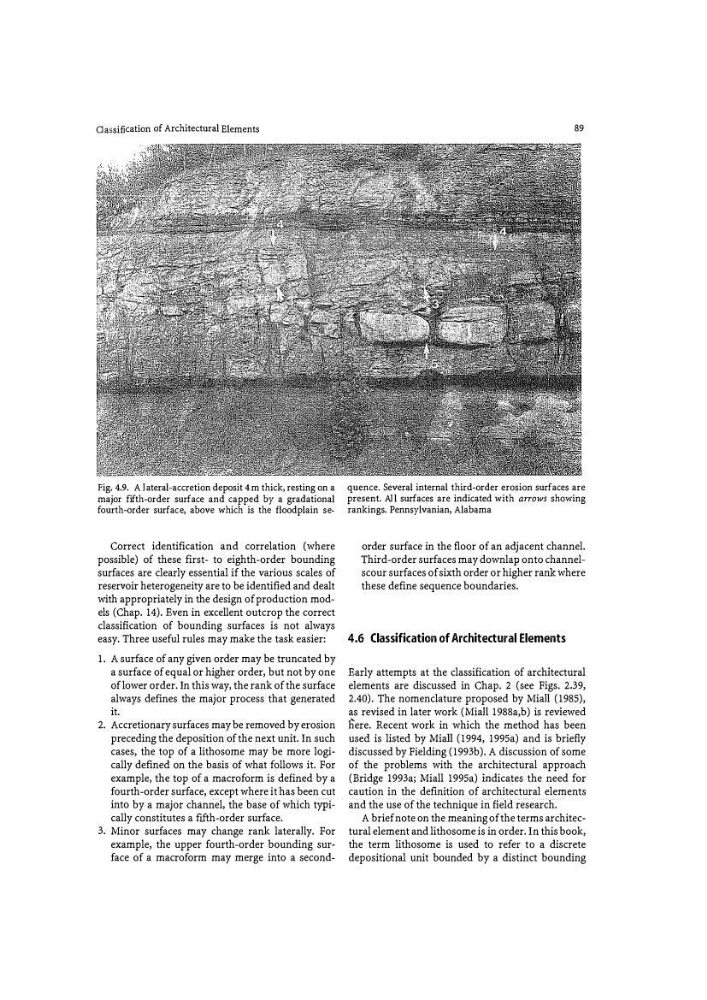
Fig. 4.9. A lateral-accretion deposit 4 m thick, resting on a
major fifth�order surface and capped by a gradational
fo urth�order surface, above which is the floodplain se�
Correct identification and correlation (where
possible) of these first- to eighth-order bounding
surfaces are clearly essential if the various scales of
reservoir heterogeneity are to be identified and dealt
with appropriately in the design of production models (Chap. 14). Even in excellent outcrop the correct
classification of bounding surfaces is not always
easy. Three useful rules may make the task easier:
1. A surface of any given order may be truncated by
a surface of equal or higher order, but not by one
of lower order. In this way, the rank of the surface
always defines the major process that generated
it.
2. Accretionary surfaces may be removed by erosion
preceding the deposition of the next unit. In such
cases, the top of a lithesome may be more logically defined on the basis of what follows it. For
example, the top of a macro form is defined by a
fourth-order surface, except where it has been cut
into by a major channel� the base of which typically constitutes a fifth-order surface.
3. Minor surfaces may change rank laterally. For
example, the upper fourth-order bounding surface of a macroform may merge into a second89
quence. Several internal third-order erosion surfaces are
present. All surfaces are indicated with arrows showing
rankings. Pennsylvanian, Alabama
order surface in the floor of an adjacent channel.
Third-order surfaces may downlap onto channelscour surfaces of sixth order or higher rank where
these define sequence boundaries.
4.6 Classification of Architectural Elements
Early attempts at the classification of architectural
elements are discussed in Chap. 2 (see Figs. 2.391
2.40). The nomenclature proposed by Miall (1985),
as revised in later work (Miall 1988a,b) is reviewed
here. Recent work in which the method has been
used is listed by Mia!! (1994, 1995a) and is briefly
discussed by Fielding (1993b). A discussion of some
of the problems with the architectural approach
(Bridge 1993a; Miall 1995a) indicates the need for
caution in the definition of architectural elements
and the use of the technique in field research.
A brief note on the meaning of the terms architectural element and lithesome is in order. In this book,
the term lithesome is used to refer to a discrete
depositional unit bounded by a distinct bounding
Fig. 4.9. A lateral-accretion deposit 4 m thick, resting on a
major fifth�order surface and capped by a gradational
fo urth�order surface, above which is the floodplain se�
Correct identification and correlation (where
possible) of these first- to eighth-order bounding
surfaces are clearly essential if the various scales of
reservoir heterogeneity are to be identified and dealt
with appropriately in the design of production models (Chap. 14). Even in excellent outcrop the correct
classification of bounding surfaces is not always
easy. Three useful rules may make the task easier:
1. A surface of any given order may be truncated by
a surface of equal or higher order, but not by one
of lower order. In this way, the rank of the surface
always defines the major process that generated
it.
2. Accretionary surfaces may be removed by erosion
preceding the deposition of the next unit. In such
cases, the top of a lithesome may be more logically defined on the basis of what follows it. For
example, the top of a macro form is defined by a
fourth-order surface, except where it has been cut
into by a major channel� the base of which typically constitutes a fifth-order surface.
3. Minor surfaces may change rank laterally. For
example, the upper fourth-order bounding surface of a macroform may merge into a second89
quence. Several internal third-order erosion surfaces are
present. All surfaces are indicated with arrows showing
rankings. Pennsylvanian, Alabama
order surface in the floor of an adjacent channel.
Third-order surfaces may downlap onto channelscour surfaces of sixth order or higher rank where
these define sequence boundaries.
4.6 Classification of Architectural Elements
Early attempts at the classification of architectural
elements are discussed in Chap. 2 (see Figs. 2.391
2.40). The nomenclature proposed by Miall (1985),
as revised in later work (Miall 1988a,b) is reviewed
here. Recent work in which the method has been
used is listed by Mia!! (1994, 1995a) and is briefly
discussed by Fielding (1993b). A discussion of some
of the problems with the architectural approach
(Bridge 1993a; Miall 1995a) indicates the need for
caution in the definition of architectural elements
and the use of the technique in field research.
A brief note on the meaning of the terms architectural element and lithesome is in order. In this book,
the term lithesome is used to refer to a discrete
depositional unit bounded by a distinct bounding