

Corrigés desproblèmes
197
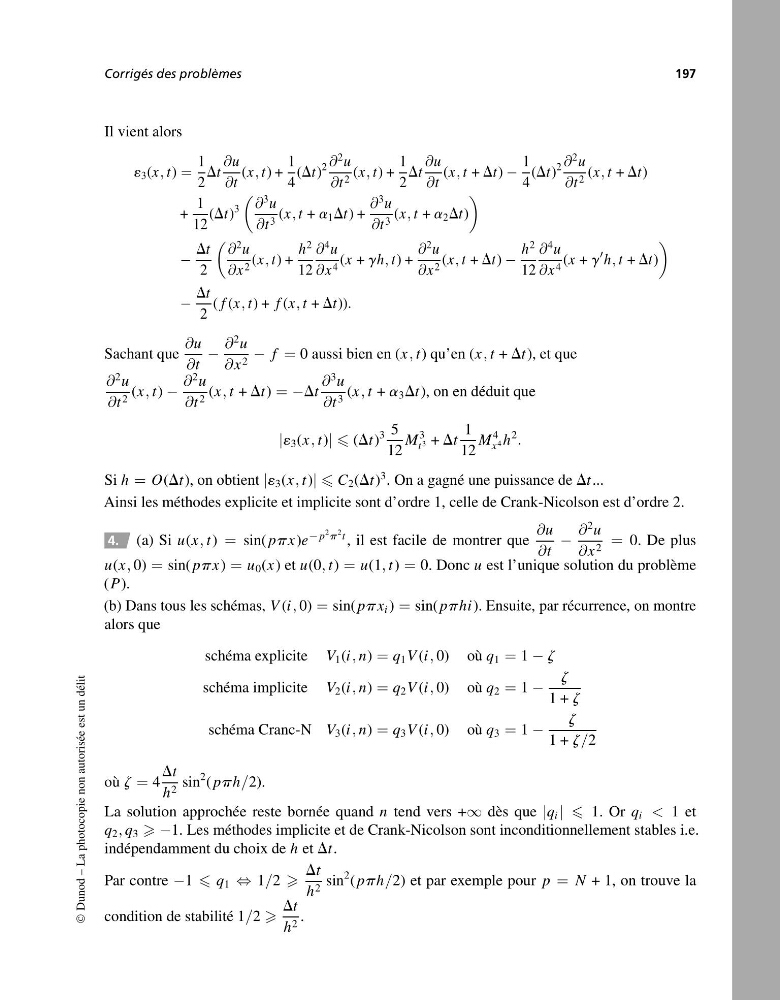
Il vient alors
´ 3 ( x , t ) =
1
2
D t
∂ u
∂ t
( x , t )+
1
4
( D t )
2 ∂
2
u
∂ t 2 ( x , t )+
1
2
D t
∂ u
∂ t
( x , t + D t ) −
1
4
( D t )
2 ∂
2
u
∂ t 2 ( x , t + D t )
+
1
12
( D t )
3
∂
3
u
∂ t 3 ( x , t + a 1 D t )+
∂
3
u
∂ t 3 ( x , t + a 2 D t )
−
D t
2
∂
2
u
∂ x 2 ( x , t )+
h
2
12
∂
4
u
∂ x 4 ( x + g h , t )+
∂
2
u
∂ x 2 ( x , t + D t ) −
h
2
12
∂
4
u
∂ x 4 ( x + g
h , t + D t )
−
D t
2
( f ( x , t )+ f ( x , t + D t )).
Sachant que
∂ u
∂ t
−
∂
2
u
∂ x 2 − f = 0aussi bien en ( x , t )qu’en ( x , t + D t ), et que
∂
2
u
∂ t 2 ( x , t ) −
∂
2
u
∂ t 2 ( x , t + D t ) = − D t
∂
3
u
∂ t 3 ( x , t + a 3 D t ), on en déduit que
| ´ 3 ( x , t ) | ( D t )
3 5
12
M
3
t 3 + D t
1
12
M
4
x 4 h
2
.
Si h = O ( D t ), on obtient | ´ 3 ( x , t ) | C 2 ( D t )
3
.Onagagné une puissance de D t ...
Ainsi les méthodes explicite et implicite sont d’ordre1,celle de Crank-Nicolson est d’ordre 2.
4. (a) Si u ( x , t ) = sin( p p x ) e
− p
2 p
2 t
,i le st facile de montrer que
∂ u
∂ t
−
∂
2
u
∂ x 2 = 0. De plus
u ( x , 0) = sin( p p x ) = u 0 ( x )et u (0, t ) = u (1, t ) = 0. Donc u est l’unique solution du problème
( P ).
(b) Dans tous les schémas, V ( i , 0) = sin( p p x i ) = sin( p p hi). Ensuite, par récurrence, on montre
alorsque
schéma explicite V 1 ( i , n ) = q 1 V ( i , 0) où q 1 = 1 − z
schéma implicite V 2 ( i , n ) = q 2 V ( i , 0) où q 2 = 1 −
z
1+z
schéma Cranc-N V 3 ( i , n ) = q 3 V ( i , 0) où q 3 = 1 −
z
1+z / 2
où z = 4
D t
h 2 sin
2
( p p h / 2).
La solution approchée reste bornée quand n tend vers + ∞ dès que | q i | 1. Or q i < 1e t
q 2 , q 3 − 1. Les méthodes implicite et de Crank-Nicolson sont inconditionnellementstables i.e.
indépendamment du choix de h et D t .
Parc ontre − 1 q 1 ⇔ 1 / 2
D t
h 2 sin
2
( p p h / 2) et par exemple pour p = N +1,ontrouvel a
condition de stabilité 1 / 2
D t
h 2 .
Dunod –Laphotocopie non autorisée est un délit
197
Il vient alors
´ 3 ( x , t ) =
1
2
D t
∂ u
∂ t
( x , t )+
1
4
( D t )
2 ∂
2
u
∂ t 2 ( x , t )+
1
2
D t
∂ u
∂ t
( x , t + D t ) −
1
4
( D t )
2 ∂
2
u
∂ t 2 ( x , t + D t )
+
1
12
( D t )
3
∂
3
u
∂ t 3 ( x , t + a 1 D t )+
∂
3
u
∂ t 3 ( x , t + a 2 D t )
−
D t
2
∂
2
u
∂ x 2 ( x , t )+
h
2
12
∂
4
u
∂ x 4 ( x + g h , t )+
∂
2
u
∂ x 2 ( x , t + D t ) −
h
2
12
∂
4
u
∂ x 4 ( x + g
h , t + D t )
−
D t
2
( f ( x , t )+ f ( x , t + D t )).
Sachant que
∂ u
∂ t
−
∂
2
u
∂ x 2 − f = 0aussi bien en ( x , t )qu’en ( x , t + D t ), et que
∂
2
u
∂ t 2 ( x , t ) −
∂
2
u
∂ t 2 ( x , t + D t ) = − D t
∂
3
u
∂ t 3 ( x , t + a 3 D t ), on en déduit que
| ´ 3 ( x , t ) | ( D t )
3 5
12
M
3
t 3 + D t
1
12
M
4
x 4 h
2
.
Si h = O ( D t ), on obtient | ´ 3 ( x , t ) | C 2 ( D t )
3
.Onagagné une puissance de D t ...
Ainsi les méthodes explicite et implicite sont d’ordre1,celle de Crank-Nicolson est d’ordre 2.
4. (a) Si u ( x , t ) = sin( p p x ) e
− p
2 p
2 t
,i le st facile de montrer que
∂ u
∂ t
−
∂
2
u
∂ x 2 = 0. De plus
u ( x , 0) = sin( p p x ) = u 0 ( x )et u (0, t ) = u (1, t ) = 0. Donc u est l’unique solution du problème
( P ).
(b) Dans tous les schémas, V ( i , 0) = sin( p p x i ) = sin( p p hi). Ensuite, par récurrence, on montre
alorsque
schéma explicite V 1 ( i , n ) = q 1 V ( i , 0) où q 1 = 1 − z
schéma implicite V 2 ( i , n ) = q 2 V ( i , 0) où q 2 = 1 −
z
1+z
schéma Cranc-N V 3 ( i , n ) = q 3 V ( i , 0) où q 3 = 1 −
z
1+z / 2
où z = 4
D t
h 2 sin
2
( p p h / 2).
La solution approchée reste bornée quand n tend vers + ∞ dès que | q i | 1. Or q i < 1e t
q 2 , q 3 − 1. Les méthodes implicite et de Crank-Nicolson sont inconditionnellementstables i.e.
indépendamment du choix de h et D t .
Parc ontre − 1 q 1 ⇔ 1 / 2
D t
h 2 sin
2
( p p h / 2) et par exemple pour p = N +1,ontrouvel a
condition de stabilité 1 / 2
D t
h 2 .
Dunod –Laphotocopie non autorisée est un délit