

196
11
•
Problèmes
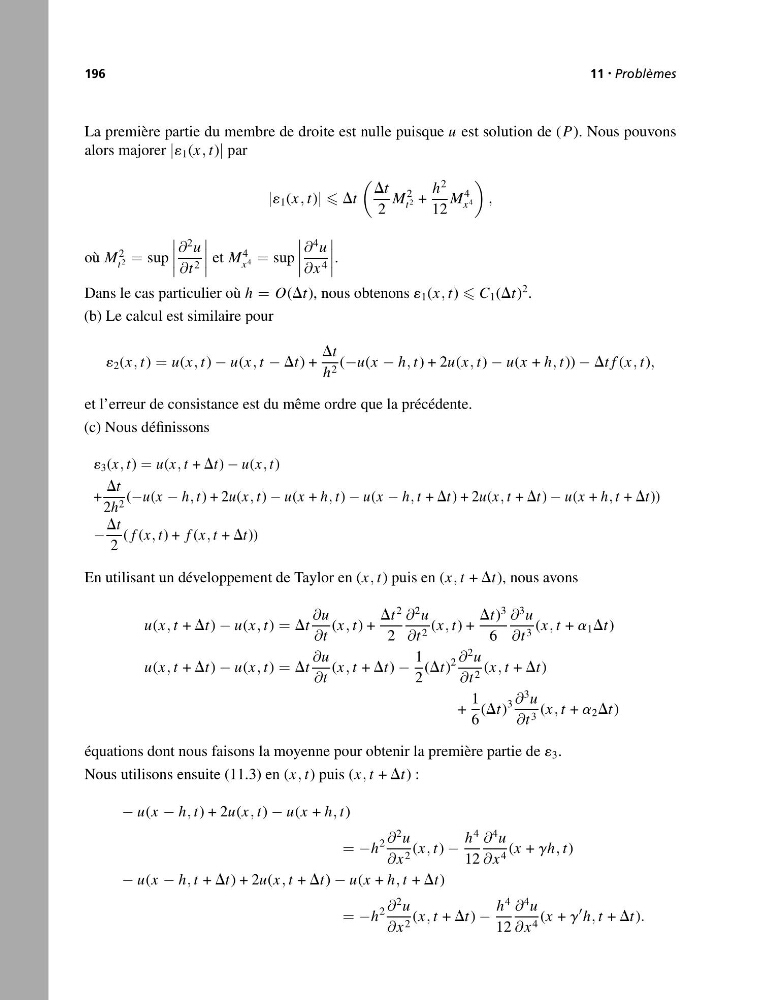
La première partie du membre de droite est nulle puisque u est solution de ( P ). Nous pouvons
alors majorer | ´ 1 ( x , t ) | par
| ´ 1 ( x , t ) | D t
D t
2
M
2
t 2 +
h
2
12
M
4
x 4
,
où M
2
t 2 = sup
∂
2
u
∂ t 2
et M
4
x 4 = sup
∂
4
u
∂ x 4
.
Dans le cas particulier où h = O ( D t ), nous obtenons ´ 1 ( x , t ) C 1 ( D t )
2
.
(b) Le calcul est similaire pour
´ 2 ( x , t ) = u ( x , t ) − u ( x , t − D t )+
D t
h 2 ( − u ( x − h , t )+2 u ( x , t ) − u ( x + h , t )) − D tf( x , t ) ,
et l’erreur de consistance est du même ordre que la précédente.
(c) Nous définissons
´ 3 ( x , t ) = u ( x , t + D t ) − u ( x , t )
+
D t
2 h 2 ( − u ( x − h , t )+2u ( x , t ) − u ( x + h , t ) − u ( x − h , t + D t )+2u ( x , t + D t ) − u ( x + h , t + D t ))
−
D t
2
( f ( x , t )+ f ( x , t + D t ))
En utilisantundéveloppement de Taylor en ( x , t )puis en ( x , t + D t ), nous avons
u ( x , t + D t ) − u ( x , t ) = D t
∂ u
∂ t
( x , t )+
D t
2
2
∂
2
u
∂ t 2 ( x , t )+
D t )
3
6
∂
3
u
∂ t 3 ( x , t + a 1 D t )
u ( x , t + D t ) − u ( x , t ) = D t
∂ u
∂ t
( x , t + D t ) −
1
2
( D t )
2 ∂
2
u
∂ t 2 ( x , t + D t )
+
1
6
( D t )
3 ∂
3
u
∂ t 3 ( x , t + a 2 D t )
équations dont nous faisons la moyenne pour obtenir la première partie de ´ 3 .
Nous utilisons ensuite (11.3) en ( x , t )puis ( x , t + D t ):
− u ( x − h , t )+2u ( x , t ) − u ( x + h , t )
= − h
2 ∂
2
u
∂ x 2 ( x , t ) −
h
4
12
∂
4
u
∂ x 4 ( x + g h , t )
− u ( x − h , t + D t )+2u ( x , t + D t ) − u ( x + h , t + D t )
= − h
2 ∂
2
u
∂ x 2 ( x , t + D t ) −
h
4
12
∂
4
u
∂ x 4 ( x + g
h , t + D t ) .
11
•
Problèmes
La première partie du membre de droite est nulle puisque u est solution de ( P ). Nous pouvons
alors majorer | ´ 1 ( x , t ) | par
| ´ 1 ( x , t ) | D t
D t
2
M
2
t 2 +
h
2
12
M
4
x 4
,
où M
2
t 2 = sup
∂
2
u
∂ t 2
et M
4
x 4 = sup
∂
4
u
∂ x 4
.
Dans le cas particulier où h = O ( D t ), nous obtenons ´ 1 ( x , t ) C 1 ( D t )
2
.
(b) Le calcul est similaire pour
´ 2 ( x , t ) = u ( x , t ) − u ( x , t − D t )+
D t
h 2 ( − u ( x − h , t )+2 u ( x , t ) − u ( x + h , t )) − D tf( x , t ) ,
et l’erreur de consistance est du même ordre que la précédente.
(c) Nous définissons
´ 3 ( x , t ) = u ( x , t + D t ) − u ( x , t )
+
D t
2 h 2 ( − u ( x − h , t )+2u ( x , t ) − u ( x + h , t ) − u ( x − h , t + D t )+2u ( x , t + D t ) − u ( x + h , t + D t ))
−
D t
2
( f ( x , t )+ f ( x , t + D t ))
En utilisantundéveloppement de Taylor en ( x , t )puis en ( x , t + D t ), nous avons
u ( x , t + D t ) − u ( x , t ) = D t
∂ u
∂ t
( x , t )+
D t
2
2
∂
2
u
∂ t 2 ( x , t )+
D t )
3
6
∂
3
u
∂ t 3 ( x , t + a 1 D t )
u ( x , t + D t ) − u ( x , t ) = D t
∂ u
∂ t
( x , t + D t ) −
1
2
( D t )
2 ∂
2
u
∂ t 2 ( x , t + D t )
+
1
6
( D t )
3 ∂
3
u
∂ t 3 ( x , t + a 2 D t )
équations dont nous faisons la moyenne pour obtenir la première partie de ´ 3 .
Nous utilisons ensuite (11.3) en ( x , t )puis ( x , t + D t ):
− u ( x − h , t )+2u ( x , t ) − u ( x + h , t )
= − h
2 ∂
2
u
∂ x 2 ( x , t ) −
h
4
12
∂
4
u
∂ x 4 ( x + g h , t )
− u ( x − h , t + D t )+2u ( x , t + D t ) − u ( x + h , t + D t )
= − h
2 ∂
2
u
∂ x 2 ( x , t + D t ) −
h
4
12
∂
4
u
∂ x 4 ( x + g
h , t + D t ) .