

Corrigés desexercices
119
8.5 Méthode de tir
1. Y ( t ) =
y ( t )
y
( t )
=
y 1 ( t )
y 2 ( t )
,calculer Y
( t ).
CORRIGÉS DES EXERCICES
8.1 Conditions initiales et pas
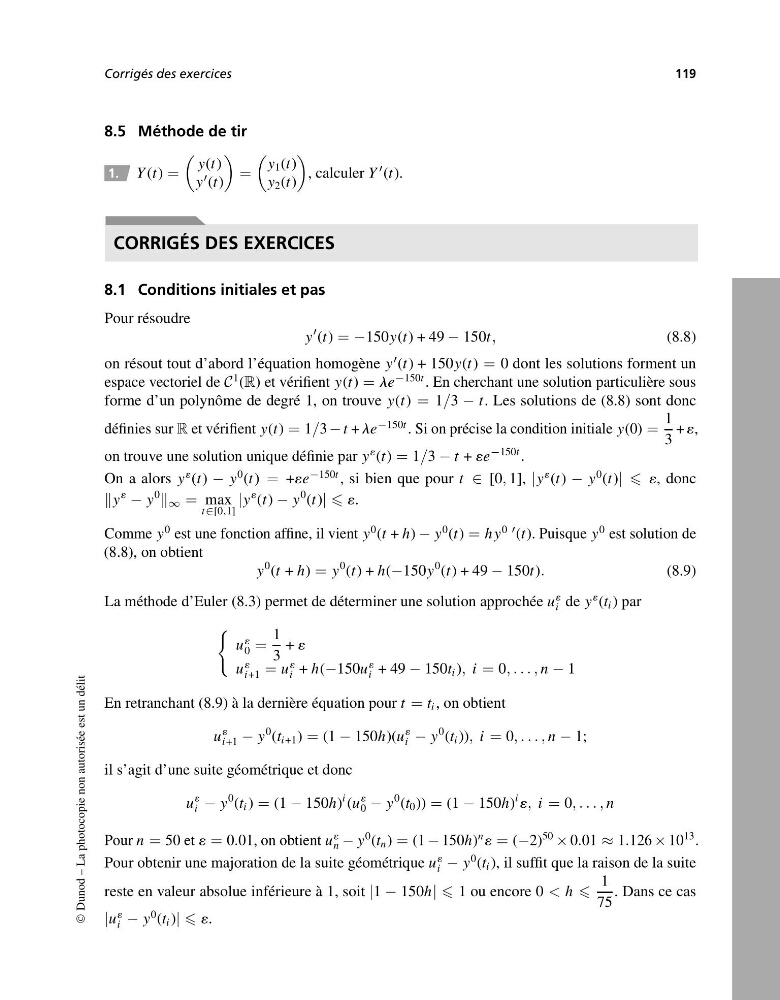
Pour résoudre
y
( t ) = − 150y ( t )+49 − 150t ,
(8.8)
on résout tout d’abord l’équation homogène y
( t )+150y ( t ) = 0dont les solutions forment un
espacevectoriel de C
1
( R )etvérifient y ( t ) = l e
− 150t
.Encherchant une solution particulière sous
formed ’un polynôme de degré 1, on trouve y ( t ) = 1 / 3 − t .L es solutions de (8.8) sontd onc
définies sur R et vérifient y ( t ) = 1 / 3 − t + l e
− 150t
.Sionprécise la condition initiale y (0) =
1
3
+ ´ ,
on trouveune solution unique définie par y
´
( t ) = 1 / 3 − t + ´ e
− 150t
.
On aa lors y
´
( t ) − y
0
( t ) = + ´ e
− 150t
,s ib ien que pour t ∈ [0, 1], | y
´
( t ) − y
0
( t ) | ´ ,d onc
y
´
− y
0
∞ = max
t ∈ [0, 1]
| y
´
( t ) − y
0
( t ) | ´ .
Comme y
0
est une fonction affine, il vient y
0
( t + h ) − y
0
( t ) = hy
0
( t ). Puisque y
0
est solution de
(8.8), on obtient
y
0
( t + h ) = y
0
( t )+h ( − 150y
0
( t )+49 − 150t ) .
(8.9)
La méthode d’Euler (8.3) permetdedéterminer une solution approchée u
´
i de y
´
( t i )par
u
´
0 =
1
3
+ ´
u
´
i +1 = u
´
i + h ( − 150u
´
i +49 − 150t i ) , i = 0 ,...,n − 1
En retranchant (8.9) àladernière équation pour t = t i ,onobtient
u
´
i +1 − y
0
( t i +1 ) = (1 − 150h )(u
´
i − y
0
( t i )), i = 0 ,...,n − 1;
il s’agit d’une suite géométrique et donc
u
´
i − y
0
( t i ) = (1 − 150h )
i
( u
´
0 − y
0
( t 0 )) = (1 − 150h )
i
´ , i = 0 ,...,n
Pour n = 50 et ´ = 0 . 01, on obtient u
´
n − y
0
( t n ) = (1 − 150h )
n
´ = ( − 2)
50
× 0 . 01 ≈ 1 . 126 × 10
13
.
Pour obtenir une majoration de la suite géométrique u
´
i − y
0
( t i ), il suffit que la raison de la suite
reste en valeur absolue inférieure à1,soit | 1 − 150h | 1ouencore0< h
1
75
.Dans ce cas
| u
´
i − y
0
( t i ) | ´ .
Dunod –Laphotocopie non autorisée est un délit
119
8.5 Méthode de tir
1. Y ( t ) =
y ( t )
y
( t )
=
y 1 ( t )
y 2 ( t )
,calculer Y
( t ).
CORRIGÉS DES EXERCICES
8.1 Conditions initiales et pas
Pour résoudre
y
( t ) = − 150y ( t )+49 − 150t ,
(8.8)
on résout tout d’abord l’équation homogène y
( t )+150y ( t ) = 0dont les solutions forment un
espacevectoriel de C
1
( R )etvérifient y ( t ) = l e
− 150t
.Encherchant une solution particulière sous
formed ’un polynôme de degré 1, on trouve y ( t ) = 1 / 3 − t .L es solutions de (8.8) sontd onc
définies sur R et vérifient y ( t ) = 1 / 3 − t + l e
− 150t
.Sionprécise la condition initiale y (0) =
1
3
+ ´ ,
on trouveune solution unique définie par y
´
( t ) = 1 / 3 − t + ´ e
− 150t
.
On aa lors y
´
( t ) − y
0
( t ) = + ´ e
− 150t
,s ib ien que pour t ∈ [0, 1], | y
´
( t ) − y
0
( t ) | ´ ,d onc
y
´
− y
0
∞ = max
t ∈ [0, 1]
| y
´
( t ) − y
0
( t ) | ´ .
Comme y
0
est une fonction affine, il vient y
0
( t + h ) − y
0
( t ) = hy
0
( t ). Puisque y
0
est solution de
(8.8), on obtient
y
0
( t + h ) = y
0
( t )+h ( − 150y
0
( t )+49 − 150t ) .
(8.9)
La méthode d’Euler (8.3) permetdedéterminer une solution approchée u
´
i de y
´
( t i )par
u
´
0 =
1
3
+ ´
u
´
i +1 = u
´
i + h ( − 150u
´
i +49 − 150t i ) , i = 0 ,...,n − 1
En retranchant (8.9) àladernière équation pour t = t i ,onobtient
u
´
i +1 − y
0
( t i +1 ) = (1 − 150h )(u
´
i − y
0
( t i )), i = 0 ,...,n − 1;
il s’agit d’une suite géométrique et donc
u
´
i − y
0
( t i ) = (1 − 150h )
i
( u
´
0 − y
0
( t 0 )) = (1 − 150h )
i
´ , i = 0 ,...,n
Pour n = 50 et ´ = 0 . 01, on obtient u
´
n − y
0
( t n ) = (1 − 150h )
n
´ = ( − 2)
50
× 0 . 01 ≈ 1 . 126 × 10
13
.
Pour obtenir une majoration de la suite géométrique u
´
i − y
0
( t i ), il suffit que la raison de la suite
reste en valeur absolue inférieure à1,soit | 1 − 150h | 1ouencore0< h
1
75
.Dans ce cas
| u
´
i − y
0
( t i ) | ´ .
Dunod –Laphotocopie non autorisée est un délit