

Estimating Mature Plays
45
biased samples on the estimation of a correlation matrix. The covariance matrix of the random variables—pool area, net pay, porosity, and
water saturation—were determined by
estimating the values of
1.
β and N by LDSCV, NDSCV, or other
methods
computing the values of
2.
β 1 , β 2 , β 3 , and β 4 using multiple regression analysis: log pool size = β 1 log pool area + β 2 log net pay +
β 3 log porosity + β 4 log water saturation
entering all estimated
3.
β i ’s, N ˆ , and β ˆ into Equation 3.9 and estimating θ = (, ⌺)
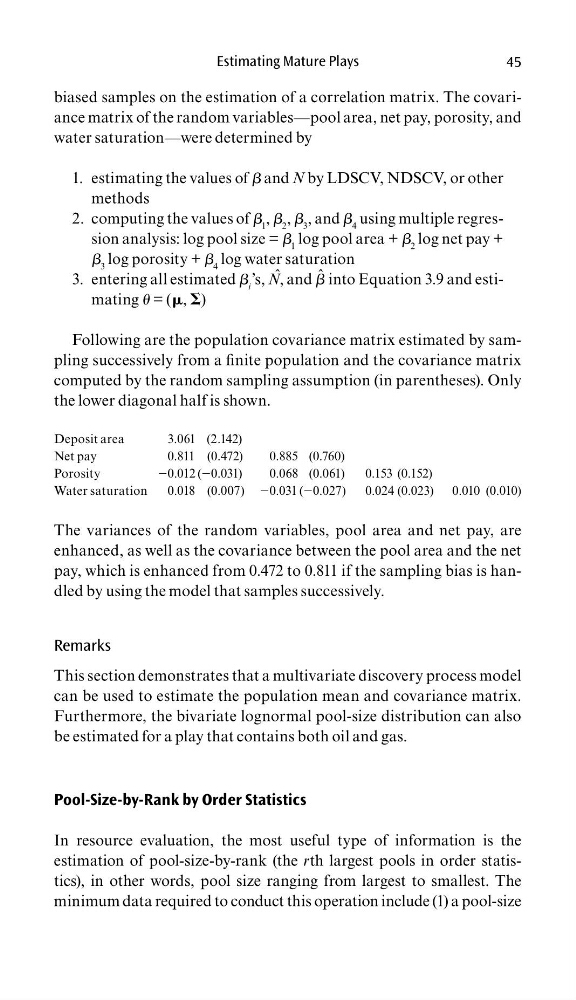
Following are the population covariance matrix estimated by sampling successively from a fi nite population and the covariance matrix
computed by the random sampling assumption (in parentheses). Only
the lower diagonal half is shown.
Deposit area
3.061 (2.142)
Net pay
0.811 (0.472)
0.885 (0.760)
Porosity
−0.012 (−0.031)
0.068 (0.061)
0.153 (0.152)
Water saturation
0.018 (0.007) −0.031 (−0.027)
0.024 (0.023) 0.010 (0.010)
The variances of the random variables, pool area and net pay, are
enhanced, as well as the covariance between the pool area and the net
pay, which is enhanced from 0.472 to 0.811 if the sampling bias is handled by using the model that samples successively.
Remarks
This section demonstrates that a multivariate discovery process model
can be used to estimate the population mean and covariance matrix.
Furthermore, the bivariate lognormal pool-size distribution can also
be estimated for a play that contains both oil and gas.
Pool-Size-by-Rank by Order Statistics
In resource evaluation, the most useful type of information is the
estimation of pool-size-by-rank (the rth largest pools in order statistics), in other words, pool size ranging from largest to smallest. The
minimum data required to conduct this operation include (1) a pool-size
45
biased samples on the estimation of a correlation matrix. The covariance matrix of the random variables—pool area, net pay, porosity, and
water saturation—were determined by
estimating the values of
1.
β and N by LDSCV, NDSCV, or other
methods
computing the values of
2.
β 1 , β 2 , β 3 , and β 4 using multiple regression analysis: log pool size = β 1 log pool area + β 2 log net pay +
β 3 log porosity + β 4 log water saturation
entering all estimated
3.
β i ’s, N ˆ , and β ˆ into Equation 3.9 and estimating θ = (, ⌺)
Following are the population covariance matrix estimated by sampling successively from a fi nite population and the covariance matrix
computed by the random sampling assumption (in parentheses). Only
the lower diagonal half is shown.
Deposit area
3.061 (2.142)
Net pay
0.811 (0.472)
0.885 (0.760)
Porosity
−0.012 (−0.031)
0.068 (0.061)
0.153 (0.152)
Water saturation
0.018 (0.007) −0.031 (−0.027)
0.024 (0.023) 0.010 (0.010)
The variances of the random variables, pool area and net pay, are
enhanced, as well as the covariance between the pool area and the net
pay, which is enhanced from 0.472 to 0.811 if the sampling bias is handled by using the model that samples successively.
Remarks
This section demonstrates that a multivariate discovery process model
can be used to estimate the population mean and covariance matrix.
Furthermore, the bivariate lognormal pool-size distribution can also
be estimated for a play that contains both oil and gas.
Pool-Size-by-Rank by Order Statistics
In resource evaluation, the most useful type of information is the
estimation of pool-size-by-rank (the rth largest pools in order statistics), in other words, pool size ranging from largest to smallest. The
minimum data required to conduct this operation include (1) a pool-size