

Evaluation Models
9
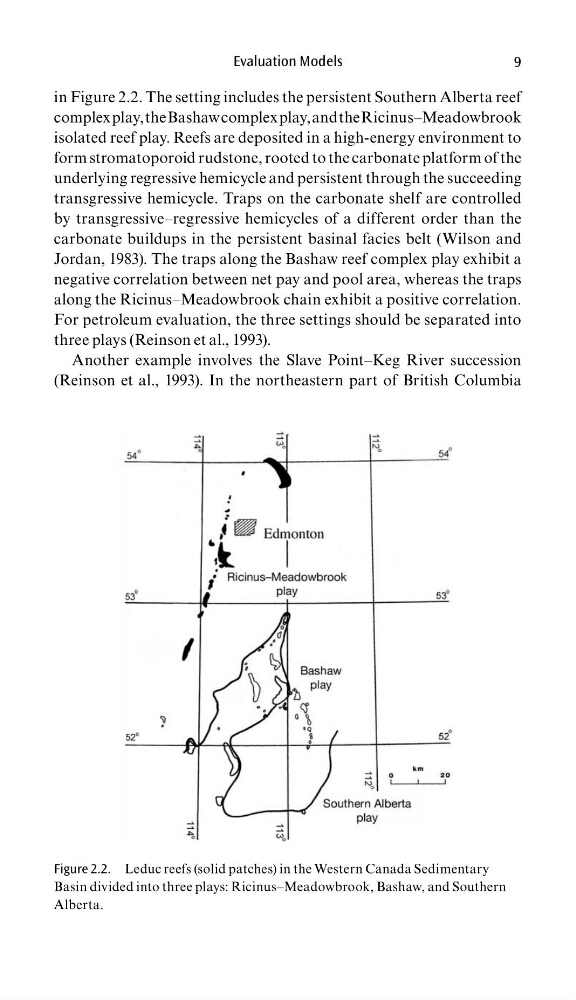
in Figure 2.2. The setting includes the persistent Southern Alberta reef
complex play, the Bashaw complex play, and the Ricinus–Meadowbrook
isolated reef play. Reefs are deposited in a high-energy environment to
form stromatoporoid rudstone, rooted to the carbonate platform of the
underlying regressive hemicycle and persistent through the succeeding
transgressive hemicycle. Traps on the carbonate shelf are controlled
by transgressive–regressive hemicycles of a different order than the
carbonate buildups in the persistent basinal facies belt (Wilson and
Jordan, 1983). The traps along the Bashaw reef complex play exhibit a
negative correlation between net pay and pool area, whereas the traps
along the Ricinus–Meadowbrook chain exhibit a positive correlation.
For petroleum evaluation, the three settings should be separated into
three plays (Reinson et al., 1993).
Another example involves the Slave Point–Keg River succession
(Reinson et al., 1993). In the northeastern part of British Columbia
Figure 2.2. Leduc reefs (solid patches) in the Western Canada Sedimentary
Basin divided into three plays: Ricinus–Meadowbrook, Bashaw, and Southern
Alberta.
9
in Figure 2.2. The setting includes the persistent Southern Alberta reef
complex play, the Bashaw complex play, and the Ricinus–Meadowbrook
isolated reef play. Reefs are deposited in a high-energy environment to
form stromatoporoid rudstone, rooted to the carbonate platform of the
underlying regressive hemicycle and persistent through the succeeding
transgressive hemicycle. Traps on the carbonate shelf are controlled
by transgressive–regressive hemicycles of a different order than the
carbonate buildups in the persistent basinal facies belt (Wilson and
Jordan, 1983). The traps along the Bashaw reef complex play exhibit a
negative correlation between net pay and pool area, whereas the traps
along the Ricinus–Meadowbrook chain exhibit a positive correlation.
For petroleum evaluation, the three settings should be separated into
three plays (Reinson et al., 1993).
Another example involves the Slave Point–Keg River succession
(Reinson et al., 1993). In the northeastern part of British Columbia
Figure 2.2. Leduc reefs (solid patches) in the Western Canada Sedimentary
Basin divided into three plays: Ricinus–Meadowbrook, Bashaw, and Southern
Alberta.