

Estimation of Superpopulation Parameters
197
because an explorationist quite frequently has other pertinent geological information about the number of fi elds/pools that could exist in the
play. This information is usually summarized as a subjective distribution for N.
In a situation in which it is known that N has a fi nite support
N 1 , ..., N k , but unknown probability masses g 1 , ..., g k with S g i = 1, the
maximum-likelihood estimation procedure for (, r) is equivalent to the
likelihood profi le method on the support N 1 , ..., N k ; hence, no advantage is gained. This equivalence can be seen as follows: For fi xed , the
likelihood is maximized by setting all g 1 ’s to zero except for the one g j
with an associated N j that maximizes the conditional likelihoods of
given N = N i for i = 1, 2, ..., k.
Inference for the Weight Function
In this section we shall consider the weight function w( y, ) where
 is a vector of parameters b 1 , … b k , and look at the joint maximumlikelihood estimation of and . To this end, let r f (l|, ) be the Laplace
transform of w( y, ) with respect to f ( y| ), and let d G n (l|) be the
general gamma density with parameters b j (), where j = 1, 2, … , n. Let
S(, |x n ) be the integral given by Equation A.12 in terms of r f (l| , )
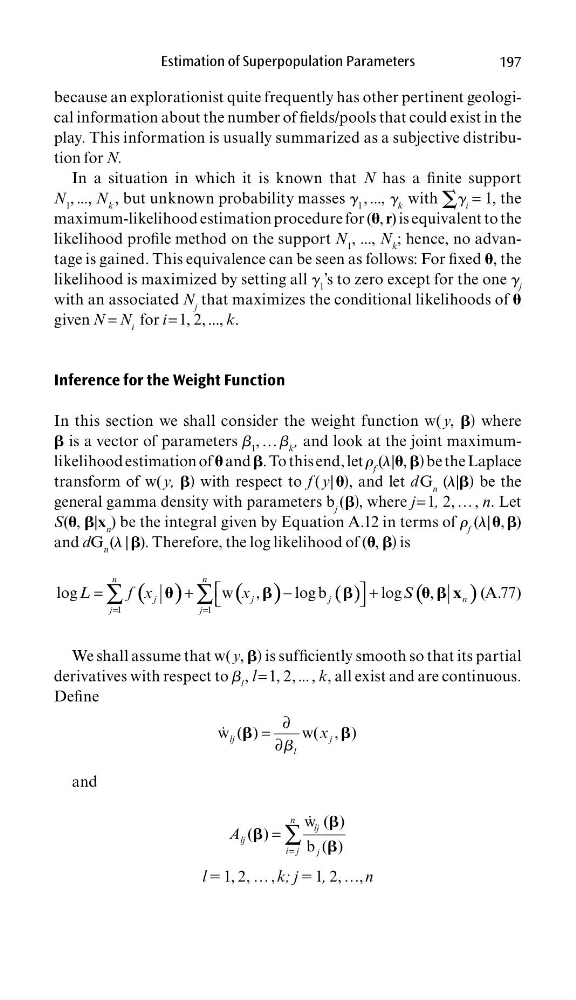
and dG n (l | ). Therefore, the log likelihood of (, ) is
( )
( )
( )
(
)
=
=
=
+
−
+
∑
∑
1
1
log
w ,
log b
log
,
n
n
j
j
j
n
j
j
L
f x
x
S
x


(A.77)
We shall assume that w( y, ) is suffi ciently smooth so that its partial
derivatives with respect to b l , l = 1, 2, ... , k, all exist and are continuous.
Defi ne
w ( )
w( , )
lj
j
l
x
∂
= ∂b


and
w ( )
( )
b ( )
n
lj
lj
i j
j
A
=
= ∑


l 5 1, 2, … , k; j 5 1, 2, …, n
197
because an explorationist quite frequently has other pertinent geological information about the number of fi elds/pools that could exist in the
play. This information is usually summarized as a subjective distribution for N.
In a situation in which it is known that N has a fi nite support
N 1 , ..., N k , but unknown probability masses g 1 , ..., g k with S g i = 1, the
maximum-likelihood estimation procedure for (, r) is equivalent to the
likelihood profi le method on the support N 1 , ..., N k ; hence, no advantage is gained. This equivalence can be seen as follows: For fi xed , the
likelihood is maximized by setting all g 1 ’s to zero except for the one g j
with an associated N j that maximizes the conditional likelihoods of
given N = N i for i = 1, 2, ..., k.
Inference for the Weight Function
In this section we shall consider the weight function w( y, ) where
 is a vector of parameters b 1 , … b k , and look at the joint maximumlikelihood estimation of and . To this end, let r f (l|, ) be the Laplace
transform of w( y, ) with respect to f ( y| ), and let d G n (l|) be the
general gamma density with parameters b j (), where j = 1, 2, … , n. Let
S(, |x n ) be the integral given by Equation A.12 in terms of r f (l| , )
and dG n (l | ). Therefore, the log likelihood of (, ) is
( )
( )
( )
(
)
=
=
=
+
−
+
∑
∑
1
1
log
w ,
log b
log
,
n
n
j
j
j
n
j
j
L
f x
x
S
x


(A.77)
We shall assume that w( y, ) is suffi ciently smooth so that its partial
derivatives with respect to b l , l = 1, 2, ... , k, all exist and are continuous.
Defi ne
w ( )
w( , )
lj
j
l
x
∂
= ∂b


and
w ( )
( )
b ( )
n
lj
lj
i j
j
A
=
= ∑


l 5 1, 2, … , k; j 5 1, 2, …, n