

190
Appendix A
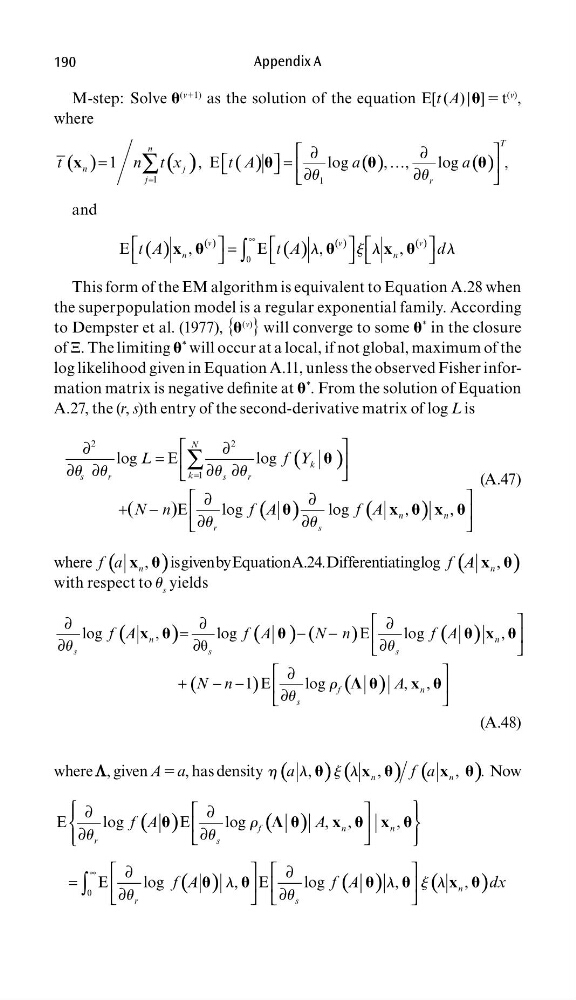
M-step: Solve
(v11) as the solution of the equation E[t (A) | ] 5 t
(v)
,
where
( )
( )
( )
( )
( )
=
∂
∂
=
=
∂
∂
∑
!
1
1
1
,E
l o g
, ,
l o g
,
T
n
n
j
j
r
t
n tx
t A
a
a
x
u
u
and
( )
( )
( )
( )
( )
0
E
,
E
,
,
v
v
v
n
n
t A
t A
d
∞
=
∫
x
x
l
j l
l
This form of the EM algorithm is equivalent to Equation A.28 when
the superpopulation model is a regular exponential family. According
to Dempster et al. (1977), {
(v)
} will converge to some
* in the closure
of Ξ. The limiting
* will occur at a local, if not global, maximum of the
log likelihood given in Equation A.11, unless the observed Fisher information matrix is negative defi nite at
*
. From the solution of Equation
A.27, the (r, s)th entry of the second-derivative matrix of log L is
(
)
( )
(
)
=
∂
∂
=
∂ ∂
∂ ∂
∂
∂
+ −
∂
∂
∑
2
2
1
log
E
log
E
log
log
,
,
(
)
N
k
k
s
r
s
r
n
n
r
s
L
fY
N n
f A
f A x
x
u u
u u
u
u
(A.47)
where (
)
,
n
f a x is given by Equation A.24. Differentiating log (
)
,
n
f A x
with respect to u s yields
(
)
( ) (
)
( )
(
)
( )
log
,
log
E
log
,
1 E
log
, ,
n
n
s
s
s
f
n
s
f A
f A
N n
f A
N n
A
u
∂
∂
∂
=
−
−
∂
∂
∂
∂
+
− −
∂
x
x
x
u
u
r
u
⌳
(A.48)
where L, given A 5 a, has density (
) (
) (
)
,
,
, .
n
n
a
fa
x
x
h l
j l
Now
( )
( )
E
log
E
log
, ,
,
f
n
n
r
s
f A
A
⌳
∂
∂
∂
∂
x
x
r
u
u
( )
( )
(
)
0
E
log
, E
log
,
,
n
r
s
f A
f A
dx
∞
∂
∂
=
∂
∂
∫
x
l
l
j l
u
u
Appendix A
M-step: Solve
(v11) as the solution of the equation E[t (A) | ] 5 t
(v)
,
where
( )
( )
( )
( )
( )
=
∂
∂
=
=
∂
∂
∑
!
1
1
1
,E
l o g
, ,
l o g
,
T
n
n
j
j
r
t
n tx
t A
a
a
x
u
u
and
( )
( )
( )
( )
( )
0
E
,
E
,
,
v
v
v
n
n
t A
t A
d
∞
=
∫
x
x
l
j l
l
This form of the EM algorithm is equivalent to Equation A.28 when
the superpopulation model is a regular exponential family. According
to Dempster et al. (1977), {
(v)
} will converge to some
* in the closure
of Ξ. The limiting
* will occur at a local, if not global, maximum of the
log likelihood given in Equation A.11, unless the observed Fisher information matrix is negative defi nite at
*
. From the solution of Equation
A.27, the (r, s)th entry of the second-derivative matrix of log L is
(
)
( )
(
)
=
∂
∂
=
∂ ∂
∂ ∂
∂
∂
+ −
∂
∂
∑
2
2
1
log
E
log
E
log
log
,
,
(
)
N
k
k
s
r
s
r
n
n
r
s
L
fY
N n
f A
f A x
x
u u
u u
u
u
(A.47)
where (
)
,
n
f a x is given by Equation A.24. Differentiating log (
)
,
n
f A x
with respect to u s yields
(
)
( ) (
)
( )
(
)
( )
log
,
log
E
log
,
1 E
log
, ,
n
n
s
s
s
f
n
s
f A
f A
N n
f A
N n
A
u
∂
∂
∂
=
−
−
∂
∂
∂
∂
+
− −
∂
x
x
x
u
u
r
u
⌳
(A.48)
where L, given A 5 a, has density (
) (
) (
)
,
,
, .
n
n
a
fa
x
x
h l
j l
Now
( )
( )
E
log
E
log
, ,
,
f
n
n
r
s
f A
A
⌳
∂
∂
∂
∂
x
x
r
u
u
( )
( )
(
)
0
E
log
, E
log
,
,
n
r
s
f A
f A
dx
∞
∂
∂
=
∂
∂
∫
x
l
l
j l
u
u