

Estimation of Superpopulation Parameters
177
If the population of units is infi nite, this sampling mechanism yields
the selection-biased model studied by Cox (1969), Patil and Rao (1977,
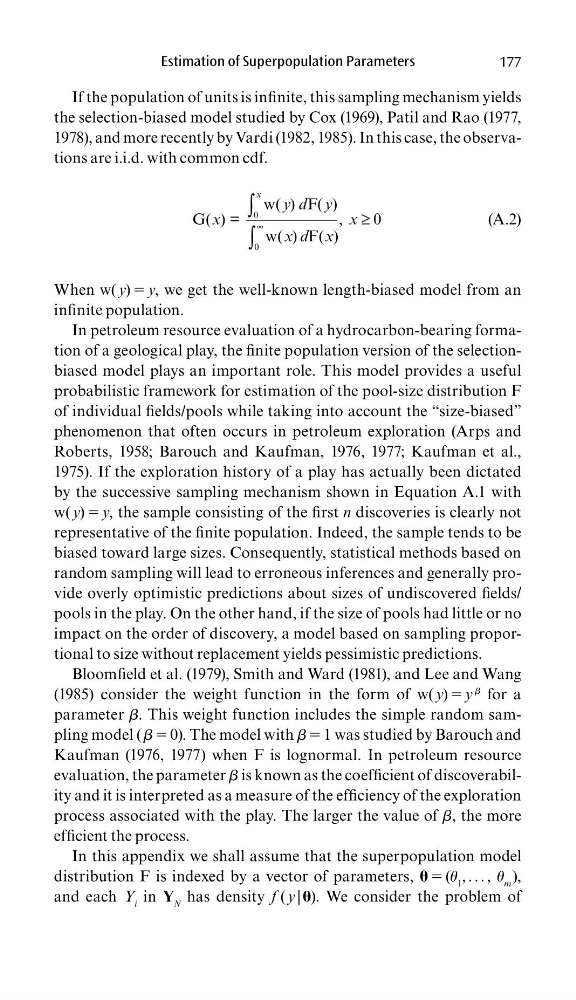
1978), and more recently by Vardi (1982, 1985). In this case, the observations are i.i.d. with common cdf.
0
0
w( ) F( )
G( ) =
,
0
w( ) F( )
x
y d y
x
x
x d x
∞
≥
∫
∫
(A.2)
When w( y) 5 y, we get the well-known length-biased model from an
infi nite population.
In petroleum resource evaluation of a hydrocarbon-bearing formation of a geological play, the fi nite population version of the selectionbiased model plays an important role. This model provides a useful
probabilistic framework for estimation of the pool-size distribution F
of individual fi elds/pools while taking into account the “size-biased”
phenomenon that often occurs in petroleum exploration (Arps and
Roberts, 1958; Barouch and Kaufman, 1976, 1977; Kaufman et al.,
1975). If the exploration history of a play has actually been dictated
by the successive sampling mechanism shown in Equation A.1 with
w( y) 5 y, the sample consisting of the fi rst n discoveries is clearly not
representative of the fi nite population. Indeed, the sample tends to be
biased toward large sizes. Consequently, statistical methods based on
random sampling will lead to erroneous inferences and generally provide overly optimistic predictions about sizes of undiscovered fi elds/
pools in the play. On the other hand, if the size of pools had little or no
impact on the order of discovery, a model based on sampling proportional to size without replacement yields pessimistic predictions.
Bloomfi eld et al. (1979), Smith and Ward (1981), and Lee and Wang
(1985) consider the weight function in the form of w( y) 5 y
b for a
parameter b. This weight function includes the simple random sampling model ( b 5 0). The model with b 5 1 was studied by Barouch and
Kaufman (1976, 1977) when F is lognormal. In petroleum resource
evaluation, the parameter b is known as the coeffi cient of discoverability and it is interpreted as a measure of the effi ciency of the exploration
process associated with the play. The larger the value of b, the more
effi cient the process.
In this appendix we shall assume that the superpopulation model
distribution F is indexed by a vector of parameters, 5 (u 1 , . . . , u m ),
and each Y i in Y N has density f ( y | ). We consider the problem of
177
If the population of units is infi nite, this sampling mechanism yields
the selection-biased model studied by Cox (1969), Patil and Rao (1977,
1978), and more recently by Vardi (1982, 1985). In this case, the observations are i.i.d. with common cdf.
0
0
w( ) F( )
G( ) =
,
0
w( ) F( )
x
y d y
x
x
x d x
∞
≥
∫
∫
(A.2)
When w( y) 5 y, we get the well-known length-biased model from an
infi nite population.
In petroleum resource evaluation of a hydrocarbon-bearing formation of a geological play, the fi nite population version of the selectionbiased model plays an important role. This model provides a useful
probabilistic framework for estimation of the pool-size distribution F
of individual fi elds/pools while taking into account the “size-biased”
phenomenon that often occurs in petroleum exploration (Arps and
Roberts, 1958; Barouch and Kaufman, 1976, 1977; Kaufman et al.,
1975). If the exploration history of a play has actually been dictated
by the successive sampling mechanism shown in Equation A.1 with
w( y) 5 y, the sample consisting of the fi rst n discoveries is clearly not
representative of the fi nite population. Indeed, the sample tends to be
biased toward large sizes. Consequently, statistical methods based on
random sampling will lead to erroneous inferences and generally provide overly optimistic predictions about sizes of undiscovered fi elds/
pools in the play. On the other hand, if the size of pools had little or no
impact on the order of discovery, a model based on sampling proportional to size without replacement yields pessimistic predictions.
Bloomfi eld et al. (1979), Smith and Ward (1981), and Lee and Wang
(1985) consider the weight function in the form of w( y) 5 y
b for a
parameter b. This weight function includes the simple random sampling model ( b 5 0). The model with b 5 1 was studied by Barouch and
Kaufman (1976, 1977) when F is lognormal. In petroleum resource
evaluation, the parameter b is known as the coeffi cient of discoverability and it is interpreted as a measure of the effi ciency of the exploration
process associated with the play. The larger the value of b, the more
effi cient the process.
In this appendix we shall assume that the superpopulation model
distribution F is indexed by a vector of parameters, 5 (u 1 , . . . , u m ),
and each Y i in Y N has density f ( y | ). We consider the problem of