

176
Consider the superpopulation model in which unit values belonging
to Y N 5 (Y 1 , . . . , Y N ), a fi nite population of size N, are independent and
identically distributed (i.i.d.) according to a cdf (cumulative distribution function), F. The prescribed sampling procedure is successive
drawings without replacement, as follows: At each draw, the probability of selecting any particular unit is proportional to a weight function
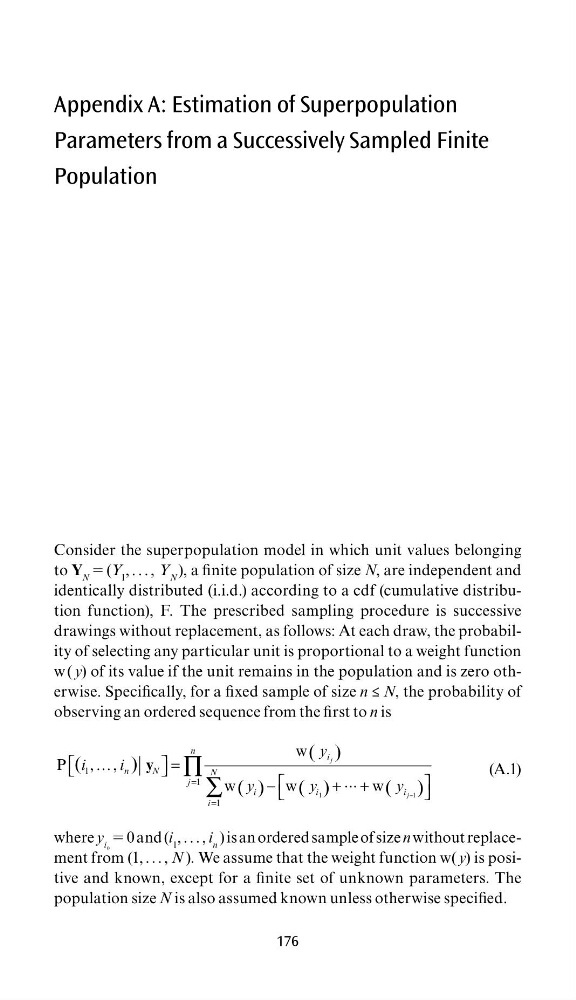
w ( y) of its value if the unit remains in the population and is zero otherwise. Specifi cally, for a fi xed sample of size n ≤ N, the probability of
observing an ordered sequence from the fi rst to n is
−
=
=
…
=
−
+ +
∏ ∑
1
1
1
1
1
w
P
, ,
w
w
w
···
( )
(
)
( )
( )
( )
j
j
n
i
n
N
N
j
i
i
i
i
y
i
i
y
y
y
y
(A.1)
where y i 0 5 0 and (i 1 , . . . , i n ) is an ordered sample of size n without replacement from (1, . . . , N ). We assume that the weight function w( y) is positive and known, except for a fi nite set of unknown parameters. The
population size N is also assumed known unless otherwise specifi ed.
Appendix A: Estimation of Superpopulation
Parameters from a Successively Sampled Finite
Population
Consider the superpopulation model in which unit values belonging
to Y N 5 (Y 1 , . . . , Y N ), a fi nite population of size N, are independent and
identically distributed (i.i.d.) according to a cdf (cumulative distribution function), F. The prescribed sampling procedure is successive
drawings without replacement, as follows: At each draw, the probability of selecting any particular unit is proportional to a weight function
w ( y) of its value if the unit remains in the population and is zero otherwise. Specifi cally, for a fi xed sample of size n ≤ N, the probability of
observing an ordered sequence from the fi rst to n is
−
=
=
…
=
−
+ +
∏ ∑
1
1
1
1
1
w
P
, ,
w
w
w
···
( )
(
)
( )
( )
( )
j
j
n
i
n
N
N
j
i
i
i
i
y
i
i
y
y
y
y
(A.1)
where y i 0 5 0 and (i 1 , . . . , i n ) is an ordered sample of size n without replacement from (1, . . . , N ). We assume that the weight function w( y) is positive and known, except for a fi nite set of unknown parameters. The
population size N is also assumed known unless otherwise specifi ed.
Appendix A: Estimation of Superpopulation
Parameters from a Successively Sampled Finite
Population