

136
Statistical Methods for Estimating Petroleum Resources
has a multivariate lognormal distribution, (, ⌺), where ⌺ is positive
defi nite. The mean and variance of X given X = x can be estimated (see
Appendix C).
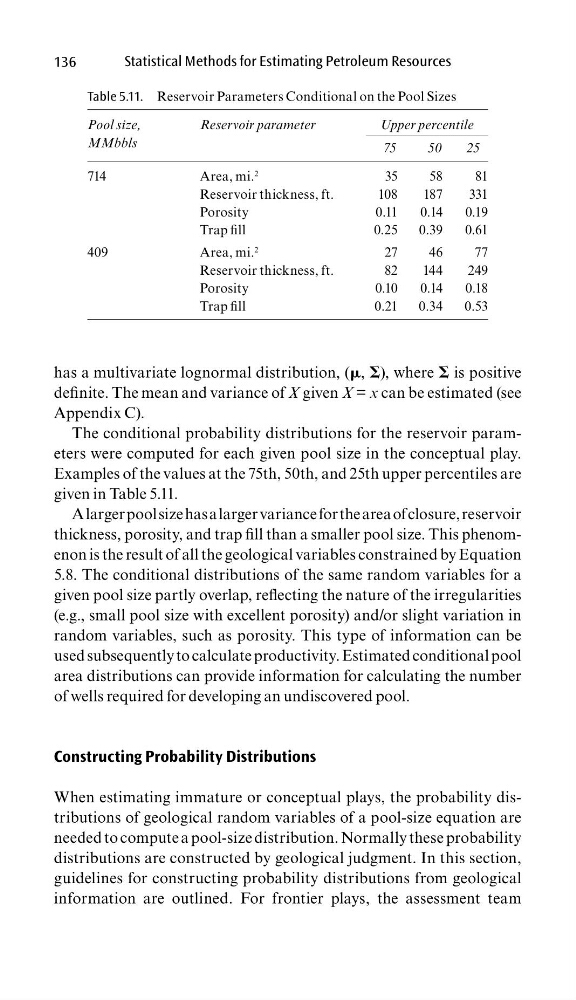
The conditional probability distributions for the reservoir parameters were computed for each given pool size in the conceptual play.
Examples of the values at the 75th, 50th, and 25th upper percentiles are
given in Table 5.11.
A larger pool size has a larger variance for the area of closure, reservoir
thickness, porosity, and trap fi ll than a smaller pool size. This phenomenon is the result of all the geological variables constrained by Equation
5.8. The conditional distributions of the same random variables for a
given pool size partly overlap, refl ecting the nature of the irregularities
(e.g., small pool size with excellent porosity) and/or slight variation in
random variables, such as porosity. This type of information can be
used subsequently to calculate productivity. Estimated conditional pool
area distributions can provide information for calculating the number
of wells required for developing an undiscovered pool.
Constructing Probability Distributions
When estimating immature or conceptual plays, the probability distributions of geological random variables of a pool-size equation are
needed to compute a pool-size distribution. Normally these probability
distributions are constructed by geological judgment. In this section,
guidelines for constructing probability distributions from geological
information are outlined. For frontier plays, the assessment team
Table 5.11. Reservoir Parameters Conditional on the Pool Sizes
Pool size,
MMbbls
Reservoir parameter
Upper percentile
75
50
25
714
Area, mi.
2
35
58
81
Reservoir thickness, ft.
108
187
331
Porosity
0.11
0.14
0.19
Trap fi ll
0.25
0.39
0.61
409
Area, mi.
2
27
46
77
Reservoir thickness, ft.
82
144
249
Porosity
0.10
0.14
0.18
Trap fi ll
0.21
0.34
0.53
Statistical Methods for Estimating Petroleum Resources
has a multivariate lognormal distribution, (, ⌺), where ⌺ is positive
defi nite. The mean and variance of X given X = x can be estimated (see
Appendix C).
The conditional probability distributions for the reservoir parameters were computed for each given pool size in the conceptual play.
Examples of the values at the 75th, 50th, and 25th upper percentiles are
given in Table 5.11.
A larger pool size has a larger variance for the area of closure, reservoir
thickness, porosity, and trap fi ll than a smaller pool size. This phenomenon is the result of all the geological variables constrained by Equation
5.8. The conditional distributions of the same random variables for a
given pool size partly overlap, refl ecting the nature of the irregularities
(e.g., small pool size with excellent porosity) and/or slight variation in
random variables, such as porosity. This type of information can be
used subsequently to calculate productivity. Estimated conditional pool
area distributions can provide information for calculating the number
of wells required for developing an undiscovered pool.
Constructing Probability Distributions
When estimating immature or conceptual plays, the probability distributions of geological random variables of a pool-size equation are
needed to compute a pool-size distribution. Normally these probability
distributions are constructed by geological judgment. In this section,
guidelines for constructing probability distributions from geological
information are outlined. For frontier plays, the assessment team
Table 5.11. Reservoir Parameters Conditional on the Pool Sizes
Pool size,
MMbbls
Reservoir parameter
Upper percentile
75
50
25
714
Area, mi.
2
35
58
81
Reservoir thickness, ft.
108
187
331
Porosity
0.11
0.14
0.19
Trap fi ll
0.25
0.39
0.61
409
Area, mi.
2
27
46
77
Reservoir thickness, ft.
82
144
249
Porosity
0.10
0.14
0.18
Trap fi ll
0.21
0.34
0.53