

130
Statistical Methods for Estimating Petroleum Resources
Similarly,
2
2
2
2
2
2
2
2
E
1
P
1
P
1
E
E
(
)
[ ]
(
)
[ ]
(
) [ ]
( [ ])
n
mn
r
r
m n
r
r
r
m
r
r
g
M
r
m
N G
n
m
n
m
m
m
m
M
−
=
−
=
×
−
+
×
×
= × −
×
+ ×
+ ×
∑∑
∑
u
u
u
u
u
u
u
u s
u
Hence,
2
2
2
2
2
2
2
2
2
2
2
2
2
Var
E
E
E
E
E
E
1
E
[ ]
( )
[ ]
[ ]
[ ]
(
)
[ ]
g
r
g
g
r
g
r
g
r
r
g
r
M
N
N
N
N G
M
M
M
M
=
−
=
− × ×
= × ×
−
×
×
= ×
−
×
+ × ×
u
u u
u u
u
u
u u
u
u u s
(5.22)
Therefore,
( )
2
2
2
1
E
1
E
(
) [ ]
[ ]
N
g
r
r
g
r
r
M
M
M
= ×
−
×
+ − ×
+ ×
s
u u u
u
u
u s
(5.23)
Equation 5.23 shows that s
2
N
is dominated by E[M], because the contribution from s
2
M
is diminished by the multiplier u r .
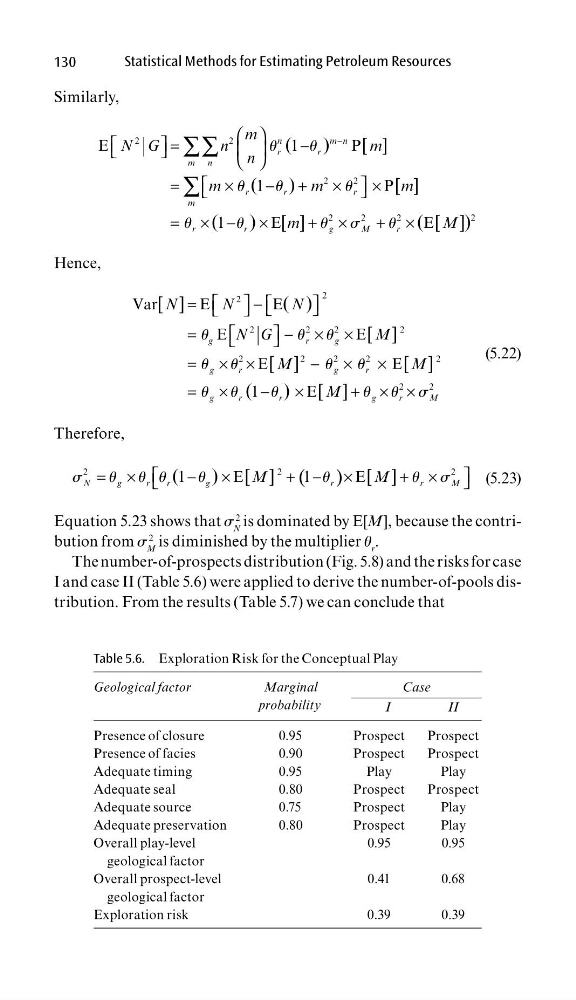
The number-of-prospects distribution (Fig. 5.8) and the risks for case
I and case II (Table 5.6) were applied to derive the number-of-pools distribution. From the results (Table 5.7) we can conclude that
Table 5.6. Exploration Risk for the Conceptual Play
Geological factor
Marginal
probability
Case
I
I I
Presence of closure
0.95
Prospect
Prospect
Presence of facies
0.90
Prospect
Prospect
Adequate timing
0.95
Play
Play
Adequate seal
0.80
Prospect
Prospect
Adequate source
0.75
Prospect
Play
Adequate preservation
0.80
Prospect
Play
Overall play-level
geological factor
0.95
0.95
Overall prospect-level
geological factor
0.41
0.68
Exploration risk
0.39
0.39
Statistical Methods for Estimating Petroleum Resources
Similarly,
2
2
2
2
2
2
2
2
E
1
P
1
P
1
E
E
(
)
[ ]
(
)
[ ]
(
) [ ]
( [ ])
n
mn
r
r
m n
r
r
r
m
r
r
g
M
r
m
N G
n
m
n
m
m
m
m
M
−
=
−
=
×
−
+
×
×
= × −
×
+ ×
+ ×
∑∑
∑
u
u
u
u
u
u
u
u s
u
Hence,
2
2
2
2
2
2
2
2
2
2
2
2
2
Var
E
E
E
E
E
E
1
E
[ ]
( )
[ ]
[ ]
[ ]
(
)
[ ]
g
r
g
g
r
g
r
g
r
r
g
r
M
N
N
N
N G
M
M
M
M
=
−
=
− × ×
= × ×
−
×
×
= ×
−
×
+ × ×
u
u u
u u
u
u
u u
u
u u s
(5.22)
Therefore,
( )
2
2
2
1
E
1
E
(
) [ ]
[ ]
N
g
r
r
g
r
r
M
M
M
= ×
−
×
+ − ×
+ ×
s
u u u
u
u
u s
(5.23)
Equation 5.23 shows that s
2
N
is dominated by E[M], because the contribution from s
2
M
is diminished by the multiplier u r .
The number-of-prospects distribution (Fig. 5.8) and the risks for case
I and case II (Table 5.6) were applied to derive the number-of-pools distribution. From the results (Table 5.7) we can conclude that
Table 5.6. Exploration Risk for the Conceptual Play
Geological factor
Marginal
probability
Case
I
I I
Presence of closure
0.95
Prospect
Prospect
Presence of facies
0.90
Prospect
Prospect
Adequate timing
0.95
Play
Play
Adequate seal
0.80
Prospect
Prospect
Adequate source
0.75
Prospect
Play
Adequate preservation
0.80
Prospect
Play
Overall play-level
geological factor
0.95
0.95
Overall prospect-level
geological factor
0.41
0.68
Exploration risk
0.39
0.39