

72
X. Li et al.
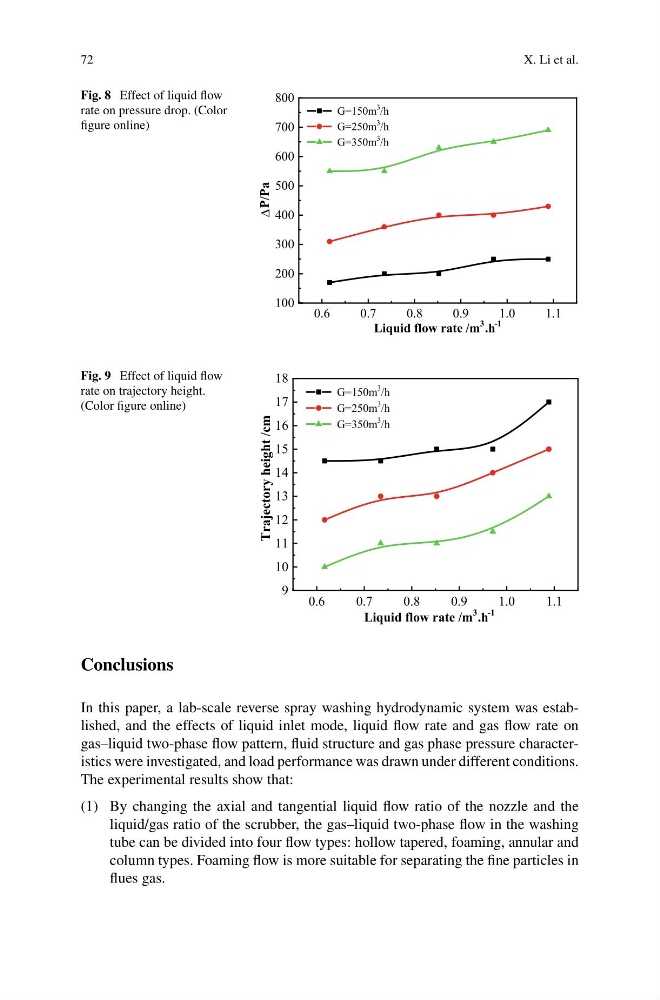
Fig. 8 Effect of liquid flow
rate on pressure drop. (Color
figure online)
0.6
0.7
0.8
0.9
1.0
1.1
100
200
300
400
500
600
700
800
P/Pa
Liquid flow rate /m
3 .h
-1
G=150m
3 /h
G=250m
3 /h
G=350m
3 /h
∇
Fig. 9 Effect of liquid flow
rate on trajectory height.
(Color figure online)
0.6
0.7
0.8
0.9
1.0
1.1
9
10
11
12
13
14
15
16
17
18
G=150m
3 /h
G=250m
3 /h
G=350m
3 /h
Liquid flow rate /m
3 .h
-1
Trajectory height /cm
Conclusions
In this paper, a lab-scale reverse spray washing hydrodynamic system was established, and the effects of liquid inlet mode, liquid flow rate and gas flow rate on
gas–liquid two-phase flow pattern, fluid structure and gas phase pressure characteristics were investigated, and load performance was drawn under different conditions.
The experimental results show that:
(1) By changing the axial and tangential liquid flow ratio of the nozzle and the
liquid/gas ratio of the scrubber, the gas–liquid two-phase flow in the washing
tube can be divided into four flow types: hollow tapered, foaming, annular and
column types. Foaming flow is more suitable for separating the fine particles in
flues gas.
X. Li et al.
Fig. 8 Effect of liquid flow
rate on pressure drop. (Color
figure online)
0.6
0.7
0.8
0.9
1.0
1.1
100
200
300
400
500
600
700
800
P/Pa
Liquid flow rate /m
3 .h
-1
G=150m
3 /h
G=250m
3 /h
G=350m
3 /h
∇
Fig. 9 Effect of liquid flow
rate on trajectory height.
(Color figure online)
0.6
0.7
0.8
0.9
1.0
1.1
9
10
11
12
13
14
15
16
17
18
G=150m
3 /h
G=250m
3 /h
G=350m
3 /h
Liquid flow rate /m
3 .h
-1
Trajectory height /cm
Conclusions
In this paper, a lab-scale reverse spray washing hydrodynamic system was established, and the effects of liquid inlet mode, liquid flow rate and gas flow rate on
gas–liquid two-phase flow pattern, fluid structure and gas phase pressure characteristics were investigated, and load performance was drawn under different conditions.
The experimental results show that:
(1) By changing the axial and tangential liquid flow ratio of the nozzle and the
liquid/gas ratio of the scrubber, the gas–liquid two-phase flow in the washing
tube can be divided into four flow types: hollow tapered, foaming, annular and
column types. Foaming flow is more suitable for separating the fine particles in
flues gas.