

70
X. Li et al.
A small part of the airflow breaks the liquid flow into small droplets, while most of
the airflow passes through the thin liquid film, thus weakening the blocking effect of
the liquid on the airflow and reducing the pressure loss. Therefore, only in the case
of high liquid flow rate, the axial liquid column can block the flow and strengthen
the collision between gas and liquid to achieve the performance of the foaming flow.
Hydrodynamics of Gas–Liquid Two-Phase Flow with Gas
Flow Rate
Gas flow rate is an important factor affecting gas–liquid flow pattern and the dust
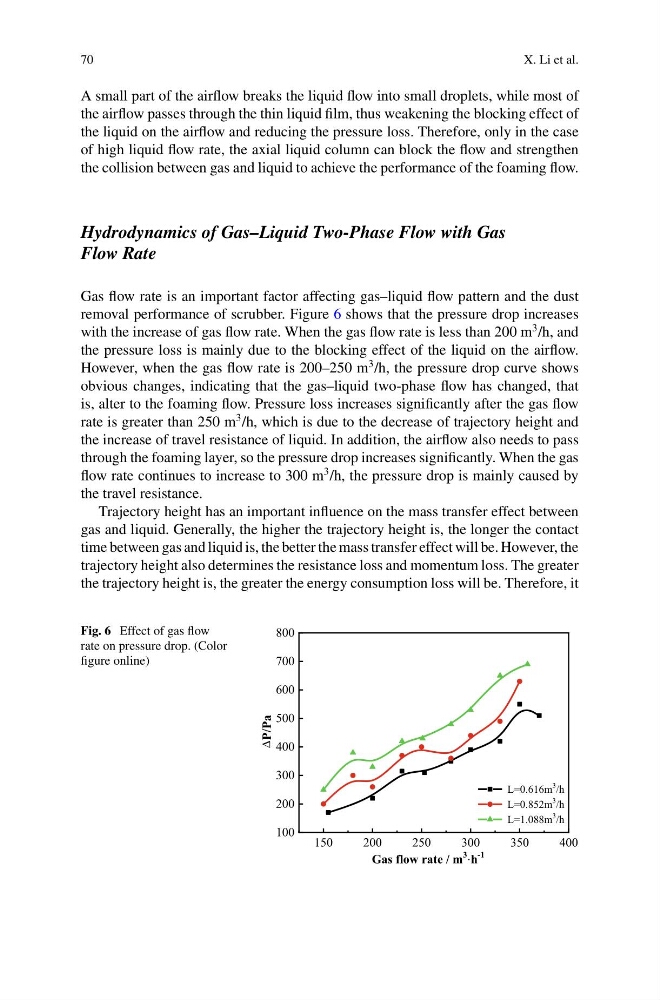
removal performance of scrubber. Figure 6 shows that the pressure drop increases
with the increase of gas flow rate. When the gas flow rate is less than 200 m
3 /h, and
the pressure loss is mainly due to the blocking effect of the liquid on the airflow.
However, when the gas flow rate is 200–250 m
3 /h, the pressure drop curve shows
obvious changes, indicating that the gas–liquid two-phase flow has changed, that
is, alter to the foaming flow. Pressure loss increases significantly after the gas flow
rate is greater than 250 m
3 /h, which is due to the decrease of trajectory height and
the increase of travel resistance of liquid. In addition, the airflow also needs to pass
through the foaming layer, so the pressure drop increases significantly. When the gas
flow rate continues to increase to 300 m
3 /h, the pressure drop is mainly caused by
the travel resistance.
Trajectory height has an important influence on the mass transfer effect between
gas and liquid. Generally, the higher the trajectory height is, the longer the contact
time between gas and liquid is, the better the mass transfer effect will be. However, the
trajectory height also determines the resistance loss and momentum loss. The greater
the trajectory height is, the greater the energy consumption loss will be. Therefore, it
Fig. 6 Effect of gas flow
rate on pressure drop. (Color
figure online)
150
200
250
300
350
400
100
200
300
400
500
600
700
800
P/Pa
Gas flow rate / m
3
·h
-1
L=0.616m
3 /h
L=0.852m
3 /h
L=1.088m
3 /h
∇
X. Li et al.
A small part of the airflow breaks the liquid flow into small droplets, while most of
the airflow passes through the thin liquid film, thus weakening the blocking effect of
the liquid on the airflow and reducing the pressure loss. Therefore, only in the case
of high liquid flow rate, the axial liquid column can block the flow and strengthen
the collision between gas and liquid to achieve the performance of the foaming flow.
Hydrodynamics of Gas–Liquid Two-Phase Flow with Gas
Flow Rate
Gas flow rate is an important factor affecting gas–liquid flow pattern and the dust
removal performance of scrubber. Figure 6 shows that the pressure drop increases
with the increase of gas flow rate. When the gas flow rate is less than 200 m
3 /h, and
the pressure loss is mainly due to the blocking effect of the liquid on the airflow.
However, when the gas flow rate is 200–250 m
3 /h, the pressure drop curve shows
obvious changes, indicating that the gas–liquid two-phase flow has changed, that
is, alter to the foaming flow. Pressure loss increases significantly after the gas flow
rate is greater than 250 m
3 /h, which is due to the decrease of trajectory height and
the increase of travel resistance of liquid. In addition, the airflow also needs to pass
through the foaming layer, so the pressure drop increases significantly. When the gas
flow rate continues to increase to 300 m
3 /h, the pressure drop is mainly caused by
the travel resistance.
Trajectory height has an important influence on the mass transfer effect between
gas and liquid. Generally, the higher the trajectory height is, the longer the contact
time between gas and liquid is, the better the mass transfer effect will be. However, the
trajectory height also determines the resistance loss and momentum loss. The greater
the trajectory height is, the greater the energy consumption loss will be. Therefore, it
Fig. 6 Effect of gas flow
rate on pressure drop. (Color
figure online)
150
200
250
300
350
400
100
200
300
400
500
600
700
800
P/Pa
Gas flow rate / m
3
·h
-1
L=0.616m
3 /h
L=0.852m
3 /h
L=1.088m
3 /h
∇