

Hydrodynamics of Gas–Liquid Two-Phase Flow …
67
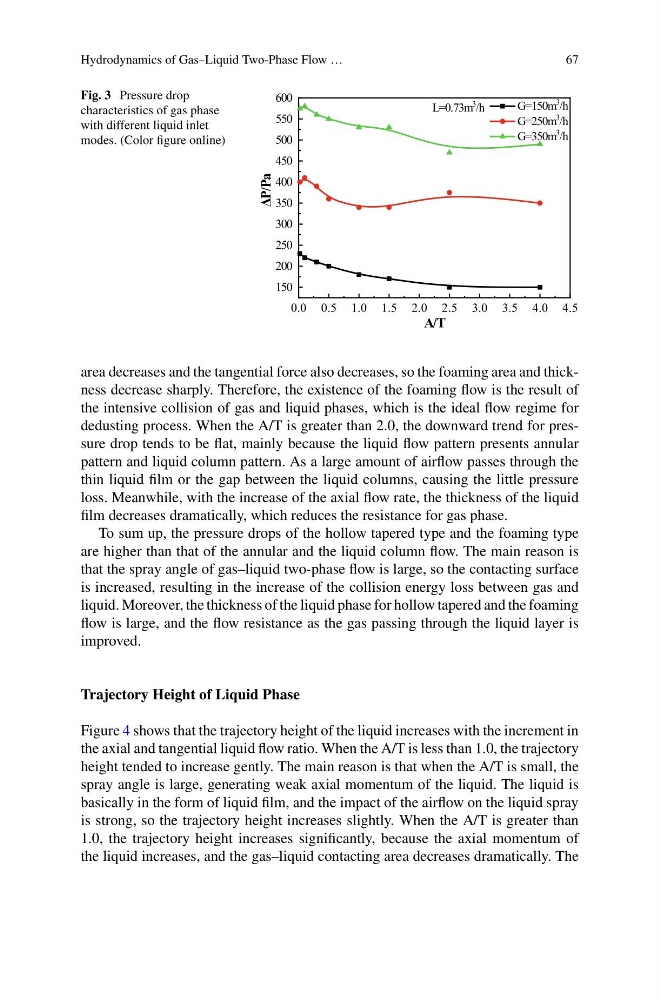
Fig. 3 Pressure drop
characteristics of gas phase
with different liquid inlet
modes. (Color figure online)
0.0 0.5 1.0 1.5 2.0 2.5 3.0 3.5 4.0 4.5
150
200
250
300
350
400
450
500
550
600
ΔP/Pa
A/T
G=150m
3
/h
G=250m
3
/h
G=350m
3
/h
L=0.73m
3
/h
area decreases and the tangential force also decreases, so the foaming area and thickness decrease sharply. Therefore, the existence of the foaming flow is the result of
the intensive collision of gas and liquid phases, which is the ideal flow regime for
dedusting process. When the A/T is greater than 2.0, the downward trend for pressure drop tends to be flat, mainly because the liquid flow pattern presents annular
pattern and liquid column pattern. As a large amount of airflow passes through the
thin liquid film or the gap between the liquid columns, causing the little pressure
loss. Meanwhile, with the increase of the axial flow rate, the thickness of the liquid
film decreases dramatically, which reduces the resistance for gas phase.
To sum up, the pressure drops of the hollow tapered type and the foaming type
are higher than that of the annular and the liquid column flow. The main reason is
that the spray angle of gas–liquid two-phase flow is large, so the contacting surface
is increased, resulting in the increase of the collision energy loss between gas and
liquid. Moreover, the thickness of the liquid phase for hollow tapered and the foaming
flow is large, and the flow resistance as the gas passing through the liquid layer is
improved.
Trajectory Height of Liquid Phase
Figure 4 shows that the trajectory height of the liquid increases with the increment in
the axial and tangential liquid flow ratio. When the A/T is less than 1.0, the trajectory
height tended to increase gently. The main reason is that when the A/T is small, the
spray angle is large, generating weak axial momentum of the liquid. The liquid is
basically in the form of liquid film, and the impact of the airflow on the liquid spray
is strong, so the trajectory height increases slightly. When the A/T is greater than
1.0, the trajectory height increases significantly, because the axial momentum of
the liquid increases, and the gas–liquid contacting area decreases dramatically. The
67
Fig. 3 Pressure drop
characteristics of gas phase
with different liquid inlet
modes. (Color figure online)
0.0 0.5 1.0 1.5 2.0 2.5 3.0 3.5 4.0 4.5
150
200
250
300
350
400
450
500
550
600
ΔP/Pa
A/T
G=150m
3
/h
G=250m
3
/h
G=350m
3
/h
L=0.73m
3
/h
area decreases and the tangential force also decreases, so the foaming area and thickness decrease sharply. Therefore, the existence of the foaming flow is the result of
the intensive collision of gas and liquid phases, which is the ideal flow regime for
dedusting process. When the A/T is greater than 2.0, the downward trend for pressure drop tends to be flat, mainly because the liquid flow pattern presents annular
pattern and liquid column pattern. As a large amount of airflow passes through the
thin liquid film or the gap between the liquid columns, causing the little pressure
loss. Meanwhile, with the increase of the axial flow rate, the thickness of the liquid
film decreases dramatically, which reduces the resistance for gas phase.
To sum up, the pressure drops of the hollow tapered type and the foaming type
are higher than that of the annular and the liquid column flow. The main reason is
that the spray angle of gas–liquid two-phase flow is large, so the contacting surface
is increased, resulting in the increase of the collision energy loss between gas and
liquid. Moreover, the thickness of the liquid phase for hollow tapered and the foaming
flow is large, and the flow resistance as the gas passing through the liquid layer is
improved.
Trajectory Height of Liquid Phase
Figure 4 shows that the trajectory height of the liquid increases with the increment in
the axial and tangential liquid flow ratio. When the A/T is less than 1.0, the trajectory
height tended to increase gently. The main reason is that when the A/T is small, the
spray angle is large, generating weak axial momentum of the liquid. The liquid is
basically in the form of liquid film, and the impact of the airflow on the liquid spray
is strong, so the trajectory height increases slightly. When the A/T is greater than
1.0, the trajectory height increases significantly, because the axial momentum of
the liquid increases, and the gas–liquid contacting area decreases dramatically. The