

Hydrodynamics of Gas–Liquid Two-Phase Flow …
65
Measurement of Flow Patterns
The change of operating conditions affects the collision intensity and mixing performances of gas and liquid phases, thus forming different types of flow regimes, and
determining the capture efficiency of fine particles in the air. Therefore, it is essential
to reveal the flow states of gas–liquid two-phase under different conditions. Highspeed photographic technique (Olympus I-Speed 3, resolution 1280 × 1024, CMOS
sensor size 21.504 × 26.88 mm) was utilized to record the gas–liquid two-phase
flow regimes and fluid structures under different operating parameters. In the experiment, the image acquisition frequency was set at 400 FPS to capture transient motion
images of gas–liquid two-phase flow.
Results and Discussion
Flow Regimes of Gas–Liquid Two-Phase Flow
In reverse spray washing tube, the gas phase (from top to bottom) collides with the
liquid jet (from bottom to top) at high speed, accompanied by the momentum and
mass transfer of soluble gas. With the changes of axial and tangential liquid flow
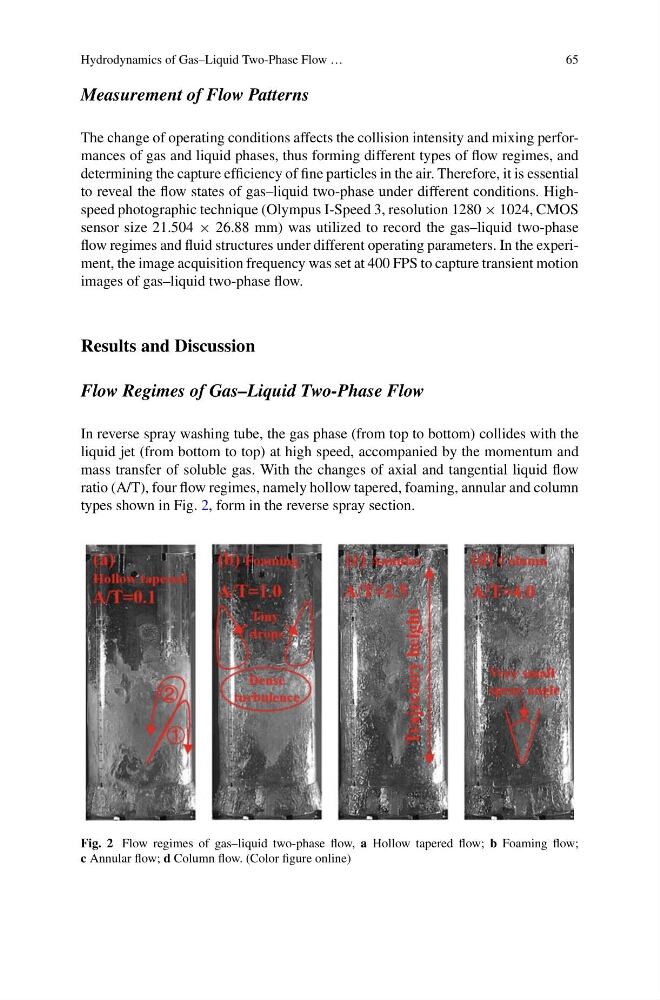
ratio (A/T), four flow regimes, namely hollow tapered, foaming, annular and column
types shown in Fig. 2, form in the reverse spray section.
Fig. 2 Flow regimes of gas–liquid two-phase flow, a Hollow tapered flow; b Foaming flow;
c Annular flow; d Column flow. (Color figure online)
65
Measurement of Flow Patterns
The change of operating conditions affects the collision intensity and mixing performances of gas and liquid phases, thus forming different types of flow regimes, and
determining the capture efficiency of fine particles in the air. Therefore, it is essential
to reveal the flow states of gas–liquid two-phase under different conditions. Highspeed photographic technique (Olympus I-Speed 3, resolution 1280 × 1024, CMOS
sensor size 21.504 × 26.88 mm) was utilized to record the gas–liquid two-phase
flow regimes and fluid structures under different operating parameters. In the experiment, the image acquisition frequency was set at 400 FPS to capture transient motion
images of gas–liquid two-phase flow.
Results and Discussion
Flow Regimes of Gas–Liquid Two-Phase Flow
In reverse spray washing tube, the gas phase (from top to bottom) collides with the
liquid jet (from bottom to top) at high speed, accompanied by the momentum and
mass transfer of soluble gas. With the changes of axial and tangential liquid flow
ratio (A/T), four flow regimes, namely hollow tapered, foaming, annular and column
types shown in Fig. 2, form in the reverse spray section.
Fig. 2 Flow regimes of gas–liquid two-phase flow, a Hollow tapered flow; b Foaming flow;
c Annular flow; d Column flow. (Color figure online)