

64
X. Li et al.
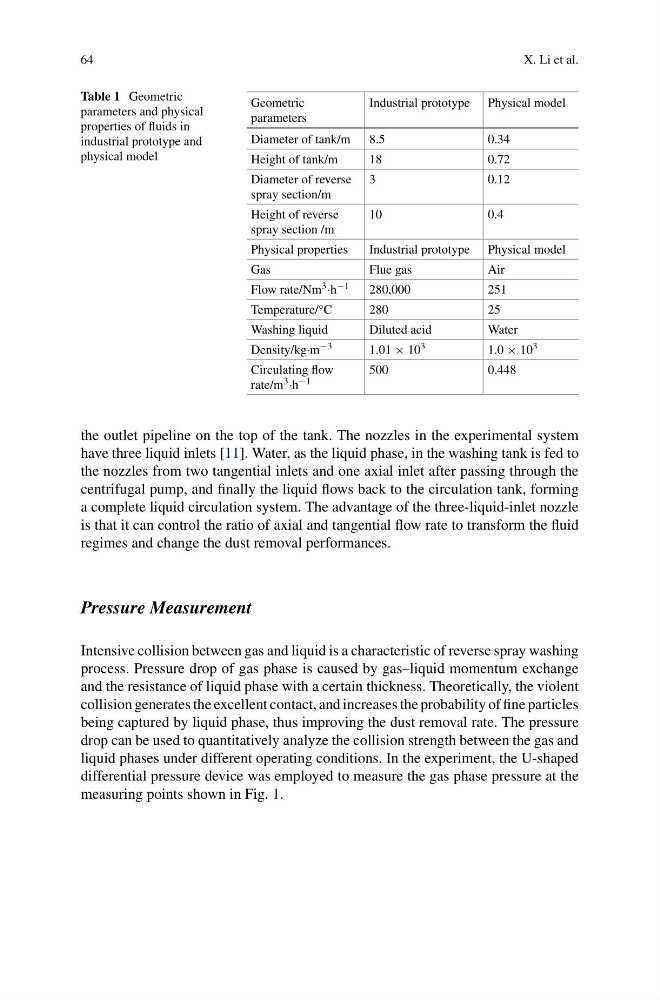
Table 1 Geometric
parameters and physical
properties of fluids in
industrial prototype and
physical model
Geometric
parameters
Industrial prototype Physical model
Diameter of tank/m 8.5
0.34
Height of tank/m
18
0.72
Diameter of reverse
spray section/m
3
0.12
Height of reverse
spray section /m
10
0.4
Physical properties
Industrial prototype Physical model
Gas
Flue gas
Air
Flow rate/Nm 3 ·h −1
280,000
251
Temperature/°C
280
25
Washing liquid
Diluted acid
Water
Density/kg·m −3
1.01 × 10 3
1.0 × 10 3
Circulating flow
rate/m 3 ·h −1
500
0.448
the outlet pipeline on the top of the tank. The nozzles in the experimental system
have three liquid inlets [11]. Water, as the liquid phase, in the washing tank is fed to
the nozzles from two tangential inlets and one axial inlet after passing through the
centrifugal pump, and finally the liquid flows back to the circulation tank, forming
a complete liquid circulation system. The advantage of the three-liquid-inlet nozzle
is that it can control the ratio of axial and tangential flow rate to transform the fluid
regimes and change the dust removal performances.
Pressure Measurement
Intensive collision between gas and liquid is a characteristic of reverse spray washing
process. Pressure drop of gas phase is caused by gas–liquid momentum exchange
and the resistance of liquid phase with a certain thickness. Theoretically, the violent
collision generates the excellent contact, and increases the probability of fine particles
being captured by liquid phase, thus improving the dust removal rate. The pressure
drop can be used to quantitatively analyze the collision strength between the gas and
liquid phases under different operating conditions. In the experiment, the U-shaped
differential pressure device was employed to measure the gas phase pressure at the
measuring points shown in Fig. 1.
X. Li et al.
Table 1 Geometric
parameters and physical
properties of fluids in
industrial prototype and
physical model
Geometric
parameters
Industrial prototype Physical model
Diameter of tank/m 8.5
0.34
Height of tank/m
18
0.72
Diameter of reverse
spray section/m
3
0.12
Height of reverse
spray section /m
10
0.4
Physical properties
Industrial prototype Physical model
Gas
Flue gas
Air
Flow rate/Nm 3 ·h −1
280,000
251
Temperature/°C
280
25
Washing liquid
Diluted acid
Water
Density/kg·m −3
1.01 × 10 3
1.0 × 10 3
Circulating flow
rate/m 3 ·h −1
500
0.448
the outlet pipeline on the top of the tank. The nozzles in the experimental system
have three liquid inlets [11]. Water, as the liquid phase, in the washing tank is fed to
the nozzles from two tangential inlets and one axial inlet after passing through the
centrifugal pump, and finally the liquid flows back to the circulation tank, forming
a complete liquid circulation system. The advantage of the three-liquid-inlet nozzle
is that it can control the ratio of axial and tangential flow rate to transform the fluid
regimes and change the dust removal performances.
Pressure Measurement
Intensive collision between gas and liquid is a characteristic of reverse spray washing
process. Pressure drop of gas phase is caused by gas–liquid momentum exchange
and the resistance of liquid phase with a certain thickness. Theoretically, the violent
collision generates the excellent contact, and increases the probability of fine particles
being captured by liquid phase, thus improving the dust removal rate. The pressure
drop can be used to quantitatively analyze the collision strength between the gas and
liquid phases under different operating conditions. In the experiment, the U-shaped
differential pressure device was employed to measure the gas phase pressure at the
measuring points shown in Fig. 1.