

Homogenization of the Dense Composite Membranes …
55
added. The amount of additive was calculated versus the mass of the zeolite powder.
Additive solution was mixed using ultrasound mixer (power source 90 W, frequency
40 kHz). The solution of the zeolite and (eventually) additive was added to the
polymer solutions and mixing was continued overnight at the same conditions as the
pure polymers. Obtained viscous solution was casted on the Teflon surface bordered
with the Teflon ring to prevent the membrane from stitching to the surface during
the drying process. The drying process was done overnight at room temperature with
the casted membranes covered with non-woven textile. If the higher temperatures or
lower pressures were applied, there was a high probability of bubbles being formed
inside the membrane which would rapidly decrease the permeation properties. The
crucial parameter in this step was the optimal viscosity of the polymer solution.
If the viscosity is too high, the surface tension dominates the casting process and
the thickness of the membrane would be uneven. If the viscosity is too low, the
sedimentation of the zeolite powder would occur before the membrane is dried, so the
particles would be unevenly distributed through the thickness of the membrane, and
the membrane would self-roll. Prior to measurement, membranes were positioned in
the apparatus at the vacuum line (pressure below 250 Pa) in order to remove potential
traces of the residual solvent. Permeability properties were determined by applying
the time lag method applying the solution-diffusion model which takes into account
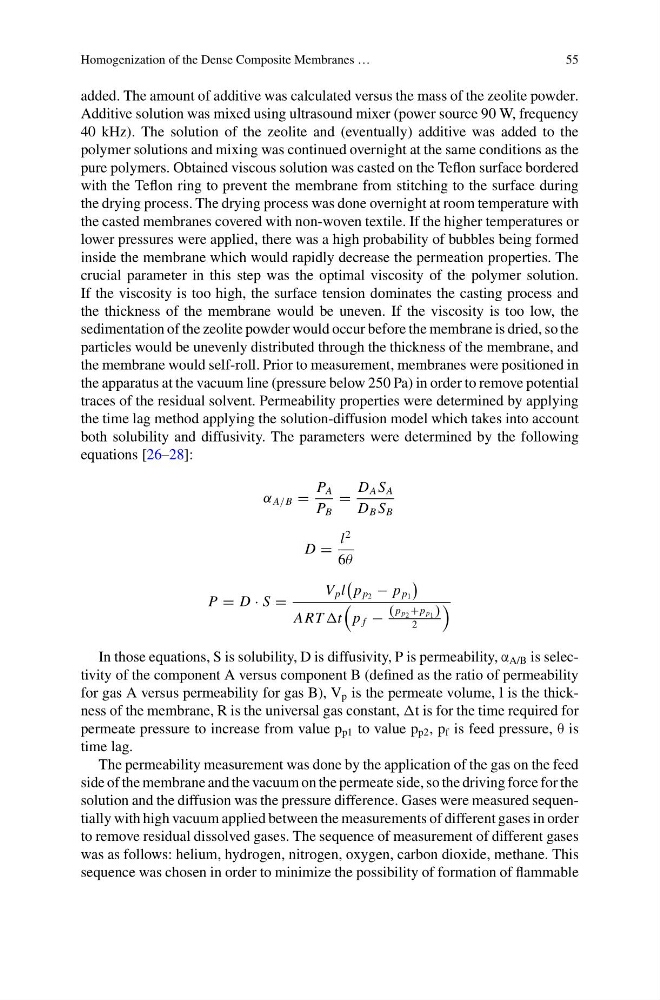
both solubility and diffusivity. The parameters were determined by the following
equations [26–28]:
α A/B =
P A
P B
=
D A S A
D B S B
D =
l
2
6θ
P = D · S =
V p l
p p 2 − p p 1
ART t
p f − (pp 2 + p p 1 )
2
In those equations, S is solubility, D is diffusivity, P is permeability, α A/B is selectivity of the component A versus component B (defined as the ratio of permeability
for gas A versus permeability for gas B), V p is the permeate volume, l is the thickness of the membrane, R is the universal gas constant, t is for the time required for
permeate pressure to increase from value p p1 to value p p2 , p f is feed pressure, θ is
time lag.
The permeability measurement was done by the application of the gas on the feed
side of the membrane and the vacuum on the permeate side, so the driving force for the
solution and the diffusion was the pressure difference. Gases were measured sequentially with high vacuum applied between the measurements of different gases in order
to remove residual dissolved gases. The sequence of measurement of different gases
was as follows: helium, hydrogen, nitrogen, oxygen, carbon dioxide, methane. This
sequence was chosen in order to minimize the possibility of formation of flammable
55
added. The amount of additive was calculated versus the mass of the zeolite powder.
Additive solution was mixed using ultrasound mixer (power source 90 W, frequency
40 kHz). The solution of the zeolite and (eventually) additive was added to the
polymer solutions and mixing was continued overnight at the same conditions as the
pure polymers. Obtained viscous solution was casted on the Teflon surface bordered
with the Teflon ring to prevent the membrane from stitching to the surface during
the drying process. The drying process was done overnight at room temperature with
the casted membranes covered with non-woven textile. If the higher temperatures or
lower pressures were applied, there was a high probability of bubbles being formed
inside the membrane which would rapidly decrease the permeation properties. The
crucial parameter in this step was the optimal viscosity of the polymer solution.
If the viscosity is too high, the surface tension dominates the casting process and
the thickness of the membrane would be uneven. If the viscosity is too low, the
sedimentation of the zeolite powder would occur before the membrane is dried, so the
particles would be unevenly distributed through the thickness of the membrane, and
the membrane would self-roll. Prior to measurement, membranes were positioned in
the apparatus at the vacuum line (pressure below 250 Pa) in order to remove potential
traces of the residual solvent. Permeability properties were determined by applying
the time lag method applying the solution-diffusion model which takes into account
both solubility and diffusivity. The parameters were determined by the following
equations [26–28]:
α A/B =
P A
P B
=
D A S A
D B S B
D =
l
2
6θ
P = D · S =
V p l
p p 2 − p p 1
ART t
p f − (pp 2 + p p 1 )
2
In those equations, S is solubility, D is diffusivity, P is permeability, α A/B is selectivity of the component A versus component B (defined as the ratio of permeability
for gas A versus permeability for gas B), V p is the permeate volume, l is the thickness of the membrane, R is the universal gas constant, t is for the time required for
permeate pressure to increase from value p p1 to value p p2 , p f is feed pressure, θ is
time lag.
The permeability measurement was done by the application of the gas on the feed
side of the membrane and the vacuum on the permeate side, so the driving force for the
solution and the diffusion was the pressure difference. Gases were measured sequentially with high vacuum applied between the measurements of different gases in order
to remove residual dissolved gases. The sequence of measurement of different gases
was as follows: helium, hydrogen, nitrogen, oxygen, carbon dioxide, methane. This
sequence was chosen in order to minimize the possibility of formation of flammable