

54
D. Nedeljkovic
Table 1 Properties of the
zeolites used in experiment
Zeolite type Channel system Pore size, pm Max. diff.
diam., pm
ITR
3d
64
57
IWS
3d
82
67
OWE
2d
58
38
CFI
1d
75
73
Zeolite powder (inorganic aluminosilicates) was dispersed in order to improve the
solubility properties of the carbon dioxide. The properties of the inorganic powder
can be described on two different levels. On the frame (micro) level, the diffusion
properties of the zeolite are determined by the direction of the pores (one, two, or
three dimensions) and the maximum diameter of the sphere that can diffuse through
the available frame. On the bulk (macro) level, the main property of the powder is its
specific surface which represents surface available for the adsorption per unit mass.
Zeolite powders used in this work have specific surface in the range between 500
and 900 m
2 /g. Four different types of powder were used for this experiment, with
different sizes and orientation of the pores.
All zeolite powders tested in this paper are selected based on their relatively high
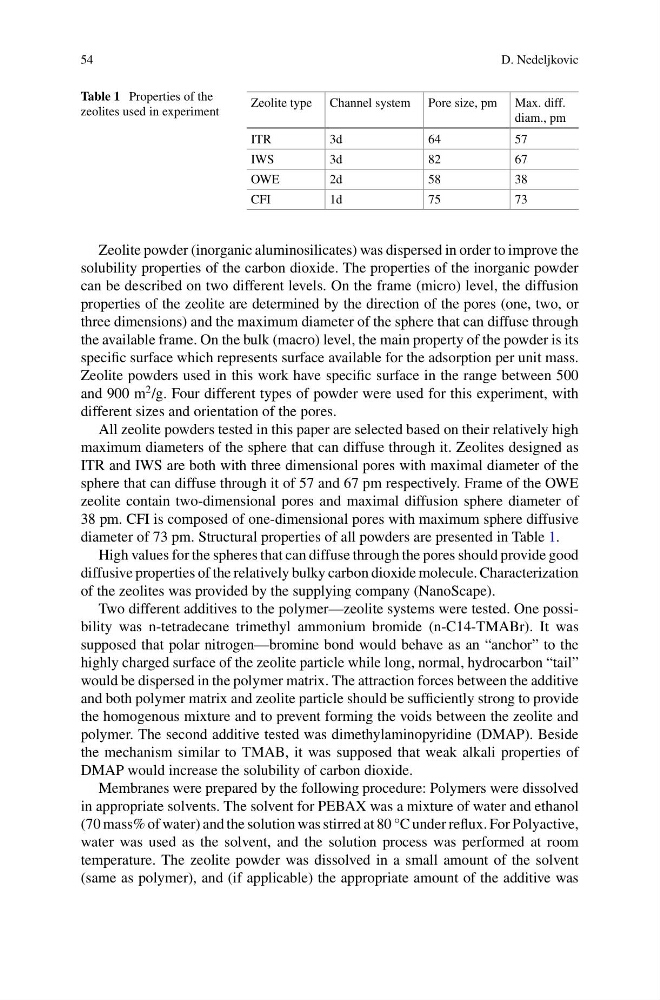
maximum diameters of the sphere that can diffuse through it. Zeolites designed as
ITR and IWS are both with three dimensional pores with maximal diameter of the
sphere that can diffuse through it of 57 and 67 pm respectively. Frame of the OWE
zeolite contain two-dimensional pores and maximal diffusion sphere diameter of
38 pm. CFI is composed of one-dimensional pores with maximum sphere diffusive
diameter of 73 pm. Structural properties of all powders are presented in Table 1.
High values for the spheres that can diffuse through the pores should provide good
diffusive properties of the relatively bulky carbon dioxide molecule. Characterization
of the zeolites was provided by the supplying company (NanoScape).
Two different additives to the polymer—zeolite systems were tested. One possibility was n-tetradecane trimethyl ammonium bromide (n-C14-TMABr). It was
supposed that polar nitrogen—bromine bond would behave as an “anchor” to the
highly charged surface of the zeolite particle while long, normal, hydrocarbon “tail”
would be dispersed in the polymer matrix. The attraction forces between the additive
and both polymer matrix and zeolite particle should be sufficiently strong to provide
the homogenous mixture and to prevent forming the voids between the zeolite and
polymer. The second additive tested was dimethylaminopyridine (DMAP). Beside
the mechanism similar to TMAB, it was supposed that weak alkali properties of
DMAP would increase the solubility of carbon dioxide.
Membranes were prepared by the following procedure: Polymers were dissolved
in appropriate solvents. The solvent for PEBAX was a mixture of water and ethanol
(70 mass% of water) and the solution was stirred at 80 °C under reflux. For Polyactive,
water was used as the solvent, and the solution process was performed at room
temperature. The zeolite powder was dissolved in a small amount of the solvent
(same as polymer), and (if applicable) the appropriate amount of the additive was
D. Nedeljkovic
Table 1 Properties of the
zeolites used in experiment
Zeolite type Channel system Pore size, pm Max. diff.
diam., pm
ITR
3d
64
57
IWS
3d
82
67
OWE
2d
58
38
CFI
1d
75
73
Zeolite powder (inorganic aluminosilicates) was dispersed in order to improve the
solubility properties of the carbon dioxide. The properties of the inorganic powder
can be described on two different levels. On the frame (micro) level, the diffusion
properties of the zeolite are determined by the direction of the pores (one, two, or
three dimensions) and the maximum diameter of the sphere that can diffuse through
the available frame. On the bulk (macro) level, the main property of the powder is its
specific surface which represents surface available for the adsorption per unit mass.
Zeolite powders used in this work have specific surface in the range between 500
and 900 m
2 /g. Four different types of powder were used for this experiment, with
different sizes and orientation of the pores.
All zeolite powders tested in this paper are selected based on their relatively high
maximum diameters of the sphere that can diffuse through it. Zeolites designed as
ITR and IWS are both with three dimensional pores with maximal diameter of the
sphere that can diffuse through it of 57 and 67 pm respectively. Frame of the OWE
zeolite contain two-dimensional pores and maximal diffusion sphere diameter of
38 pm. CFI is composed of one-dimensional pores with maximum sphere diffusive
diameter of 73 pm. Structural properties of all powders are presented in Table 1.
High values for the spheres that can diffuse through the pores should provide good
diffusive properties of the relatively bulky carbon dioxide molecule. Characterization
of the zeolites was provided by the supplying company (NanoScape).
Two different additives to the polymer—zeolite systems were tested. One possibility was n-tetradecane trimethyl ammonium bromide (n-C14-TMABr). It was
supposed that polar nitrogen—bromine bond would behave as an “anchor” to the
highly charged surface of the zeolite particle while long, normal, hydrocarbon “tail”
would be dispersed in the polymer matrix. The attraction forces between the additive
and both polymer matrix and zeolite particle should be sufficiently strong to provide
the homogenous mixture and to prevent forming the voids between the zeolite and
polymer. The second additive tested was dimethylaminopyridine (DMAP). Beside
the mechanism similar to TMAB, it was supposed that weak alkali properties of
DMAP would increase the solubility of carbon dioxide.
Membranes were prepared by the following procedure: Polymers were dissolved
in appropriate solvents. The solvent for PEBAX was a mixture of water and ethanol
(70 mass% of water) and the solution was stirred at 80 °C under reflux. For Polyactive,
water was used as the solvent, and the solution process was performed at room
temperature. The zeolite powder was dissolved in a small amount of the solvent
(same as polymer), and (if applicable) the appropriate amount of the additive was