

48
F. Dong et al.
increase, the gas–liquid contact can be used more effectively. So the dust removal
efficiency is improved. When the dust mass concentration reaches a certain value, the
gas–liquid contact area has been fully utilized and tends to be saturated, so the dust
removal efficiency begins to no longer increase but has a slight downward trend. It
can be seen from the figure that the maximum dust removal efficiency occurs when
the dust mass concentration is about 12 g/m
3 . When the dust mass concentration
increases from 4 to 16 g/m
3 , the dust removal efficiency is unaffected and can be
maintained above 98.5%.
Classification Efficiency
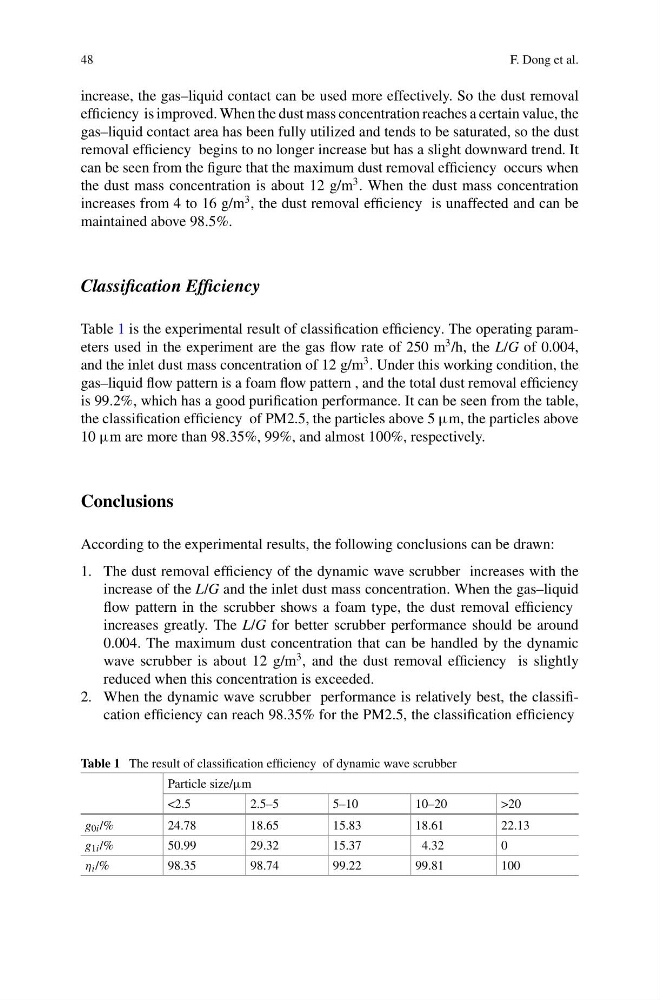
Table 1 is the experimental result of classification efficiency. The operating parameters used in the experiment are the gas flow rate of 250 m
3 /h, the L/G of 0.004,
and the inlet dust mass concentration of 12 g/m
3 . Under this working condition, the
gas–liquid flow pattern is a foam flow pattern , and the total dust removal efficiency
is 99.2%, which has a good purification performance. It can be seen from the table,
the classification efficiency of PM2.5, the particles above 5 µm, the particles above
10 µm are more than 98.35%, 99%, and almost 100%, respectively.
Conclusions
According to the experimental results, the following conclusions can be drawn:
1. The dust removal efficiency of the dynamic wave scrubber increases with the
increase of the L/G and the inlet dust mass concentration. When the gas–liquid
flow pattern in the scrubber shows a foam type, the dust removal efficiency
increases greatly. The L/G for better scrubber performance should be around
0.004. The maximum dust concentration that can be handled by the dynamic
wave scrubber is about 12 g/m
3 , and the dust removal efficiency is slightly
reduced when this concentration is exceeded.
2. When the dynamic wave scrubber performance is relatively best, the classification efficiency can reach 98.35% for the PM2.5, the classification efficiency
Table 1 The result of classification efficiency of dynamic wave scrubber
Particle size/µm
<2.5
2.5–5
5–10
10–20
>20
g 0i /%
24.78
18.65
15.83
18.61
22.13
g 1i /%
50.99
29.32
15.37
4.32
0
η i /%
98.35
98.74
99.22
99.81
100
F. Dong et al.
increase, the gas–liquid contact can be used more effectively. So the dust removal
efficiency is improved. When the dust mass concentration reaches a certain value, the
gas–liquid contact area has been fully utilized and tends to be saturated, so the dust
removal efficiency begins to no longer increase but has a slight downward trend. It
can be seen from the figure that the maximum dust removal efficiency occurs when
the dust mass concentration is about 12 g/m
3 . When the dust mass concentration
increases from 4 to 16 g/m
3 , the dust removal efficiency is unaffected and can be
maintained above 98.5%.
Classification Efficiency
Table 1 is the experimental result of classification efficiency. The operating parameters used in the experiment are the gas flow rate of 250 m
3 /h, the L/G of 0.004,
and the inlet dust mass concentration of 12 g/m
3 . Under this working condition, the
gas–liquid flow pattern is a foam flow pattern , and the total dust removal efficiency
is 99.2%, which has a good purification performance. It can be seen from the table,
the classification efficiency of PM2.5, the particles above 5 µm, the particles above
10 µm are more than 98.35%, 99%, and almost 100%, respectively.
Conclusions
According to the experimental results, the following conclusions can be drawn:
1. The dust removal efficiency of the dynamic wave scrubber increases with the
increase of the L/G and the inlet dust mass concentration. When the gas–liquid
flow pattern in the scrubber shows a foam type, the dust removal efficiency
increases greatly. The L/G for better scrubber performance should be around
0.004. The maximum dust concentration that can be handled by the dynamic
wave scrubber is about 12 g/m
3 , and the dust removal efficiency is slightly
reduced when this concentration is exceeded.
2. When the dynamic wave scrubber performance is relatively best, the classification efficiency can reach 98.35% for the PM2.5, the classification efficiency
Table 1 The result of classification efficiency of dynamic wave scrubber
Particle size/µm
<2.5
2.5–5
5–10
10–20
>20
g 0i /%
24.78
18.65
15.83
18.61
22.13
g 1i /%
50.99
29.32
15.37
4.32
0
η i /%
98.35
98.74
99.22
99.81
100