

Experimental Study on Dust Removal Performance …
47
the liquid, the remaining dust particles are greatly reduced. Therefore, the effective
gas–liquid collision decreases and dust removal efficiency will gradually decrease.
When the liquid velocity is fixed, increasing the L/G is equivalent to reducing the G.
The G decreases, so the gas–liquid collision degree and gas–liquid contact surface
area are reduced, and the gas phase mass transfer resistance is relatively reduced, the
absorption rate is reduced. However, as the amount of scrubbing gas decreases, the
absolute amount of dust in the scrubbing gas at the same time decreases. Therefore,
when the G decreases, the dust removal efficiency will also increase.
It can also be seen from Figs. 5 and 6 that in the same range of L, the influence of
liquid velocity on dust removal efficiency is greater than that of gas velocity. It can
be seen from the trend of pressure drop (ΔP) that in the process of dust removal, the
mass transfer resistance is mainly on the gas phase side. Therefore, considering the
factors of dust removal efficiency and investment and operating costs, the optimal
L/G of the dynamic wave scrubber should be about 0.004.
Influence of Dust Mass Concentration on Dust Removal
Performance
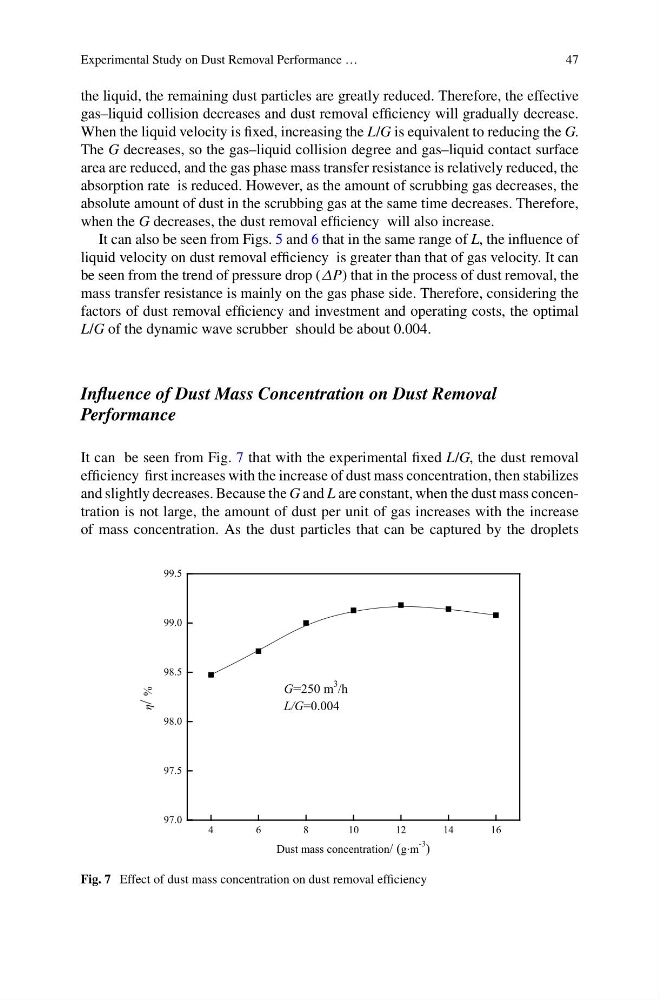
It can be seen from Fig. 7 that with the experimental fixed L/G, the dust removal
efficiency first increases with the increase of dust mass concentration, then stabilizes
and slightly decreases. Because the G and L are constant, when the dust mass concentration is not large, the amount of dust per unit of gas increases with the increase
of mass concentration. As the dust particles that can be captured by the droplets
4
6
8
1 0
1 2
1 4
1 6
97.0
97.5
98.0
98.5
99.0
99.5
η/
%
Dust mass concentration/ (g⋅m
-3 )
G=250 m
3 /h
L/G=0.004
Fig. 7 Effect of dust mass concentration on dust removal efficiency
47
the liquid, the remaining dust particles are greatly reduced. Therefore, the effective
gas–liquid collision decreases and dust removal efficiency will gradually decrease.
When the liquid velocity is fixed, increasing the L/G is equivalent to reducing the G.
The G decreases, so the gas–liquid collision degree and gas–liquid contact surface
area are reduced, and the gas phase mass transfer resistance is relatively reduced, the
absorption rate is reduced. However, as the amount of scrubbing gas decreases, the
absolute amount of dust in the scrubbing gas at the same time decreases. Therefore,
when the G decreases, the dust removal efficiency will also increase.
It can also be seen from Figs. 5 and 6 that in the same range of L, the influence of
liquid velocity on dust removal efficiency is greater than that of gas velocity. It can
be seen from the trend of pressure drop (ΔP) that in the process of dust removal, the
mass transfer resistance is mainly on the gas phase side. Therefore, considering the
factors of dust removal efficiency and investment and operating costs, the optimal
L/G of the dynamic wave scrubber should be about 0.004.
Influence of Dust Mass Concentration on Dust Removal
Performance
It can be seen from Fig. 7 that with the experimental fixed L/G, the dust removal
efficiency first increases with the increase of dust mass concentration, then stabilizes
and slightly decreases. Because the G and L are constant, when the dust mass concentration is not large, the amount of dust per unit of gas increases with the increase
of mass concentration. As the dust particles that can be captured by the droplets
4
6
8
1 0
1 2
1 4
1 6
97.0
97.5
98.0
98.5
99.0
99.5
η/
%
Dust mass concentration/ (g⋅m
-3 )
G=250 m
3 /h
L/G=0.004
Fig. 7 Effect of dust mass concentration on dust removal efficiency