

CO 2 Emission Calculation Model of Integrated Steel Works Based on Process Analysis
37
Table 3 Electric structure of EAF process
Type of electricity
consumption
Boiler power
generation
Waste heat power
generation
Purchased electricity
Electricity
consumption
(10,000kWh)
11,594.93
1849.48
16,699.90
Proportion (%)
38.46
6.14
55.40
generation is considered as zero carbon emission. Table 3 shows the electricity structure of EAF process of the enterprise, in which the purchased electricity and selfpowered electricity account for nearly 94% of the total direct electricity, which was
used to calculate the electricity emission of CO 2 from EAF process as 41.09 kg/t
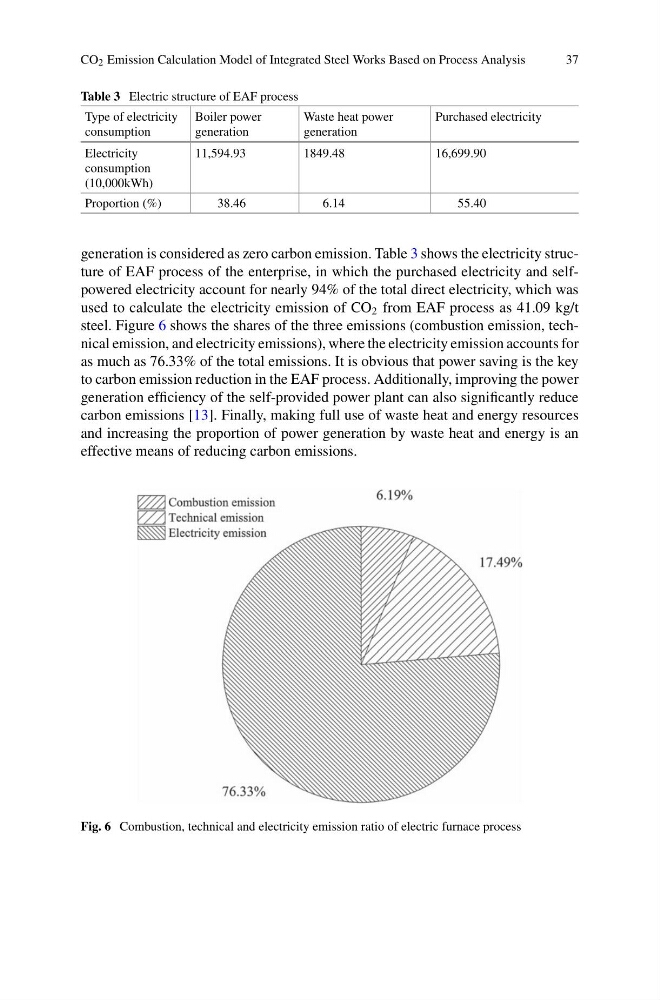
steel. Figure 6 shows the shares of the three emissions (combustion emission, technical emission, and electricity emissions), where the electricity emission accounts for
as much as 76.33% of the total emissions. It is obvious that power saving is the key
to carbon emission reduction in the EAF process. Additionally, improving the power
generation efficiency of the self-provided power plant can also significantly reduce
carbon emissions [13]. Finally, making full use of waste heat and energy resources
and increasing the proportion of power generation by waste heat and energy is an
effective means of reducing carbon emissions.
Fig. 6 Combustion, technical and electricity emission ratio of electric furnace process
37
Table 3 Electric structure of EAF process
Type of electricity
consumption
Boiler power
generation
Waste heat power
generation
Purchased electricity
Electricity
consumption
(10,000kWh)
11,594.93
1849.48
16,699.90
Proportion (%)
38.46
6.14
55.40
generation is considered as zero carbon emission. Table 3 shows the electricity structure of EAF process of the enterprise, in which the purchased electricity and selfpowered electricity account for nearly 94% of the total direct electricity, which was
used to calculate the electricity emission of CO 2 from EAF process as 41.09 kg/t
steel. Figure 6 shows the shares of the three emissions (combustion emission, technical emission, and electricity emissions), where the electricity emission accounts for
as much as 76.33% of the total emissions. It is obvious that power saving is the key
to carbon emission reduction in the EAF process. Additionally, improving the power
generation efficiency of the self-provided power plant can also significantly reduce
carbon emissions [13]. Finally, making full use of waste heat and energy resources
and increasing the proportion of power generation by waste heat and energy is an
effective means of reducing carbon emissions.
Fig. 6 Combustion, technical and electricity emission ratio of electric furnace process